Mains: GS-II – Polity & Governance
Why in news?
The Motor Vehicle and Police departments of Keralam have started a State-wide campaign against underage driving by booking cases against the parents and owners of the vehicles allegedly driven by minors.
Who are underage/Juvenile drivers and legal provisions?
- Underage drivers – They are individuals who operate a motor vehicle in a public place without meeting the legally required minimum age or holding a valid driving license.
- Status of incidents caused by minors – According to the Ministry of Road Transport and Highways (MoRTH),
- Minors were responsible for 11,890 road crashes in a single year; an average of 16 crashes every day.
- Tamil Nadu ranks highest in this category, reporting 2,063 crashes involving minors, or roughly three every day. Madhya Pradesh follows with 1,138 such crashes in 2023–24.
- In Delhi alone, and in just 6 weeks since this year began, nine minors have already been prosecuted for unlicensed driving, almost double the number recorded during the same period last year.
- MoRTH 2023 data reports – Two-wheeler riders account for 45% of all road fatalities in India. 48,818 lives were lost due to these vehicles, among whom 9,951 were pedestrians.
- In Tamil Nadu, 8,113 two-wheeler deaths were recorded, amounting to 44% of the road crashes (18,347) in the state.
Legal provisions
- Motor Vehicles Act, 1988 – It is the primary legislation regulating all aspects of road transport, traffic control, vehicle registration, driver licensing, and motor insurance across India.
- Section 3, Motor Vehicles Act, 1988 – No person shall drive a motor vehicle in any public place unless he holds an effective driving licence issued to him authorising him to drive the vehicle.
- No person shall drive a transport vehicle hired for his own use or rented under any scheme unless his driving licence specifically entitles him to do so.
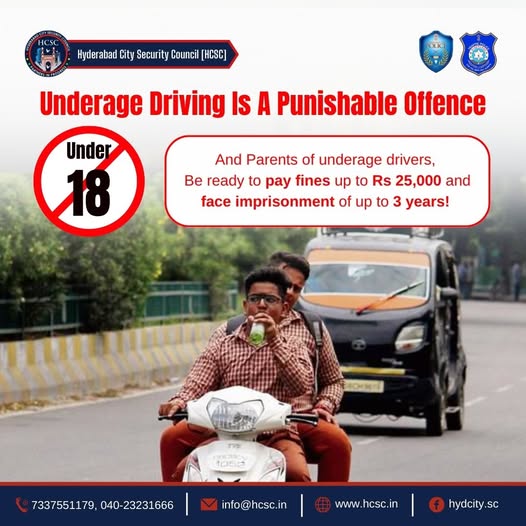
- Legal Age Limits – Section 4 – No person under the age of eighteen years shall drive a motor vehicle in any public place.
- General Vehicles (Cars & Motorcycles > 50cc) – Minimum age is 18 years.
- Low-Power Motorcycles (≤ 50cc without gears) – Minimum age is 16 years
- Transport Vehicles (Trucks, Commercial vehicles) – The minimum age is 20 years
- Section 5 – Forbids owners or persons in charge of a motor vehicle from permitting any person who does not satisfy the provisions of the licence to drive a vehicle.
What are the liabilities for offences committed by Minors?
- Legal changes to address underage driving – Two decades after the enactment of the Act, the Union Ministry of Law and Justice brought in a series of amendments to the legislation in 2019, including the penal provisions for offences caused by minors driving motor vehicles.
- Guardian or vehicle owner’s responsibility – Section 199A – The newly introduced Section 199A of the Act states that when an offence under the Act is committed by a juvenile, the guardian of such juvenile or the owner of the motor vehicle shall be deemed to be guilty of the violation.
- If found guilty, the guardian of the minor or the owner of the vehicle faces legal proceedings and punishment.
- Exception – However, the Act further states that such guardian or owner shall not be liable for punishment if he/she proves that the offence was committed without his/her knowledge or that he/she exercised all due diligence to prevent the commission of such offence.
- Presumption of consent – The act assumes that the use of the motor vehicle by the juvenile was with the consent of the guardian or the owner of the motor vehicle, unless it is proved otherwise.
- The law presumes that the guardian or the owner of the vehicle is guilty of the offence, contrary to the presumption of innocence of the accused in most criminal cases.
- Shift in burden of proof – The legal presumption of guilt thus shifts the burden of proving innocence onto the shoulders of the guardian or the owner of the vehicle.
- Generally, it’s the responsibility of the prosecution to prove the guilt of the accused, who will be deemed innocent until proven guilty, beyond any reasonable doubt to secure punishment to the accused.
- Punishment – The Act has also prescribed imprisonment of up to three years and a fine of Rs. 25,000 to such guardian or owner of the vehicle who has been convicted in the case.
- Cancellation of registration – The registration of vehicles thus involved in the commission of the offence shall be cancelled for a period of twelve months.
- Restriction to obtain license – A juvenile found guilty of such an offence will not be eligible for a driving license until attaining the age of 25 years.
- Penalties applicable – The juveniles thus found guilty shall be punishable with such fine as provided in the Act, and their custodial sentences would be decided by the provisions of the Juvenile Justice Act, 2000, not by the Motor Vehicles Act.
What about the insurance claims?
- Financial liability for owners – The offences thus committed by the juveniles bring a huge financial burden on the registered owners of such vehicles when the motor accident claims are considered.
- Parties involved – The driver of the vehicle, the insurance company and the registered owner of such vehicle will be arraigned as the first three respondents in the compensation cases.
- Role of insurance companies – The insurance companies will be made to pay compensation to the affected parties, which they may eventually recover from the registered owner of the vehicle.
- The insurance companies are first made to pay the compensation so as to provide quick relief to the victims, which they can recover from the registered owner in due course.
- Violation of insurance policy conditions – The insurance companies would take the contention that the provisions of the motor vehicle insurance were violated by the driver and the registered owner of the vehicle, and hence the money shall be recovered from them.
Why is underage driving dangerous?
- Lack of Experience – Minors lack the spatial awareness, hazard detection, and road sense required to react to emergencies.
- Cognitive Immaturity – The prefrontal cortex—the part of the brain responsible for impulse control and risk assessment—is still developing during adolescence.
- Financial & Legal Liability – If an underage driver causes an accident, insurance companies may initially pay the victims but have the legal right to recover the entire compensation amount directly from the vehicle's owner or parents.
How can authorities prevent underage driving?
- Establish clear rules – There should be no confusion as to what kind of vehicles children are allowed to drive on our roads.
- A blanket rule that applies to all motorised vehicles must be applied to children below 18. If that is seen as extreme, restrictions on where low-speed e-bikes can operate must be put in place.
- Strengthen driving license testing – RTOs need to ensure that licenses for 2 and 4 wheelers are only given after very stringent testing that follows global standards.
- Impose stronger penalties – Penalties must be so severe that they act as a deterrent, especially for the parents or guardians of the child.
- Improve data collection and transparency – Data should be available on whether crashes involve low-speed EVs, bikes below 50 cc, and the age range of underage drivers of both 2 and 4 wheelers.
- This would be a critical factor in building a fact-based narrative around underage driving in the public domain.
References
- The Hindu | What does the law say about offences committed by underage drivers?
- CAG Org | India’s underage driving problem



