Prelims (GS - I) – Environmental Ecology & Climate Change, International Relations.
Mains (GS - II & III) – GS II (Governance, International Relations) | GS III (Environment, Economy, Science & Tech).
Why in News?
India and Japan plan to sign a Memorandum of cooperation for setting up a Joint Crediting Mechanism (JCM) to share emission reduction credits under Article 6.2 of the Paris Agreement.
- Initiated by – Japan.
- Objective – To facilitate the transfer of low-carbon technologies and infrastructure through investment by Japanese corporations to developing nations in exchange for carbon credits.
- Purpose – Helps both India and Japan achieve their climate targets (NDCs) by implementing sustainable technologies and sharing the resulting emission reductions.
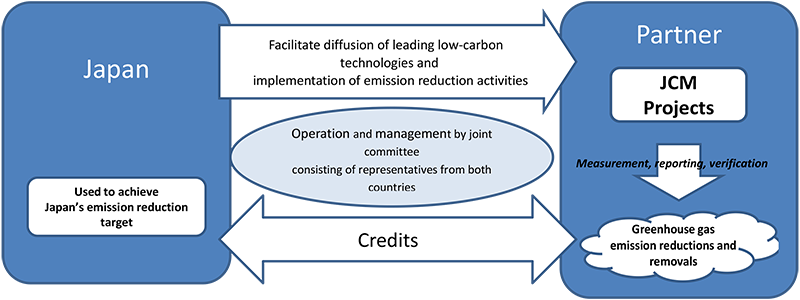
- Tracking Mechanism – Carbon credits will be tracked through a registry system, with joint committees managing projects and certifying credits.
- Key Features of India-Japan JCM - Japan will invest in India’s decarbonization efforts by deploying advanced clean energy technologies.
- India will adopt new emission-reducing technologies in various industries, focusing on high-cost sectors that lack financing.
- Japan can use these credits to meet its NDC commitments, while India benefits from technology transfer and infrastructure development.
- Sectors Covered Under the JCM Agreement - The agreement covers 14 key sectors, including
- Renewable energy with storage solutions
- Solar thermal power plants
- Green hydrogen production
- Sustainable aviation fuel (SAF)
- Decarbonization of hard-to-abate sectors
Reference
Business Standard | Joint Crediting Mechanism (JCM)



