Prelims: Current events of national and international importance Geography
Why in News?
A recent study has revealed that the underground coal fires in the Jharia coal fields (Jharkhand) burn significantly hotter and release far more greenhouse gases than previously estimated.
- Published by – Journal Communications Earth & Environment with help of researchers from UK & India along with Council of Scientific & Industrial Research (CSIR) - Central Institute of Mining and Fuel Research (CIMFR)
Research Findings
- Subsurface fire – when mining exposes coal to oxygen immediately natural oxidation reactions trigger underground fire that can burn for decades
- Vertical Collapse - As underground fires consume coal seams, they destabilize the overlying rock layers.
- This creates collapse structures up to 10 meters wide and can vertically stretch up 100 Meters, acting as massive vents for toxic and hot gases.
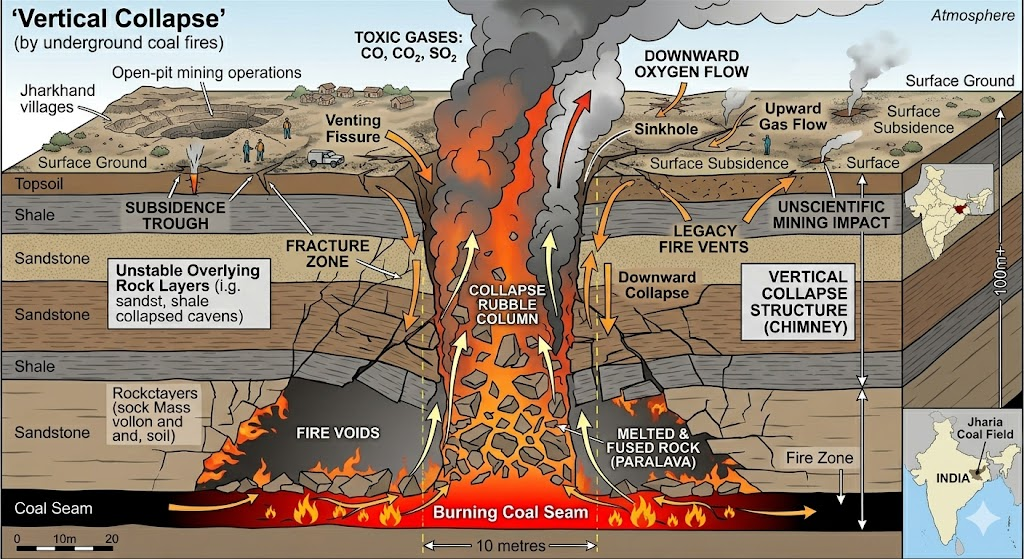
- Extreme Temperatures – Use of modern Computer with field observations suggested that large, isolated collapse structure could approach temperature near 4,000°C in specific conditions far higher than typical coal fire estimates.
- High Global Warming Potential (GWP) - The study estimates the fugitive emissions from Jharia’s fires could be up to 748.72 Million Tonnes (MT) of CO2-equivalent per year.
- Fugitive Emissions- These are emissions of gases or vapors from pressurized equipment due to leaks, or from uncontrolled sources like coal fires and open tailings, which are seldom captured in official global greenhouse gas audits.
Important Mineralogical & Geological Terms
- Paralava - A type of rock formed when sedimentary rock surrounding a coal seam is melted and subsequently re-solidified by the intense heat generated by underground coal fires.
- Birianiite - A nickname given by the researchers to a newly documented type of fused, glass-enveloped rock found at the Ena and Tisera collieries. It reflects the rock’s highly heterogeneous mix of geological ingredients and its layered resemblance to the popular Indian rice dish, biryani.
|
Coal Field of Jharia
|
- Location – Dhanbad District of Jharkhand in the Damodar river Valley.
- Importance – It is the largest repository of coking coal in India used in blast furnaces for making steel.
- Background of fire - The underground fires in Jharia have been burning continuously since at least 1916, primarily driven by legacy unscientific mining practices and historical open-cast mining methods.
|
For Reference: The Hindu | IAS Parliament



