Mains: GS II – International Issues
Why in News?
Recently, USA and Israel are engaged in war against Iran and it is important to know the historical background and recent issues.
What is the historical background?
- Pre-1979: Limited Cooperation – Before 1979, Iran under Shah Mohammad Reza Pahlavi maintained relatively cordial ties with Israel.
- Despite not formally recognizing Israel in strong diplomatic terms, Iran engaged in economic and security cooperation.
- Both countries shared concerns regarding Arab nationalism and Soviet influence in the region.
- Iran also maintained close strategic relations with the United States, which viewed the Shah as a key ally in its Cold War containment strategy.
- Thus, prior to 1979, the triangular relationship was not adversarial but strategically aligned.
- The 1979 Watershed Moment – The turning point came with the Iranian Revolution, which replaced the pro-Western monarchy with an Islamic Republic led by clerical leadership.
- The new regime adopted a strong anti-Israel and anti-U.S. ideological stance, portraying Israel as illegitimate and the United States as an imperial power interfering in regional sovereignty.
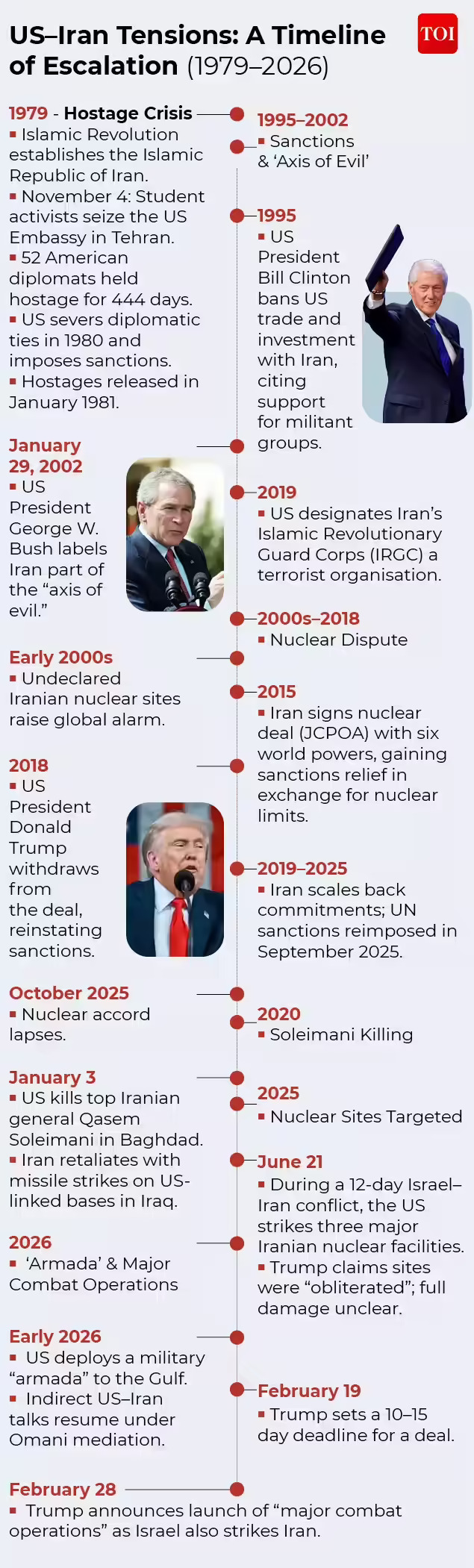
- The subsequent U.S. Embassy hostage crisis (1979–81) severely damaged Iran–U.S. relations. Diplomatic ties were severed, and mutual mistrust became institutionalized.
- Iran’s new foreign policy emphasized resistance against Western influence and support for anti-Israel movements.
- Emergence of proxy conflict (1980s–2010s)
- Iran’s “axis of resistance” – Over the decades, Iran developed strategic partnerships with non-state actors to expand its regional influence.
- Key among these were:
- Hezbollah in Lebanon
- Hamas in Gaza
- Various Shia militias in Iraq and Syria
- Through financial, military, and logistical support, Iran cultivated what it termed the “Axis of Resistance.”
- These groups opposed Israeli policies and resisted U.S. military presence in the region.
- For Israel, Hezbollah’s missile arsenal in Lebanon and Hamas’s operations in Gaza constituted direct security threats. For the United States, attacks by Iran-linked militias on U.S. bases in Iraq and Syria deepened hostilities.
- Israel’s security doctrine – Israel has long adhered to a doctrine of pre-emption and deterrence, particularly regarding existential threats.
- It has conducted covert and overt operations targeting Iranian assets in Syria and allegedly inside Iran to prevent advanced weapon transfers and nuclear development.
- The shadow war included cyber operations, targeted assassinations of nuclear scientists, and airstrikes on Iranian military infrastructure in Syria.
- The nuclear question
- Iran’s nuclear program – Iran insists its nuclear program is for peaceful energy purposes.
- However, enrichment activities and reduced transparency raised international concerns about possible weaponization.
- Israel considers a nuclear-armed Iran an existential threat. The United States also views Iran’s nuclear ambitions as destabilizing to regional security.
- The JCPOA (2015) – In 2015, Iran and world powers signed the Joint Comprehensive Plan of Action (JCPOA). The agreement restricted Iran’s uranium enrichment levels in exchange for sanctions relief.
- However, in 2018, the United States under President Donald Trump withdrew from the deal, calling it inadequate. Sanctions were reimposed under a “maximum pressure” campaign. In response, Iran gradually increased uranium enrichment beyond JCPOA limits.
- The collapse of the deal significantly heightened tensions among the three actors.
- Escalation in the 2020s
- From proxy to direct confrontation – The October 2023 conflict between Israel and Hamas marked another turning point.
- Israel accused Iran of backing militant operations.
- While Iran denied direct involvement, regional hostilities intensified.
- By 2024 and 2025, the long-running shadow conflict transitioned into direct exchanges.
- Missile and drone attacks were launched between Iranian and Israeli territories, marking an unprecedented escalation.
- Open military engagement (2025–26) – In mid-2025, Israel reportedly carried out extensive airstrikes on Iranian nuclear and military facilities.
- Iran retaliated with missile barrages targeting Israeli cities.
- The United States entered the confrontation more directly, conducting strikes against Iranian strategic sites, citing intelligence assessments of nuclear weapon proximity.
- In early 2026, joint Israeli-U.S. operations reportedly targeted high-value Iranian leadership and infrastructure.
- Among those reportedly killed was Iran’s Supreme Leader, Ali Khamenei, marking a historic escalation.
- Iran responded with drone and missile attacks on Israeli urban centers and U.S. bases in the Gulf region.
- Maritime tensions also increased, especially around the strategically crucial Strait of Hormuz, through which a significant portion of global oil supplies transit.
What are the core drivers of conflict?
- Ideological conflict – Iran’s Islamic revolutionary ideology rejects Israel’s legitimacy and challenges U.S. regional dominance. Conversely, Israel frames Iran’s rhetoric and support for armed groups as existential threats.
- Security dilemma – Each actor perceives its military actions as defensive, while rivals interpret them as aggressive.
- This classic security dilemma has fueled an arms race involving missile systems, drones, and cyber capabilities.
- Regional power competition – Iran seeks strategic depth through influence in Iraq, Syria, Lebanon, and Yemen.
- Israel and the U.S. aim to prevent Iranian regional hegemony.
- Nuclear proliferation concerns – A nuclear-armed Iran could trigger proliferation in West Asia, with countries like Saudi Arabia potentially pursuing similar capabilities.
- Thus, the nuclear question has global implications.
What are the global and regional implications?
- Energy security – Instability in the Strait of Hormuz affects global oil prices and energy markets.
- Great power politics – China and Russia have adopted diplomatic positions favoring de-escalation while expanding ties with Iran.
- International law – Questions arise regarding pre-emptive strikes, sovereignty, and proportionality under international humanitarian law.
- Humanitarian concerns – Civilian casualties and displacement have increased with urban missile exchanges.
What can be done for long-term regional stability?
- Revival or renegotiation of a nuclear agreement with stronger verification mechanisms.
- Regional security dialogue involving Gulf States.
- De-escalation channels between military establishments.
- Multilateral mediation under the United Nations framework.
What lies ahead?
- The Israel–Iran–United States conflict has evolved from ideological hostility and proxy warfare into direct interstate confrontation.
- Its roots lie in the 1979 transformation of Iran’s political system, compounded by nuclear disputes and regional power struggles.
- The current phase marks one of the most dangerous moments in West Asian geopolitics, with implications for global energy security, non-proliferation regimes, and international stability.
- For UPSC aspirants, the issue exemplifies how ideology, geopolitics, security dilemmas, and international institutions intersect in shaping modern conflicts.
- Understanding its historical depth and structural drivers is essential for analyzing contemporary international relations and India’s strategic interests in the region.
Reference
The Times of India| Israel-Us and Iran War



