What is the issue?
- Conventionally, private investment drives capitalism.
- But in recently, in the US and China, it is public investment that has been the driving force.
How has capitalism been doing in its “globalised” phase?
- Beginning with the 1980s but gathering force from the 1990s.
- It is when global capital managed to reduce almost all restrictions and regulatory constraints on its activities.
- New forms of ownership were strengthened, like intellectual property rights.
- This in turn created other monopolies and forms of surplus extraction.
- Public sectors across the world were eroded and states withdrew from the provision of important physical and social infrastructure.
- Tax rules led to reduced rates and loopholes that enabled MNCs to pay very little tax, even when their profits soared.
- Therefore,
How did global capital respond to this immensely supportive configuration?
- Given the favourable conditions the past three decades should have experienced an explosion in private corporate activity.
- Instead, the average rates of growth have been declining over the half-century.
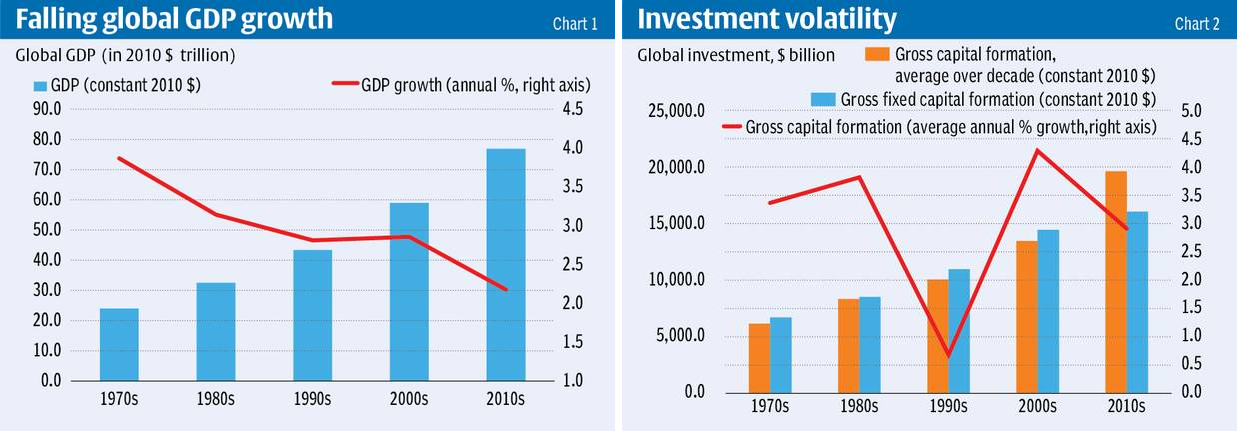
- The average investment rates plummeted in the first decade of the current globalisation.
- Overall, the performance was not significantly better than the “stagflationary” 1970s or the crisis-ridden 1980s.
How has East Asia fared?
- East Asia became really significant in terms of investment in the 2000s, equalling both the US and EU.
- After 2007, China’s capital formation soared well beyond that of these two major capitalist economies.
- China alone accounted for 77% of the increase in East Asian gross capital formation between 2007 and 2019.
- Inherent dynamism of capital suggests that when the more advanced regions show signs of saturation, capital moves to newer, lower-income geographical areas.
- This then allow these newer areas to expand rapidly.
- The regional shift to East Asia is seen as the example of this dynamism.
Is this claim valid?
- The argument that of China’s growth is an example of Capitalism assumes that it is really private capital has been the major driver.
- But it turns out that the opposite is true.
- WDI data shows that throughout this entire period, private capital provided only the smaller part of gross fixed capital formation in US & China.
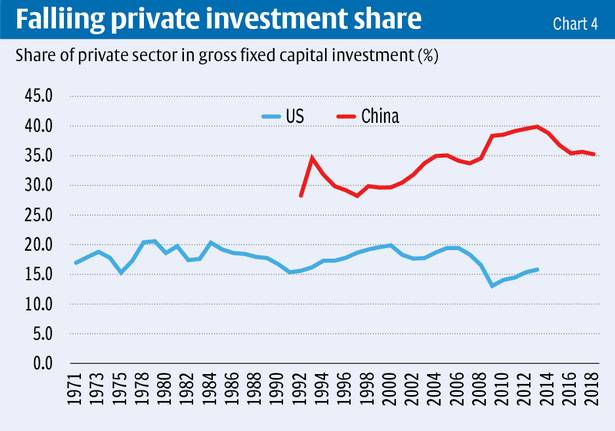
- The share of the private sector investment in total fixed capital investment was even smaller in the US.
- Most of the fixed investment that is essential for capitalist accumulation and growth was undertaken by the public sector.
- Public investment accounts for more than 4/5th of total fixed capital formation in the US and more than 2/3rd in China.
- This underlines the fact that global capitalism is on life support provided by governments.
- The central bank intervention through massive creation of liquidity is essential to maintain economic functioning in the advanced economies.
- Even the investment that does occur is mainly because of public sector activity, with private investment playing at best a supporting role.
Source: BusinessLine



