Mains: GS II – Polity and Governance
Why in News?
Recently, The two Election Commissioners have raised formal objections regarding the style of functioning of Chief Election Commissioner (CEC).
What is the background and evolution of the multi-member Election Commission?
- Single-Member Era (1950–1989) – During the first general election in 1951-52 up to October 1989, the Election Commission of India (ECI) functioned as a single-member body headed solely by the Chief Election Commissioner (CEC).
- The 1989 Transition and S.S. Dhanoa v. Union of India (1991) – In October 1989, the government expanded the ECI into a three-member body by appointing S.S. Dhanoa and V.S. Seigell alongside CEC R.V.S. Peri Sastry. The move was later revoked by the incoming government.
- Challenging this revocation, the Supreme Court in S.S. Dhanoa (1991) held that under Article 324(2), the President has the discretion to fix the number of Election Commissioners, noting that a multi-member body was desirable to handle expanding workloads (such as lowering the voting age from 21 to 18).
- Permanent Multi-Member Structure (1993) – On October, 1993, the President promulgated an Ordinance later enacted as the Chief Election Commissioner and Election Commissioners (Conditions of Service) Amendment Act appointing M.S. Gill and G.V.G. Krishnamurthy as Election Commissioners and the ECI has functioned as a three-member body ever since.
What key judicial rulings settled the parity and operational powers between the CEC and ECs?
- Equal Status and Decision-Making (T.N. Seshan v. Union of India, 1995) – CEC T.N. Seshan challenged the 1993 appointments and the coordinate powers granted to Election Commissioners in the Supreme Court.
- A Constitution Bench rejected his challenge, ruling that –
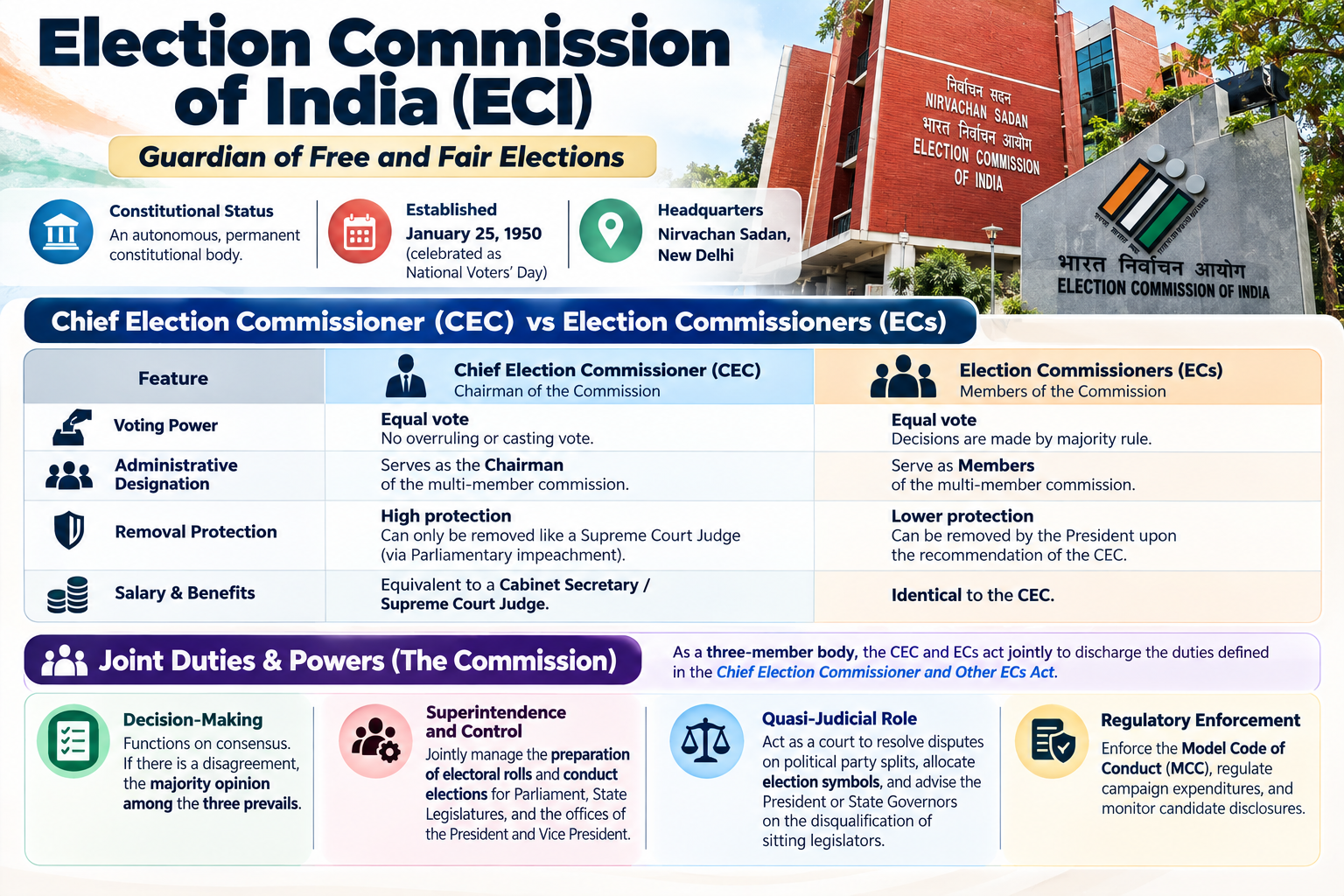
- The CEC does not possess higher status or superior authority over Election Commissioners; all three members hold equal status and coordinate powers.
- All decisions in the ECI must be taken unanimously or, in case of a difference of opinion, by a majority vote.
- Removal Powers and Article 324(5) Interpretation (2009 Episode) – In January 2009, CEC N. Gopalaswami made a suo motu recommendation to the President seeking the removal of Election Commissioner Navin Chawla over alleged political bias.
- President Pratibha Patil rejected the recommendation, The episode highlighted that under Article 324(5), the CEC cannot act suo motu to remove an EC without a formal reference through proper constitutional channels, maintaining parity across the panel.
What structural challenges impact the autonomy and functioning of the ECI?
- Asymmetry in Removal Safeguards – While the CEC enjoys constitutional protection equivalent to a Supreme Court judge (removal via Parliamentary impeachment), Election Commissioners can be removed simply on the recommendation of the CEC under Article 324(5), creating a structural inequality among equals.
- Lack of Transparency in Minority Dissent – Suppressing minority opinions in quasi-judicial rulings or MCC decisions weakens public trust, accountability, and judicial review of regulatory decisions.
- Perceived Executive Influence in Appointments – Recurrent friction often stems from political appointments where the executive holds dominant influence in selecting commissioners, leading to perceptions of partisan bias.
What policy measures and reforms are required going forward?
- Constitutional Parity in Protection – Amend Article 324(5) to extend identical constitutional protection against removal (impeachment process) to Election Commissioners, ensuring absolute security of tenure for all panel members.
- Institutionalizing Dissent Recording – Mandate the formal recording and public disclosure of dissenting opinions in all quasi-judicial and Model Code of Conduct rulings to preserve transparency and public faith.
- Independent and Balanced Selection Committee – Ensure the appointment process for the CEC and ECs is insulated from executive dominance through a balanced selection committee involving independent constitutional functionaries.
- Codifying Internal Rules of Procedure – Establish formal statutory rules governing internal administrative functions, meeting agendas, and operational protocols within the ECI to prevent individual-centric conflicts.
Reference
The Hindu | ECI



