Why in news?
India secures position in top 10 countries in Patents, Trademarks, and Industrial Designs as per WIPO 2024 Report.
What are the highlights of the WIPO 2024 report?
- WIPO report - The World Intellectual Property Report, published biennially by the World Intellectual Property Organization (WIPO), provides insights into global IP trends and innovations.
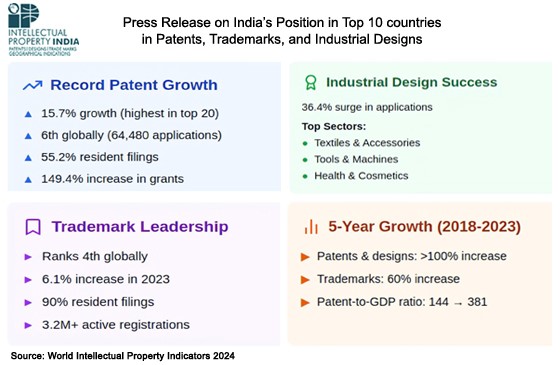
- India’s growth in patents - India recorded a 15.7% increase in patent applications, ranking 6th globally with 64,480 applications in 2023.
- This marks the fifth consecutive year of double-digit growth, with over half of these applications from domestic applicants.
- Industrial design surge - India’s industrial design sector also witnessed significant growth, with applications rising by 36.4%.
- This surge reflects the increasing focus on product design, manufacturing, and the creative industries in India.
- Leading sectors of Industrial Design -Textiles and Accessories, Tools and Machines, and Health and Cosmetics, together accounted for nearly half of the design filings.
- Strength in trademark filings - With a 6.1% increase in 2023, India ranked 4th globally for trademarks.
- Leading sectors in trademark filings - Health (21.9%), Agriculture (15.3%), and Clothing (12.8%).
- India’s trademark office now holds the 2nd largest number of active trademark registrations worldwide, with over 3.2 million trademarks in force.
- Patent-to-GDP ratio - Over the past 5 years, India’s IP activity has shown significant growth.
- Between 2018 and 2023, patent and industrial design applications more than doubled, while trademark filings increased by 60%.
- This surge reflects the growing importance of intellectual property in India’s economic expansion, with the country’s patent-to-GDP ratio rising sharply from 144 in 2013 to 381 in 2023.
- Global patent trends - Worldwide, 3.55 million patent applications were filed in 2023, a 2.7% increase from 2022, with Asian economies like China, Japan, South Korea, and India leading the charge.
- This surge highlights Asia’s dominance in IP and innovation.
What is intellectual property?
- Intellectual Property (IP) - It refers to creations of the mind, including inventions, literary and artistic works, designs, and symbols used in commerce.
- IP is protected by laws that allow creators to earn recognition or financial benefits from their innovations.
- Types of intellectual property
- Patents - Exclusive rights for inventions, allowing owners to decide how or if others may use their invention.
- Copyright - Rights for creators over literary and artistic works, such as books, music, and films.
- Trademarks - Symbols or marks that distinguish the goods or services of one entity from others.
- Industrial designs - Protection for the aesthetic aspects of articles, including patterns and colors.
- A design may consist of three-dimensional features, such as the shape or surface of an article, or of two-dimensional features, such as patterns, lines or color.
- Geographical indications – These are signs used on goods that have a specific geographical origin and possess qualities, a reputation or characteristics that are essentially attributable to that place of origin.
- Trade secrets - These are IP rights on confidential information which may be sold or licensed.
What are the importances of Intellectual Property?
- Encourages innovation and creativity - By protecting creators’ rights, IP fosters an environment where innovation can thrive.
- Inventors are motivated to develop new technologies, knowing their efforts are legally safeguarded.
- Economic growth - IP-intensive industries contribute substantially to GDP and job creation.
- IP rights allow businesses to commercialize their products, generating revenue and spurring economic activity.
- Attracting investments - Strong IP protection encourages foreign and domestic investment in research and development, fueling industrial growth and global competitiveness.
- Consumer confidence - IP rights ensure that consumers receive authentic products, improving trust and safety in the marketplace.
What are the Indian government measures to improve IP?
- National IPR Policy 2016 - This comprehensive policy unifies all IP rights under a single framework, focusing on innovation promotion, IP protection, and policy review mechanisms.
- Cell for IPR Promotion and Management (CIPAM) - CIPAM, established under the National IPR Policy, coordinates policy implementation and promotes IP awareness across sectors.
- National Intellectual Property Awareness Mission (NIPAM) - NIPAM aims to spread IP awareness and provide training in educational institutions, building a culture of innovation from a young age.
- Startup Intellectual Property Protection (SIPP) scheme - This program supports startups in managing and protecting IP assets, fostering innovation and entrepreneurship in the tech and creative industries.
- Atal Innovation Mission (AIM) - Launched by NITI Aayog in 2016, AIM encourages innovation and entrepreneurship.
What lies ahead?
- Enhancing IP education and awareness to help innovators understand IP benefits and protection mechanisms, especially at grassroots levels.
- Strengthening IP enforcement to boost investor confidence and protect innovators’ rights.
- Investing in IP infrastructure to streamline processes, reducing wait times and improving IP service quality.
- Encouraging domestic innovation to reduce dependence on foreign patents and strengthen India’s self-reliance in innovation.
Reference
- PIB | India’s Performance In WIPO 2024 Report
- WIPO |Intellectual Property



