Why in news?
Prime Minister Narendra Modi and Bangladesh Prime Minister Sheikh Hasina have signed 7 MoUs on issues related to water sharing, railways, space, science and judiciary.
How has the bilateral relationship evolved over the years?
- Trade- Bangladesh is India’s sixth largest trade partner while India is Bangladesh’s second biggest trade partner, and its largest export market in Asia.
- Bangladesh imports critical industrial raw material from India on which its exports are reliant.
- Under South Asian Free Trade Area (SAFTA), Bangladesh extends preferential tariffs to Indian exports of products outside the sensitive list.
- Connectivity- The Bangladesh, Bhutan, India, and Nepal Motor Vehicle Agreement (BBIN-MVA) is a key development that can enhance the trade potential of India with Bangladesh.
- Bangladesh has expressed its interest in joining the India-Myanmar-Thailand highway project.
- India-Bangladesh bilateral waterway trade will get boosted as India can now use the Mongla and Chittagong ports.
- Under Indo-Bangladesh Protocol on Inland Water Transit & Trade involving the Brahmaputra, inland vessels of one country can transit through the specified routes of the other country.
- Currently, three express trains and international bus services operate between Indian and Bangladesh.
- Border management- In 2015, India and Bangladesh resolved the decades-long border dispute through the Land Swap Agreement.
- Home Minister Amit Shah recently reviewed the security arrangements in the Assam-Meghalaya-Bangladesh tri-junction, which used to a smugglers’ route.
What are the pending issues?
- Regional geopolitics- Bangladesh had successfully approached China for a mega project to enhance Teesta river water flow.
- Bangladesh also requires China’s support in resolving the Rohingya refugee crisis.
- Bangladesh is the second biggest arms market for China after Pakistan.
- Although memories of 1971 remain, Bangladesh has expressed its interest in establishing peaceful relations with Pakistan.
- Border management- In 2019, India enacted the National Register of Citizens and the Citizenship (Amendment) Act, which created an uproar within and beyond the borders.
- Water sharing- For West Bengal, Teesta is important to sustain its impoverished farming districts which comprise 12.77% of its population.
- For Bangladesh, the Teesta’s flood plains cover about 14% of the total cropped area of the country and provide direct livelihood opportunities to approximately 7.3% of the population.
What agreements were signed recently?
- India and Bangladesh signed seven agreements on various fields, including
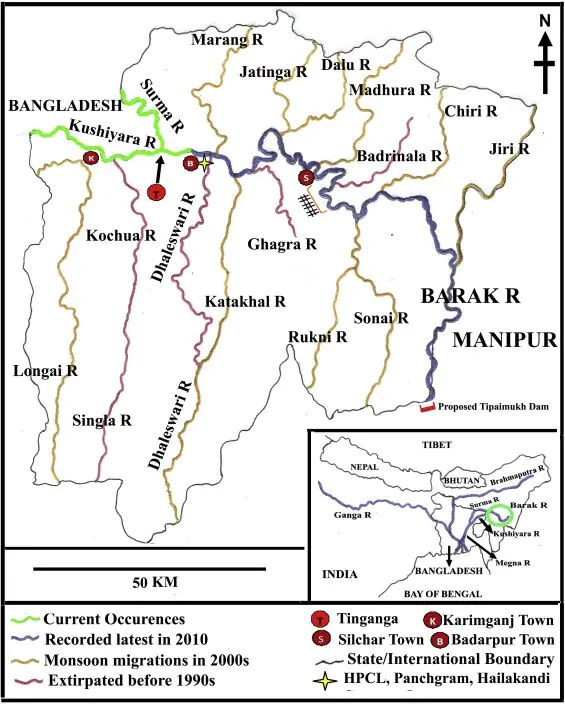
- Water resources- An interim bilateral agreement on water sharing of the Kushiyara river
- Judiciary- Capacity building of Courts
- Railways- To train personnel of Bangladesh Railways
- Other areas- Space technology, scientific and technological cooperation, TV broadcasting
- The two PMs also jointly inaugurated various projects, including a power plant, a railway bridge and several railway line projects.
What is the interim agreement on Kushiyara water sharing?
Teesta River, a major transboundary river that begins in India’s Sikkim state and runs through the north of West Bengal state before flowing into Bangladesh.
- There were 54 rivers that pass through the Indo-Bangladesh border
- India and Bangladesh had signed the Ganga water treaty in 1996 for sharing waters of Ganga for a period of 30 years.
- Bangladesh has sought the early conclusion of the Teesta water sharing agreement, which has been hanging since 2011 due to opposition from West Bengal.
- The current agreement will benefit southern parts of Assam state in India and the Sylhet region in Bangladesh.
References
- https://thediplomat.com/2022/09/india-bangladesh-sign-pact-on-sharing-waters-of-kushiyara-river/
- https://www.thehindu.com/opinion/op-ed/a-lot-is-at-stake-for-india-bangladesh-ties/article65849383.ece
- https://www.news18.com/news/world/sheikh-hasinas-lauds-pm-modis-vision-for-india-bangladesh-ties-7-mous-signed-between-delhi-and-dhaka-5900497.html
Quickfacts
Kushiyara river
- The Kushiyara River is a distributary river in Bangladesh and Assam, India.
- It forms on the India-Bangladesh border as a branch of the Barak River, when the Barak separates into the Kushiyara and Surma.
- The waters of the Kushiyara originate in the state of Nagaland in India and pick up tributaries from Manipur, Mizoram and Assam.
- After forming several braided streams it is rejoined by the Surma (locally known as the Danu River) and becomes the Meghna River.



