Mains: GS II – International Relations
Why in News?
The recent tariffs imposed by the US administration, including those targeting India, indicate not only ongoing trade disputes but also a broader transformation in US statecraft.
What is Flexible Realism?
- "Flexible realism" – It is a foreign policy approach that places a nation's immediate economic and security interests above shared values or traditional alliances.
- It combines trade, technology, and military power as tools of statecraft, judging partnerships by their tangible benefits rather than ideological alignment.
- Fundamental Principles
- Primacy of National Interest – International actions are guided by the requirements of domestic economic strength and national security.
- Transactional Partnerships – Alliances are established and sustained according to measurable strategic or economic advantages, rather than shared values or goodwill.
- Integrated Statecraft – Trade policy, tariff frameworks, industrial objectives, and defense strategies are coordinated to advance unified national objectives.
- Burden Sharing – Major powers expect regional partners to take greater responsibility for their own conventional defense capabilities.
What are the characteristics of Flexible realism?
- Rejection of Ideological Missionaries – Intentionally abandons previous efforts to promote universal democracy, human rights frameworks, or regime change as perceived moral obligations.
- Pragmatic Engagement – Emphasizes the maintenance of productive commercial and diplomatic relations with other nations, irrespective of their internal governance systems or domestic political structures.
- Non-Imposition of Values – Avoids pressuring foreign partners or adversaries to adopt social or political changes that conflict with their local histories and traditions.
- Prudent Prioritization – Rigorously evaluates what is both achievable and desirable, rather than overextending state resources on idealistic global or humanitarian initiatives.
- Interest-Centric Focus – Prioritizes national security, economic prosperity, and regional influence over adherence to abstract rules-based international orders.
Want are the historical evolution of US-India relationship?
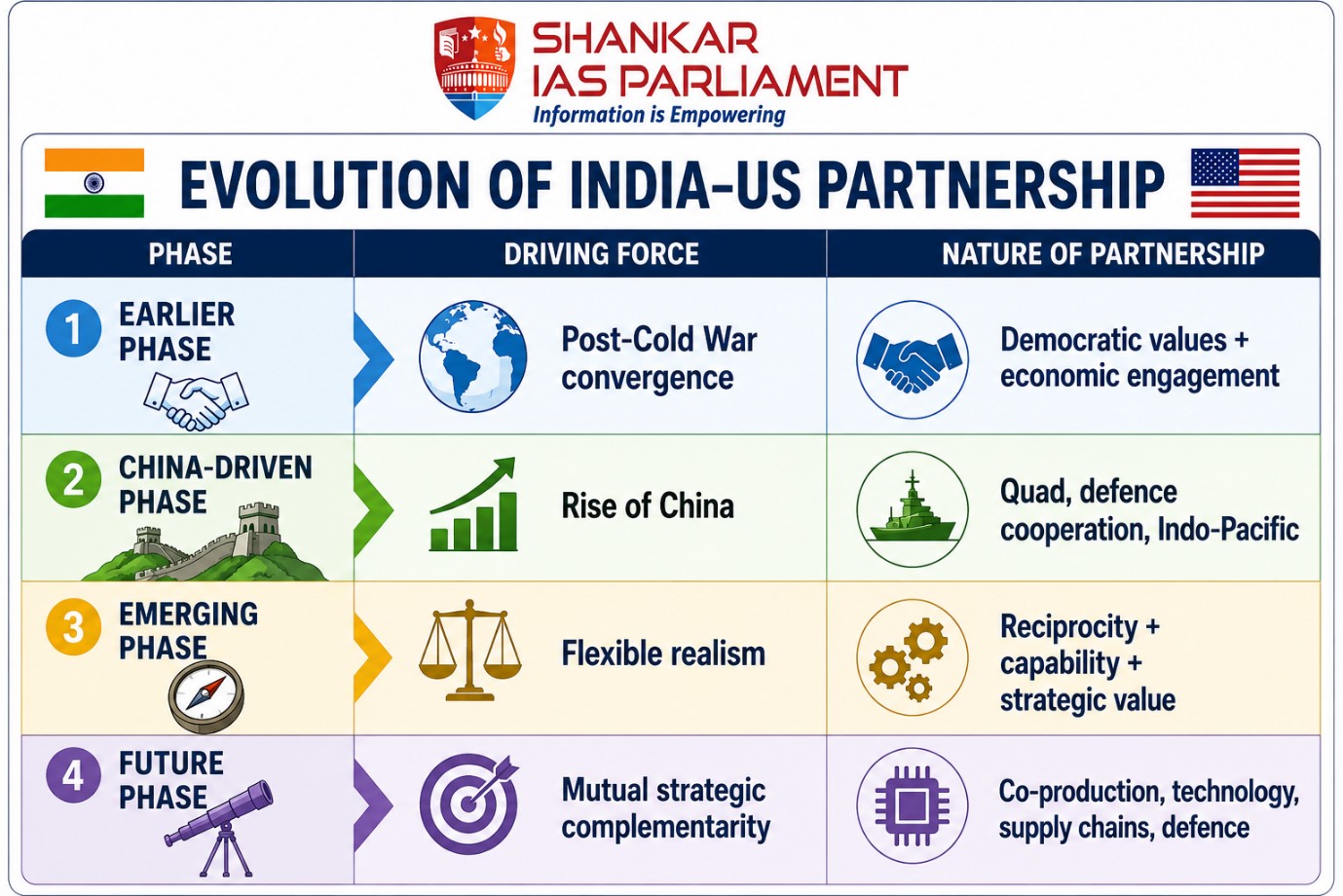
- Initial Phase – The post-Cold War period was characterized by convergence based on shared democratic values and increased economic engagement.
- China-driven Phase – The rise of China prompted the development of Quad initiatives, enhanced defence cooperation, and a strategic focus on the Indo-Pacific region.
- Emerging Phase – This phase is defined by flexible realism, with an emphasis on reciprocity, capability development, and the pursuit of strategic value.
- Future Phase – Mutual complementarity is expected to be achieved through co-production, technological collaboration, supply chain resilience, and integrated defence efforts.
What is the changing trend of US-India relationship?
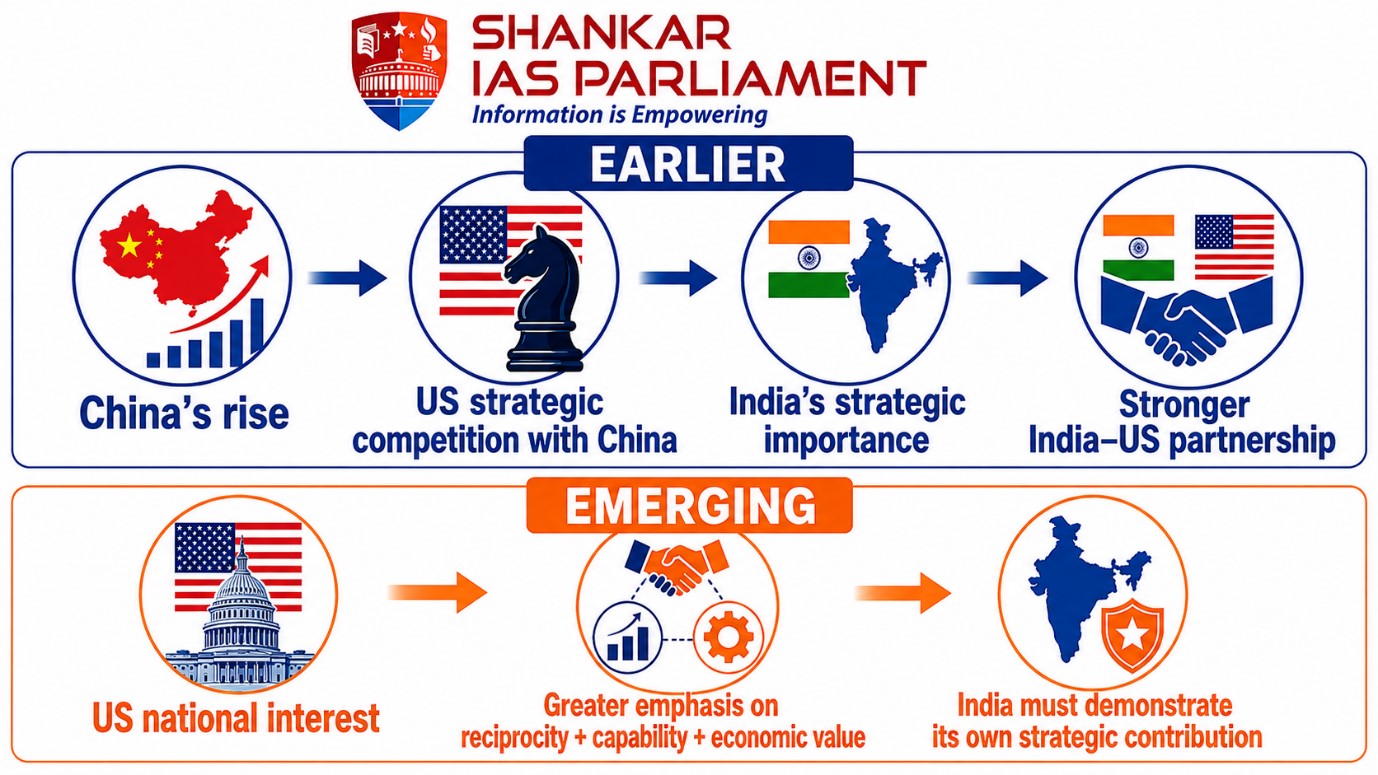
- Shift from Strategic Convergence to Strategic Complementarity
- Strategic convergence – It denotes cooperation between India and the United States that is motivated by a common strategic challenge, particularly the rise of China.
- Strategic complementarity – It characterizes a dynamic in which both countries deepen cooperation based on complementary capabilities that strengthen their respective strategic positions.
Why does China remain central to India’s security and economic calculus?
- Border tensions – Persistent disputes ensure that China remains a central consideration in India's security strategy.
- Indo-Pacific competition – China's assertive actions significantly influence the strategic dynamics of the region.
- Supply-chain dependence – India continues to rely on Chinese production networks for critical components and goods.
- Maritime security – The expansion of China's naval presence affects the stability of the Indian Ocean region.
- Technology competition – Strategic rivalry in advanced technology sectors between India and China is increasingly inevitable.
- Regional balance – The growth of China's power continues to shape the strategic equilibrium across Asia.
Why does this new strategy matter for India?
- Economic – US tariffs place pressure on India’s exports and restrict market access.
- However, they also encourage diversification and promote stronger domestic manufacturing to enhance competitiveness.
- Strategic – India–US relations may become more transactional, as strategic alignment does not ensure economic security.
- India’s contributions to Indo-Pacific security and supply chain diversification are increasingly important.
- Technological – Restrictions imposed by the United States on technology exports may limit India's access to essential technologies.
- Concurrently, India's strategic significance as a partner in the fields of semiconductors, artificial intelligence, defence technology, and critical minerals is likely to grow.
- Geopolitical – India should pursue cooperation with the United States while preserving its strategic autonomy.
- Enhancing relations with the European Union, Japan, the Association of Southeast Asian Nations (ASEAN), and the Global South may mitigate excessive reliance on a single partner.
What are the challenges before India?
- China-centric risk – Reduce dependence on the dynamics of the US–China rivalry during the formulation of foreign policy.
- Trade tension – A primarily transactional approach by the United States could negatively impact India’s exports and market access.
- Reliance on technology – Implement measures to prevent cooperation from leading to excessive dependence on foreign technology.
- Capability gap – Prioritize the rapid advancement of defence manufacturing, research and development, and advanced technology initiatives.
- Strategic autonomy – Deepen engagement with the United States while preserving independence from exclusive international alliances.
What lies ahead?
- India's long-term strategic relevance should not be contingent upon its utility in countering another power.
- Instead, it should be grounded in India's economic strength, technological capabilities, military preparedness, and diplomatic influence.
Reference
The Hindu | The changing logic of the India-U.S. partnership



