Prelims: Current events of national and international importance | Science & Technology
Why in News?
India’s solar PV module capacity has surged to 233 GW (June 2026) with another 135 GW planned, but factories run at only 35–40% utilisation, creating a clear risk of overcapacity beyond market demand.
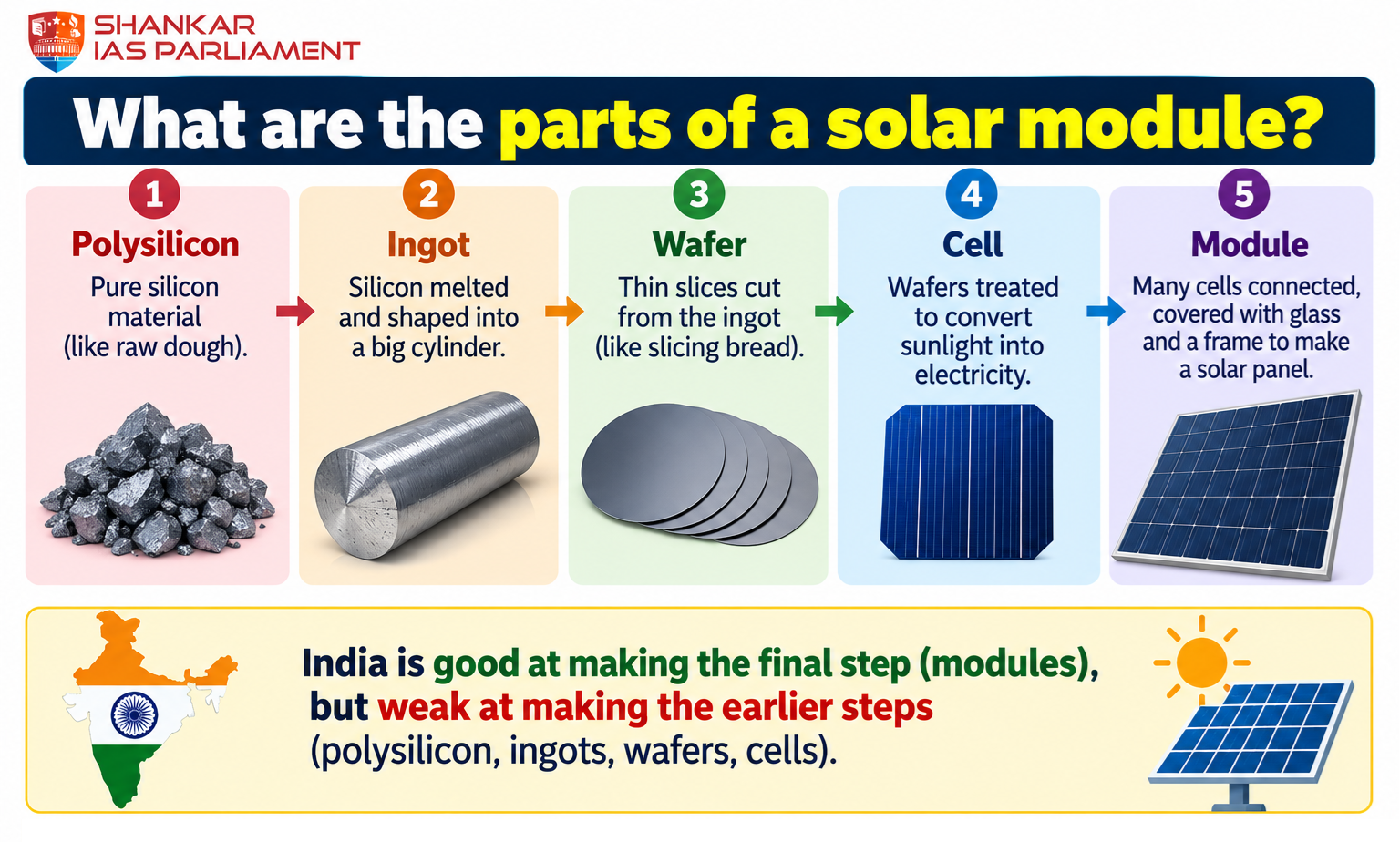
- India has significantly increased its capacity to assemble solar panels; however, the development of the complete solar manufacturing chain has not progressed at a comparable rate.
What are the main challenges?
- Overcapacity Crisis in the Photovoltaic Industry – There is a significant oversupply of modules, with 233 GW of installed capacity but a utilisation rate of only 35 to 40 percent.
- Achieving profitability in the sector requires a utilisation rate between 50 and 65 percent.
- The addition of 135 GW of new capacity in the pipeline is expected to further exacerbate the existing supply-demand imbalance.
- Supply Chain Gaps – Critical supply chain gaps include limited cell production capacity at 35 GW, with wafer and polysilicon manufacturing capacity being nearly absent.
- There is a significant reliance on imports, particularly from China, for essential raw materials.
Pax Silica Coalition facilitates India's procurement of silicon, a critical raw material, from countries other than China.
- Weak Demand Outlook – Emerging demand from data centres, hydrogen production, and exports is projected to reach only 17 to 22 GW by 2030.
- Export risks include declining competitiveness and limited market diversification due to United States import duties.
- Technology Transition – TOPCon technology now dominates the sector, with 70 percent of factories having undergone upgrades.
- Older PERC technology is increasingly vulnerable, making factory closures likely.
What steps should be taken?
- Upstream Expansion – Establish cell, wafer, and polysilicon manufacturing facilities to reduce reliance on imports.
- Export Diversification – Expand export markets to Europe, Africa, and the Middle East to decrease dependence on the United States.
- Tech Upgrade – Transition from PERC to TOPCon and other emerging solar technologies.
- Inclusive Incentives – Implement stage-wise support mechanisms that include smaller manufacturing facilities in addition to large enterprises.
- Demand‑Aligned Growth – Establish new manufacturing facilities only when there are confirmed buyers to prevent idle capacity.
Reference
Down to Earth | Solar PV Module



