Why in News?
India’s 2003 nuclear doctrine is being revisited amid changes in the strategic environment, including China’s nuclear expansion, Pakistan’s tactical nuclear weapons, China–Pakistan convergence and emerging technologies.
What is the Evolution of India’s Nuclear Doctrine?
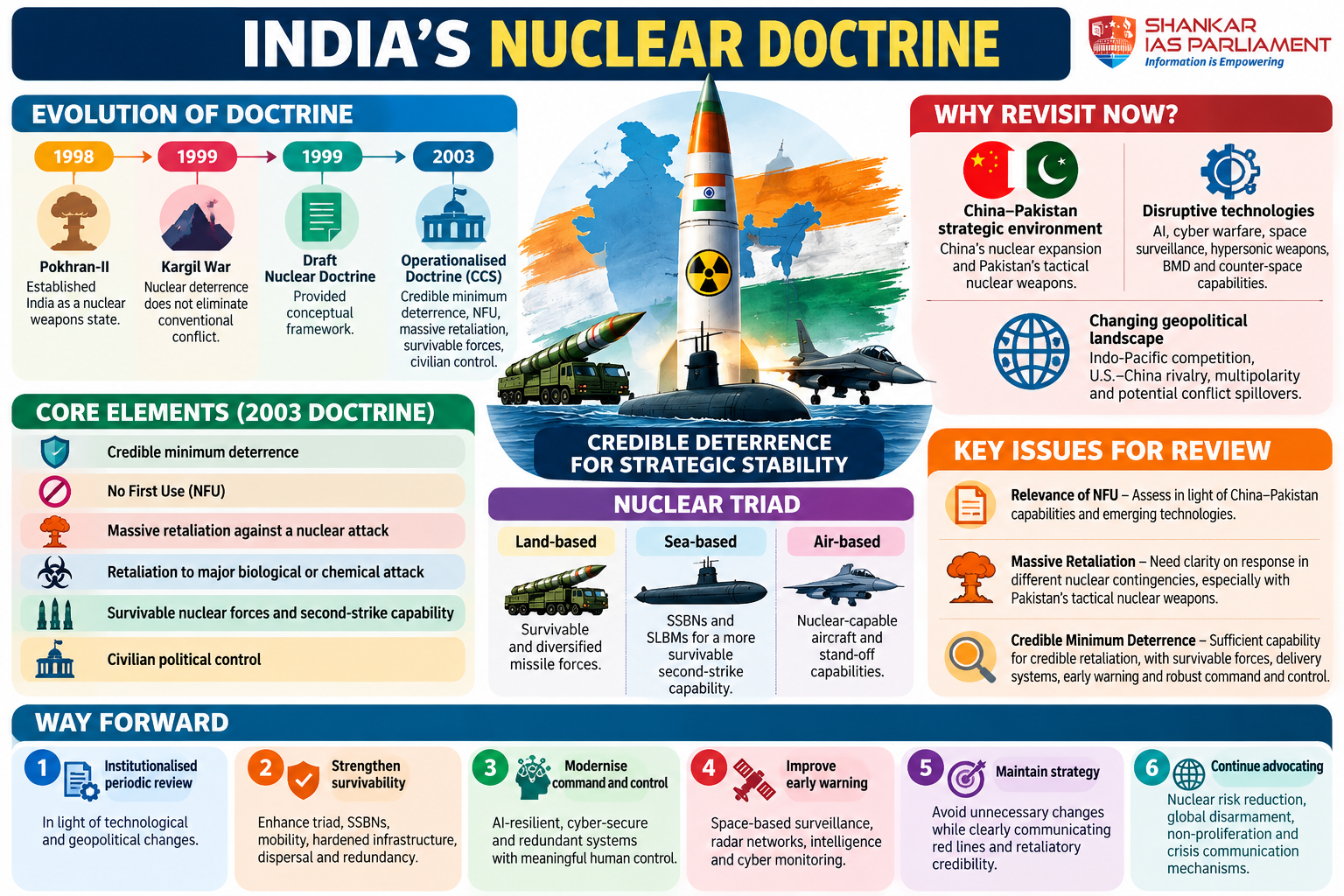
- Pokhran-II (1998) – Established India as a nuclear weapons state.
- Kargil War (1999) – Demonstrated that nuclear deterrence does not eliminate the possibility of conventional conflict.
- Draft Nuclear Doctrine (1999) – Provided the conceptual framework for India’s nuclear posture.
- 2003 Cabinet Committee on Security – Operationalised the doctrine based on –
- Credible minimum deterrence.
- No First Use of nuclear weapons.
- Massive retaliation against a nuclear attack.
- Nuclear retaliation in response to a major biological or chemical attack.
- Survivable nuclear forces and second-strike capability.
- Civilian political control.
- Thus, the doctrine sought to combine deterrence with restraint and strategic stability.
 Why Does India Need to Revisit the Doctrine?
- China–Pakistan Strategic Environment – China has significantly expanded and modernised its nuclear arsenal, delivery systems and supporting infrastructure.
- Pakistan has sought to offset India’s conventional military advantage through nuclear deterrence.
- Emergence of Disruptive Technologies – Technological developments are altering traditional assumptions about nuclear deterrence –
- Artificial Intelligence – Faster decision-making and autonomous systems can compress response time.
- Cyber warfare – Creates vulnerabilities in nuclear command, control and communication systems.
- Space-based surveillance – Enhances the ability to detect and track strategic assets.
- Hypersonic weapons – Reduce warning time and complicate interception.
- Ballistic Missile Defence – Can affect perceptions of the credibility of second-strike capabilities.
- Counter-space capabilities – Can threaten communication and early-warning infrastructure.
- Changing Geopolitical Landscape – The Indo-Pacific has emerged as a major arena of strategic competition.
- India’s nuclear policy must increasingly account for –
- U.S.–China strategic competition.
- China–Russia strategic coordination.
- India’s expanding strategic partnerships.
- Greater multipolarity in the international system.
- Potential spillovers from conflicts involving major powers.
What are the Key Issues for Doctrinal Review?
- Relevance of No First Use (NFU) – NFU provides restraint, predictability and strategic stability.
- Review should assess changing nuclear capabilities of China and Pakistan, Credibility of India’s retaliatory capability, Impact of emerging technologies.
- Massive Retaliation – Pakistan’s tactical nuclear weapons create a deterrence challenge.
- India needs greater clarity on how its massive retaliation posture would operate across different nuclear contingencies.
- Credible Minimum Deterrence – “Minimum” need not imply a fixed arsenal; it means sufficient capability for credible retaliation.
- Key requirements
- Survivable nuclear forces and second-strike capability.
- Reliable delivery systems, mobility and concealment.
- Effective intelligence and early warning.
- Robust nuclear command and control.
|
Strengthening India’s Nuclear Triad
|
- A credible doctrine requires credible capabilities.
- India should continue strengthening its –
- Land-based systems – Survivable and diversified missile forces.
- Air-based systems – Nuclear-capable aircraft and stand-off capabilities.
- Sea-based systems – SSBNs and submarine-launched ballistic missiles, providing a more survivable second-strike capability.
- The maritime leg is particularly significant because sea-based nuclear forces can enhance survivability and reduce the vulnerability of retaliatory assets.
|
What could be done?
- Institutionalised Periodic Review – India should establish a mechanism for periodically reviewing its nuclear doctrine in light of technological and geopolitical changes.
- Strengthen Survivability – Enhance Nuclear triad, SSBN capabilities, Mobility and concealment, Hardened infrastructure, Dispersal and redundancy.
- Modernise Command and Control – Develop AI-resilient, cyber-secure and redundant nuclear communication and command systems, while ensuring meaningful human control.
- Improve Early Warning – Integrate Space-based surveillance, Radar networks, Intelligence capabilities, Cyber and electronic monitoring.
- This can improve decision-making while reducing the risk of miscalculation.
- Maintain Strategy – India should avoid unnecessary changes to declaratory policy while clearly communicating its red lines, retaliatory credibility and commitment to responsible nuclear stewardship.
- Continue advocating – on nuclear risk reduction, Global disarmament, Non-proliferation, Responsible nuclear behaviour, Crisis communication mechanisms.
What lies ahead?
- India’s nuclear doctrine was designed for a different strategic era, but its core principles remain relevant.
- The changing security environment does not automatically require abandoning credible minimum deterrence or No First Use.
- The appropriate approach is therefore to revisit the assumptions, capabilities and implementation mechanisms of the doctrine without necessarily revising its fundamental principles.
Reference
The Hindu| India’s Nuclear Doctrine Revisit



