Mains: GSIII – Environment
Why in News?
India’s growing dependence on landfills has increased concerns over leachate, a toxic liquid generated when rainwater and moisture pass through decomposing waste.
What is Leachate?
- Leachate – It is a contaminated liquid formed when water percolates through layers of municipal solid waste and absorbs organic and inorganic pollutants.
- Effect – Decomposition of biodegradable waste generates methane,
- Volatile fatty acids and
- Dissolved organic carbon,
- While percolating water carries ammonia, humic substances and heavy metals.
Leachate composition changes with the age of the landfill.
- Nature of Leachate – Young leachate contains high levels of biodegradable organic pollutants, reflected in high BOD and COD.
- As the landfill matures, the BOD/COD ratio decreases and ammoniacal nitrogen and recalcitrant organic compounds become more significant.
- Heavy metals such as copper, zinc, lead, chromium and cadmium may persist depending on pH and local geochemical conditions.
- Globally, leachate has also been found to contain pharmaceutical residues, microplastics and PFAS.
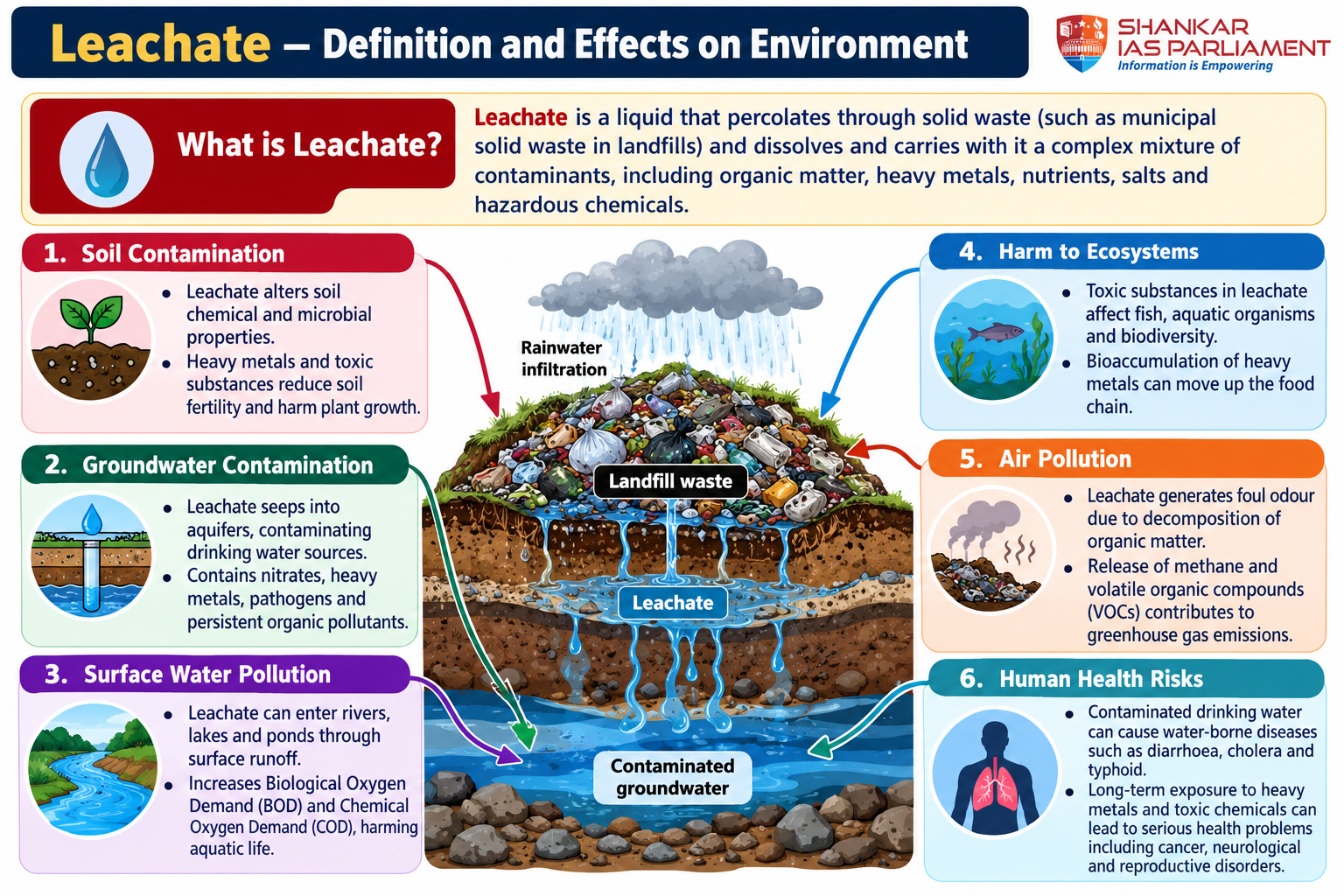
Why is Leachate a Serious Concern for India?
- High Biodegradable Waste – More than half of India’s municipal waste is biodegradable, increasing the potential for leachate generation during decomposition.
- Dependence on Landfills – Large quantities of municipal waste continue to be disposed of in landfills and open dumping areas, increasing the risk of uncontrolled leachate movement.
- Groundwater Contamination – Untreated leachate can alter soil and groundwater chemistry.
- Studies at Delhi’s Ghazipur landfill have detected hazardous substances, including cadmium, in groundwater at exceeding drinking-water limits.
- Emerging Contaminants – Pharmaceuticals, microplastics and PFAS add new dimensions to leachate pollution.
- Pharmaceutical and biomedical residues may also contribute to the spread of antibiotic-resistant bacteria and resistance genes.
What are the Existing Leachate Management Gaps in India?
- Inadequate Collection and Containment – inadequate infrastructure causing overflow of leachate into nearby ecosystems.
- Example, The Bandhwari landfill experience illustrates weaknesses in basic infrastructure.
- Temporary kutcha drains and concrete pipes were being used for movement of leachate.
- Treatment Capacity Mismatch – The Leachate transported to sewage treatment plant was lower for the estimated generation, indicating a gap between generation, and treatment capacity.
- Changing Composition – A single treatment technology is less effective throughout the landfill’s life because the characteristics of leachate changes (active to the mature stage).
- Environmental concerns – Poorly managed leachate can
- Contaminate groundwater and surface water.
- Degrade soil quality and agricultural land.
- Affect wetlands and surrounding ecosystems.
- Introduce heavy metals and persistent pollutants into food chains.
- Create long-term remediation challenges because some contaminants remain persistent.
- Public Health Problem – Contaminated groundwater can expose nearby communities to hazardous substances.
- The presence of pharmaceutical residues and biomedical contaminants can also contribute to antimicrobial resistance, creating a wider public-health concern.
- Governance and Institutional Gaps – The problem reflects not merely a technological gap but also weaknesses in:
- Monitoring of leachate quantity and quality.
- Coordination between urban local bodies and treatment facilities.
- Regular inspection and environmental compliance.
- Technological mismatch – Lack of integrated treatment systems for treating leachate as a different stream rather just as wastewater.
What measures can be taken?
- Adopt a Life-Cycle Approach – Leachate management should cover the entire landfill cycle—from waste deposition and active operation to closure and post-closure monitoring.
- Strengthen Collection Infrastructure – Construct properly designed drainage and collection systems.
- Use impervious liners for storage ponds. Prevent uncontrolled overflow and seepage.
- Improve Treatment Capacity – Treatment capacity should be based on actual and projected leachate generation, rather than merely available infrastructure.
- Promote Source Segregation – Better segregation and processing of biodegradable waste through composting, biomethanation and other decentralised methods can reduce the organic load entering landfills.
- Strengthen Monitoring – Regular testing of groundwater, surface water and leachate should be undertaken for conventional pollutants as well as emerging contaminants.
- Improve Institutional Accountability – Urban local bodies, landfill operators and pollution-control authorities should have clearly defined responsibilities, measurable compliance.
What lies ahead?
- Leachate represents the hidden liquid pathway through which landfill pollution can enter soil, groundwater and ecosystems.
- Therefore, India needs a shift from landfill-centric waste disposal towards scientific waste processing, lifecycle-based leachate management, and integrated treatment systems.
Reference
Down To Earth| How India must plug its leachate problem



