Why in news?
The Finance Minister, Nirmala Sitharaman, said that India’s long-term growth prospects are embedded in public capital expenditure programmes.
What is the picture of India’s investment pattern?
- Post- Independence- Public investment-led economic growth forms a credible strand of explanation for India’s post-Independence economic growth.
- Post Asian financial crisis - When India was faced with a slow-down after the Asian financial crisis of 1997, the government initiated public road building projects.
- The Golden Quadrilateral and the Pradhan Mantri Gram Sadak Yojana sowed the seeds of economic revival
- In the 2000s- It culminated in an investment and export-led boom in the 2000s and the GDP grew at 8%-9% annually.
- In the 2010s- In comparison, the investment record during the 2010s has been poor.
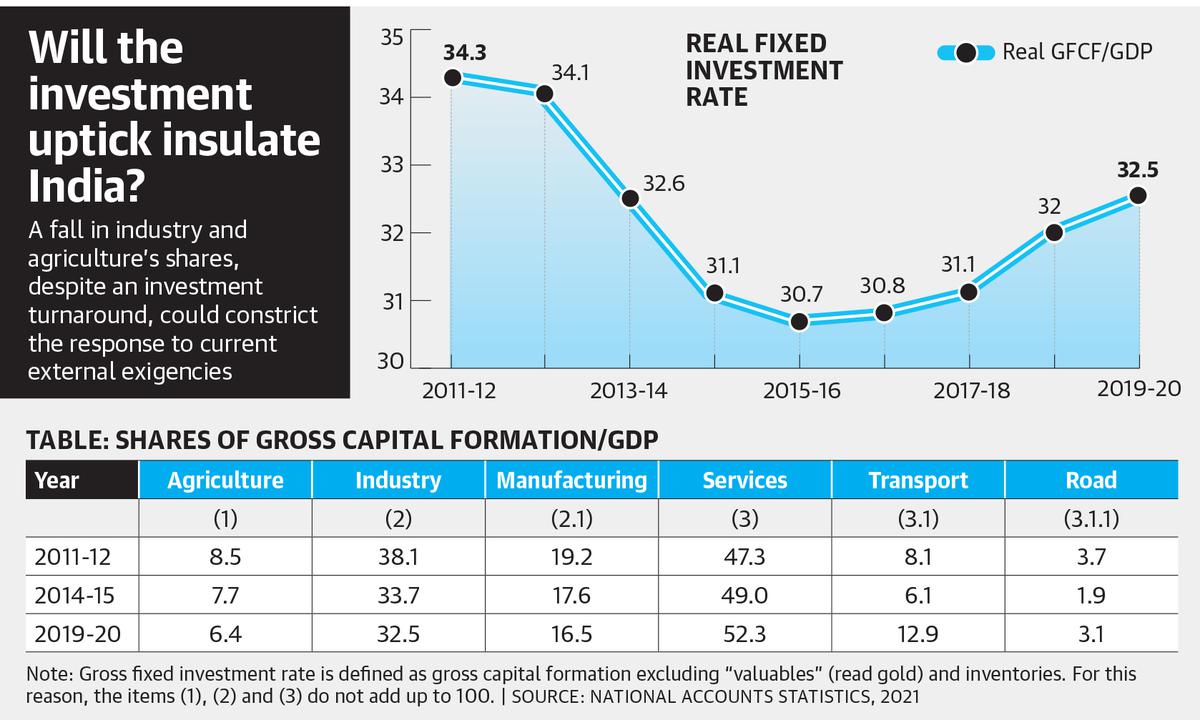
- Recent status- However, a recent uptick is evident in the real gross fixed capital formation (GFCF) rate where the the fixed investment to GDP ratio recovered to 32.5% in 2019-20 from a low of 30.7% in 2015-16.
- As in the June edition of the Ministry of Finance’s Monthly Economic Review, the fixed investment to GDP ratio was 32% in 2021-22.
What is the status of gross capital formation?
- Over 90% of gross capital formation (GCF) consists of fixed investments.
- The investment distribution has hardly changed over the last decade, with the public sector’s share remaining 20%.
- Between 2014-15 and 2019-20, the shares of agriculture and industry in fixed capital formation/GDP fell.
- Services’ share rose to 52.3% in 2019-20 and the rise is almost entirely on transport and communications.
- For healthy domestic output growth, there is a need for balance between directly productive investments (in farms and factories) and infrastructure investments.
What is the issue with manufacturing?
- Fall in investment- The share of manufacturing in the investment ratio fell from to 16.5% in 2019-20.
- Failure of ‘Make in India- The ‘Make in India’ failed to take off, import dependence went up, and India became deindustrialised.
- India’s position did go upto 63 in 2019 in Ease of Doing Business Index, but “Make in India’ failed to boost industrial investment.
- Import dependence- Import dependence on China is alarming for critical materials such as fertilizers, bulk drugs and capital goods.
- This became acute during the COVID-19 pandemic, as China imposed export restrictions prompting the Prime Minister to announce the ‘Atmanirbhar Bharat’ campaign.
- Foreign capital- The contribution of foreign capital to financing GCF fell.
- With declining investment share, industrial output growth rate fell to a negative 2.4% in 2019-20.
What scope does public investment hold in this scenario?
- Public investment is the pivot of the ongoing investment-led economic revival.
- The recent upturn in the aggregate fixed capital formation to GDP ratio is positive, though the rate is still lower than its mark in the early 2010s.
- The budgetary figures refer to financial investment indicating expansion of the economy’s productive capacity.
Reference
- https://www.thehindu.com/opinion/lead/weighing-in-on-indias-investment-led-revival/article65678946.ece



