Mains: GS III - Economy
Despite the ongoing conflict in West Asia and disruptions in the energy market, India’s key macroeconomic indicators, have demonstrated greater resilience “Goldilocks Zone” than previously anticipated.
Goldilocks economy – It refers to a state where economic conditions are balanced to provide ideal conditions for sustainable economic growth without resulting in significant inflationary pressures or leading to an economic slowdown.
Key characteristics
Low unemployment – The majority of individuals who are willing and able to work are able to secure employment.
Rising asset prices – Stocks, bonds, real estate, and other assets experience sustained price appreciation.
Low interest rates – Borrowing costs remain subdued, which encourages both investment and consumer spending.
Low inflation – Prices increase gradually, thereby maintaining consumers’ purchasing power.
Steady GDP growth – The economy expands at a consistent rate without experiencing overheating or recession.
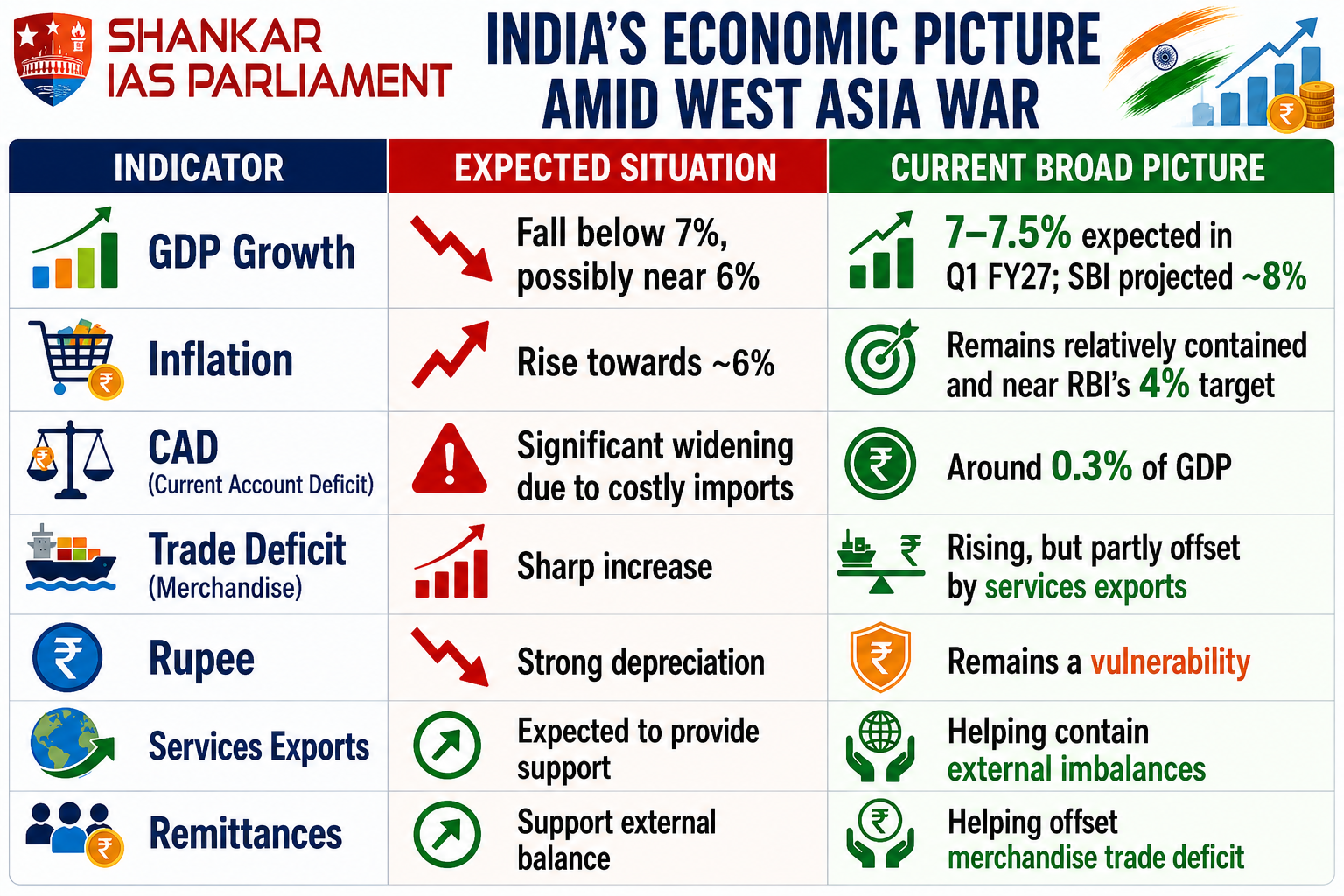
Monetary Easing – The Reserve Bank of India (RBI) reduced the repo rate by 125 basis points between December 2024 and December 2025.
Reduced borrowing costs contributed to increased consumption, investment, and credit demand.
The transmission of monetary policy typically requires several months to influence overall economic activity.
GST Rationalisation – The reduction in GST rates in 2025 led to lower prices and enhanced household purchasing power.
These changes supported increased consumption and stimulated domestic economic activity.
Robust export to US – Increased exports to the United States contributed to additional economic growth.
Manufacturing Front-Loading – Firms increased production rates due to concerns regarding future energy availability and potential supply chain disruptions.
Strength of services – The services sector contributes approximately 55% to the gross domestic product (GDP).
Robust services exports have generated significant foreign exchange earnings and have contributed to offsetting the merchandise trade deficit.
Remittance – Remittance inflows from overseas Indians have contributed to mitigating the external imbalance.
Slower Growth in Services Exports – The deceleration in India’s services exports has diminished their capacity to counterbalance the increasing goods trade deficit.
AI‑Induced Uncertainty – The global adoption of AI poses challenges to India’s traditional IT outsourcing model, potentially resulting in reduced foreign exchange earnings.
Risk of Current Account Deficit – A continued decline in services exports, combined with a persistent rise in the goods trade deficit, may lead to a broader Current Account Deficit and increased pressure on external stability.
Weakening of Credit-Driven Growth – An increase in credit, driven by government guarantees, elevated working capital requirements, and accelerated gold loans, may indicate underlying financial stress if reliance becomes excessive.
Front‑Loaded Manufacturing Slowdown – Firms accelerated production in anticipation of potential energy shortages. However, as this temporary increase subsides, manufacturing activity may experience a significant decline.
El Niño Risk – An intensified El Niño event may decrease agricultural output, which would reduce rural demand, increase food prices, and contribute to higher overall inflation.
Hidden Inflation Pressures – Headline inflation conceals underlying trends.
Goods inflation is approximately 5.4% year-over-year, while services inflation is about 2.5%, accounting for roughly 33% of the Consumer Price Index (CPI).
Key Risk – Rising services inflation with growth could spike headline inflation, forcing RBI tightening and slowing economic momentum.
Oil Price Shock – Instability in West Asia may increase crude prices, leading to higher import costs, consumer prices, a larger Current Account Deficit, and greater fiscal pressure for India.
Food inflation risk – El Niño or other adverse weather conditions may reduce agricultural output, leading to higher food prices.
Services‑Sector Vulnerability – India’s heavy reliance on services is risky if global demand weakens, AI disrupts IT‑enabled services, or export growth slows.
Rising merchandise trade deficit – India’s reliance on imports, especially crude oil and other essential commodities, increases the trade deficit.
Rupee depreciation – Rising import costs and capital outflows may weaken the rupee, leading to higher domestic import prices.
Credit-quality concerns – Rapid expansion of gold loans and guaranteed credit may mask underlying financial stress.
Temporary nature of manufacturing boost – Accelerated production may cause a temporary growth surge, followed by reduced activity.
Monetary-policy dilemma – If inflation increases while growth stays strong, the RBI may face a challenging policy decision:
Raising rates could control inflation but may slow growth.
Keeping rates low would support growth but could increase inflation risk.
Mitigate Energy Vulnerability
Diversify Crude Sources – Broaden supplier base to reduce geopolitical risk.
Strengthen Strategic Reserves – Expand petroleum storage for emergency supply stability.
Boost Renewables & Domestic Output – Accelerate clean and indigenous energy development.
Improve Energy Efficiency – Promote technology and conservation to lower overall demand.
Enhance Food Security
Build Climate‑Resilient Farming – Promote adaptive crops and sustainable practices.
Improve Water Management – Expand irrigation and optimize farm‑level efficiency.
Maintain Food Security Buffers – Ensure adequate food stock levels for shocks.
Strengthen Climate Early Warnings – Enhance El Niño and extreme‑weather monitoring systems.
Diversify Exports
Diversify markets and services – To decrease dependence on a narrow range of export destinations.
Promote high-value manufacturing – To increase exports of technologically advanced goods.
Enhance competitive sectors – To strengthen exports in electronics, pharmaceuticals, and engineering.
AI Integration in Services Sector
Invest in Advanced Skills – To build workforce capacity in digital and AI.
Shift to High‑Value Services – Move beyond low‑value IT to AI, R&D, knowledge‑intensive sectors.
Enhance Productivity & Innovation – To foster efficiency, creativity, and competitiveness.
Maintain Macroeconomic Stability
Anchor Inflation Expectations – To strengthen credibility of monetary policy.
Maintain Fiscal Prudence – To ensure disciplined and sustainable public finances.
Data‑Driven RBI Policy – To keep monetary stance evidence‑based and adaptive.
Avoid Credit Dependence – To prevent overreliance on debt‑fuelled growth.
Strengthen Domestic Demand
Boost Household Purchasing Power – To strengthen demand through income support and affordability.
Promote Private Investment – To channel capital into productive sectors.
Expand Jobs & Productivity – To enhance employment creation and labour efficiency.
Advance Tax & Structural Reforms – To continue targeted fiscal and institutional changes.
Mitigate External Vulnerabilities
Maintain Forex Buffers – To ensure adequate reserves for external shocks.
Promote Stable Capital Flows – To encourage steady, non‑volatile inflows.
Reduce Energy Import Dependence – To strengthen domestic and renewable sources.
Boost Export Competitiveness – To enhance services and merchandise performance.
What lies ahead?
India should transform short-term resilience into sustained long-term resilience by reducing energy dependence, enhancing manufacturing capacity, climate-proofing agriculture, advancing services through artificial intelligence, and maintaining prudent macroeconomic management.
Reference
Indian Express | India’s Goldilocks Economy



