Mains: GS III –Infrastructure
Why in News?
India has entered a new era of green railway transportation with the launch of its first hydrogen-powered train on the 89-km Jind–Sonipat section in Haryana, flagged off by Prime Minister Narendra Modi on 17 July 2026.
What is a Hydrogen-Powered Train?
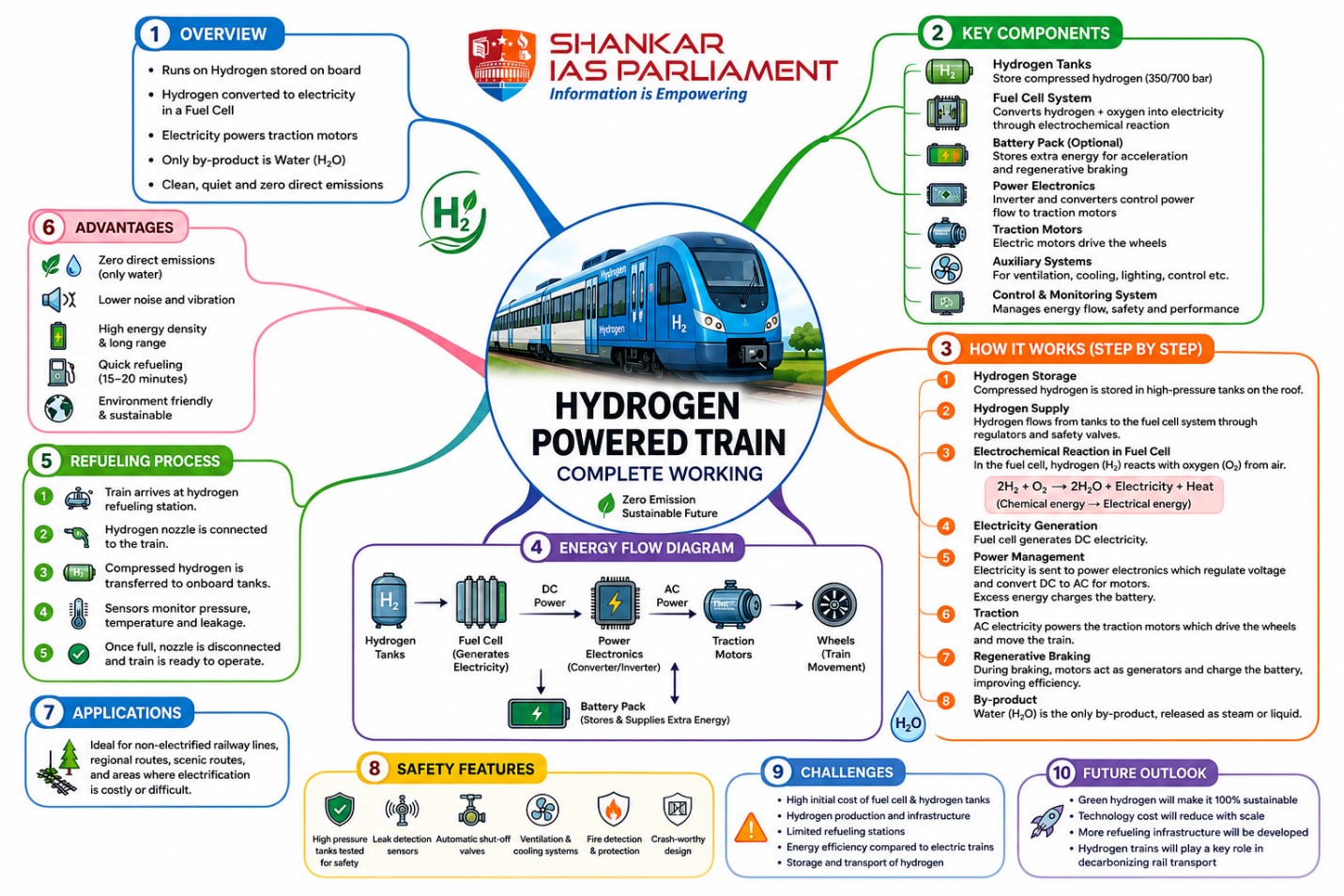
- Hydrogen-powered train – It is a self-propelled train that generates electricity onboard using hydrogen fuel instead of relying on overhead electric lines or diesel engines.
- Unlike conventional diesel locomotives that burn fuel to generate mechanical power, a hydrogen train carries a small onboard power plant in the form of a Proton Exchange Membrane (PEM) fuel cell.
- Inside the fuel cell, hydrogen combines with oxygen from the surrounding air through an electrochemical reaction to generate electricity.
- This electricity powers the traction motors that drive the wheels.
- The only direct by-products of this process are water vapour and heat, making hydrogen trains a zero tailpipe emission mode of transport with no smoke or carbon emissions during operation.
What are the key features of India’s first hydrogen train?
- Coaches – India’s first hydrogen-powered train is a ten-coach trainset comprising:
- Two Hydrogen Driving Power Cars (DPCs)
- Eight Trailer Coaches (TCs)
- Passenger capacity – The train has the capacity to carry approximately 2,600 passengers, with seating for around 682 passengers.
- Specifications – Some of its important specifications include:
- Route – Jind–Sonipat (89 km), Haryana
- Operational speed – 75 km/h
- Design speed – 110 km/h
- Trips – Two round trips per day
- Daily distance covered – 356 km
- Hydrogen consumption – Approximately 300 kg per day
- The train is regarded as one of the world’s longest hydrogen-powered passenger trainsets with eight passenger coaches and two driving power cars.
- It is also among the most powerful hydrogen trainsets globally with a total installed power of 2400 kW.
- Working of the Hydrogen Fuel Cell System – The train operates using an onboard hydrogen-electric propulsion system.
- Each Driving Power Car houses:
- Hydrogen fuel cells
- Lithium Iron Phosphate (LFP) batteries
- High-pressure hydrogen storage cylinders
- Power packs – Each power car contains four integrated power packs, each producing 300 kW of power.
- Every power pack consists of:
- 115 kW generated by the hydrogen fuel cell
- 185 kW supplied by the Lithium Iron Phosphate battery
- Power generated – Each Driving Power Car generates 1200 kW, and together the two power cars produce 2400 kW (approximately 3200 hp), comparable to conventional Electrical Multiple Units (EMU) and Diesel Electric Multiple Units (DEMU) operating on similar routes.
- The fuel cell continuously combines hydrogen stored onboard with oxygen from the atmosphere to generate electricity. Unlike internal combustion engines, this process involves no burning of fuel.
- Role of the Battery System – The hydrogen fuel cell provides a constant power output, whereas the train’s power requirement varies depending on acceleration, cruising speed, and braking.
- The battery complements the fuel cell as follows:
- During train start-up, power demand is relatively low.
- The surplus electricity generated by the fuel cell is used to charge the battery.
- As the train accelerates and reaches higher speeds, power demand increases.
- The battery supplements the fuel cell by supplying additional electricity.
- While approaching stations or during low-power operation, battery discharge stops and the excess electricity from the fuel cell again charges the battery.
- Consequently, after completing a journey, the battery remains nearly 80% charged, ensuring efficient energy management and reducing energy wastage.
- The hydrogen fuel cell used in the train has been imported from the Canadian company Ballard, which specializes in fuel cell technology.
What is the process for hydrogen production, storage and refuelling?
- Hydrogen Production – Hydrogen is produced onsite through electrolysis, wherein electricity splits water into hydrogen and oxygen. The hydrogen generated at the green hydrogen plant is stored in dedicated storage tanks.
- Hydrogen Compression – Since hydrogen occupies a large volume, it is compressed to approximately 500 bar, allowing a larger quantity of gas to be stored in a smaller space.
- Refuelling – Hydrogen is dispensed to the train at a regulated pressure of 350 bar through two independent dispensers, enabling both Driving Power Cars to be refuelled simultaneously and reducing turnaround time.
- The Jind facility has a storage capacity of nearly 3,000 kg of hydrogen, sufficient for regular train operations.
- It has also been approved by the Petroleum and Explosives Safety Organisation (PESO).
- Additionally, a chiller plant maintains hydrogen at approximately –15°C during dispensing, facilitating efficient refuelling.
- Safety Measures – Hydrogen is colourless, odourless, tasteless, non-toxic, but highly inflammable, requiring stringent safety systems.
- Since hydrogen leaks cannot be detected by human senses, the train incorporates multiple layers of safety.
- The train and hydrogen plant are equipped with:
- Continuous hydrogen leak detection systems
- Flame detectors
- Heat sensors
- Smoke detectors
- Continuous ventilation systems
- Automatic hydrogen shut-off mechanisms
- Fire alarms
- Water spray systems for fire control
- The train also includes a specially designed Loco Pilot cabin featuring:
- Real-time monitoring of the health of the hydrogen system
- Emergency operating mode enabling the train to be safely moved in case of an incident
- Before commissioning, the complete hydrogen system underwent an independent third-party safety assessment by TÜV SÜD, Germany, one of the world's leading technical inspection and certification agencies.
- Development of the Project – The hydrogen train project was initiated by Northern Railway during 2020–21 at an estimated cost of ₹136 crore.
- Implementation began in April 2022 after awarding the contract to Medha Servo Drives, Hyderabad.
- Institutions involved – The project involved multiple institutions:
- Research Designs and Standards Organisation (RDSO) formulated technical specifications and led the design approval process.
- Medha Servo Drives integrated the hydrogen propulsion system.
- Integral Coach Factory (ICF) designed the train's theme and exterior.
- Following successful trials, the Ministry of Railways sanctioned commercial operation on 22 May 2026.
What is the global status of hydrogen trains?
- Germany – It became the first country to introduce commercial hydrogen passenger trains when Alstom launched the Coradia iLint in 2018 after first presenting the technology in Berlin in 2016.
- Other countries – Countries including, France, Italy, China, Japan, and United States have launched pilot projects or limited hydrogen train services.
- However, most hydrogen trains worldwide consist of only two to four coaches and are primarily used for regional passenger services over relatively short distances.
- In comparison, India's ten-coach hydrogen train represents one of the longest and most powerful hydrogen trainsets developed so far.
What are the future prospects?
- Expansion – Indian Railways intends to use the experience gained from the Jind–Sonipat project to expand hydrogen technology to other railway routes.
- The Railways is exploring the deployment of hydrogen-powered rolling stock on heritage railways, including the Kalka–Shimla route.
- Long-term objective – It is to transition from a pilot project to a structured national programme for hydrogen-powered trains, supporting:
- Decarbonisation of railway transport
- National Green Hydrogen Mission
- Energy security
- Sustainable mobility
- India's Net Zero commitments
- The future expansion of hydrogen trains will depend on the operational performance, economic viability, and reliability of the first hydrogen train.
What lies ahead?
- India's first hydrogen-powered train represents a landmark achievement in clean transportation and railway innovation.
- By replacing diesel-based propulsion with hydrogen fuel cells and battery technology, the train demonstrates a zero-emission alternative capable of delivering performance comparable to conventional trains.
- The project marks a significant milestone in the evolution of Indian Railways—from coal and steam locomotives to diesel, electric traction, and now hydrogen-based propulsion.
- The hydrogen train is a major step towards clean mobility and aligns with India's commitment to sustainable transportation, the National Green Hydrogen Mission, and the long-term Net Zero target.
- It also places India among a small group of countries that have successfully deployed hydrogen-powered passenger trains.
- The establishment of indigenous hydrogen infrastructure, robust safety mechanisms, and successful integration of advanced fuel cell technology reflects India's growing capabilities in sustainable transport.
References
- The Hindu| India’s 1st Hydrogen Powered Train
- News on Air| PM Flags Hydrogen Train



