Prelims: Current events of national importance | Economy & Social Issues
Why in News?
Women’s workforce participation has increased, but the quality of employment remains skewed, with many engaged in unpaid or low‑value roles rather than secure, productive jobs.
Labour Force Participation Rate (LFPR)
- It is a key economic indicator that measures the percentage of the working‑age population (15 years and above in India’s PLFS (Periodic Labour Force Survey) that is either employed or unemployed.
- It is a key economic indicator of how much of the population is engaged in the labour market.
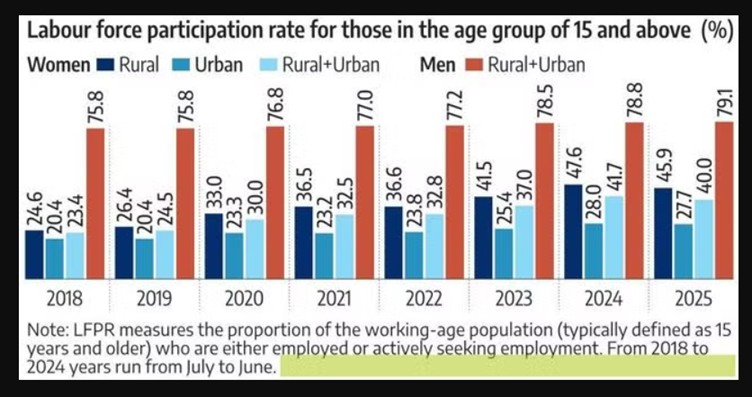
- Overall LFPR - 60.1%.
- Male LFPR – Still far higher, leaving a 60% gap in women’s presence in the job market.
- Female LFPR – Rose to 40% in 2025, driven mainly by rural areas.
Reasons for Skewed Participation
- Nature of Work – Much of the rise reflects informal or distress‑driven work, not quality employment.
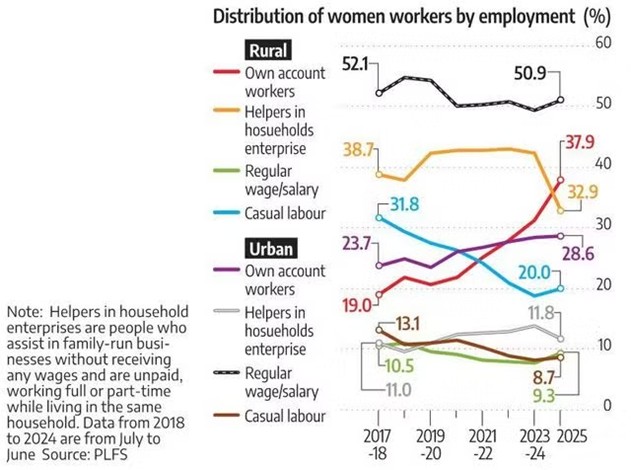
- Unpaid Helper Roles – Women concentrated in family‑based agriculture or enterprises.
- Self‑Employment Dominance – Limited access to regular salaried jobs, especially in rural areas.
- Urban Exclusion – Urban women face higher barriers to paid work despite education gains.
- Domestic Burden – Share of women in unpaid domestic duties remains high at 37.4%.
Solutions
- Policy Interventions – Strengthen schemes like Mahila Shakti Kendras, expand crèches under National Creche Scheme.
- Skill Development – Focused training in digital economy, green jobs, and entrepreneurship.
- Infrastructure – Safe transport, workplace childcare, flexible work arrangements.
- Legal Measures – Enforce equal pay, expand maternity/paternity leave, incentivize women’s hiring in formal sector.
- Social Change – Awareness campaigns to reduce unpaid domestic burden and redistribute household work.
Reference
Business Standard | Datanomics



