Mains: GS III – Indian Economy and Issues relating to Planning, Mobilisation of Resources.
Why in News?
Although India has achieved gender parity in secondary education, young women still lack adequate employment opportunities.
What is the current status of female workforce participation rate?
- Low Female WPR – The female workforce participation rate remains below 30 percent, positioning the country among the lowest globally, comparable to Saudi Arabia and Yemen.
Worker population ratio is defined as the number of persons employed per thousand persons. It is an indicator used for analysing the employment situation in the country.
WPR = No. of employed persons x 1000/Total population
- Participation Decline – The female workforce participation rate has experienced a consistent decline from 1983 to 2018.
- Despite significant improvements in female educational attainment, the labor force participation rate remains low.
- Sectoral Decline – The slowdown in job growth across both farm and non-farm sectors between 2012 and 2018 disproportionately affected female workers.
What is the historical context of women WFP?
- High Participation in Early Periods – During the 1980s and early 1990s, the female workforce participation rate was high.
- This was primarily due to the dominance of agriculture, which resulted in a significant proportion of women engaged in farm labor.
- Structural Transformation & Decline – Between 2004–05 and 2012, the economy shifted away from agriculture.
- Mechanisation – It led to a decreased demand for manual labour.
- As a result, many rural women left the workforce.
- Rise in Education – A parallel trend is the rise in educational attainment among young women.
- As school attendance increases, fewer young women participate in the labour force.
- U Shaped Curve Argument – The Indian economy experienced a decline in female workforce participation rates until 2018–19.
- This trend aligns with Claudia Goldin’s U-shaped hypothesis.
- The initial decline is associated with structural changes in the economy.
- A subsequent increase is possible as education levels and non-farm employment opportunities expand.
How many young women are classified as NEET?
- NEET – The population of young women aged 15 to 29 classified as Neither in Employment, Education, nor Training (NEET) is detailed below:
- This number remained below 70 million until 2004.
- The figure rose to 84 million in 2012.
- By 2018, this number exceeded 100 million.
- Bihar's Female Worker Population Ratio (WPR) is 15 percent, indicating extremely low participation of women in the labour force.
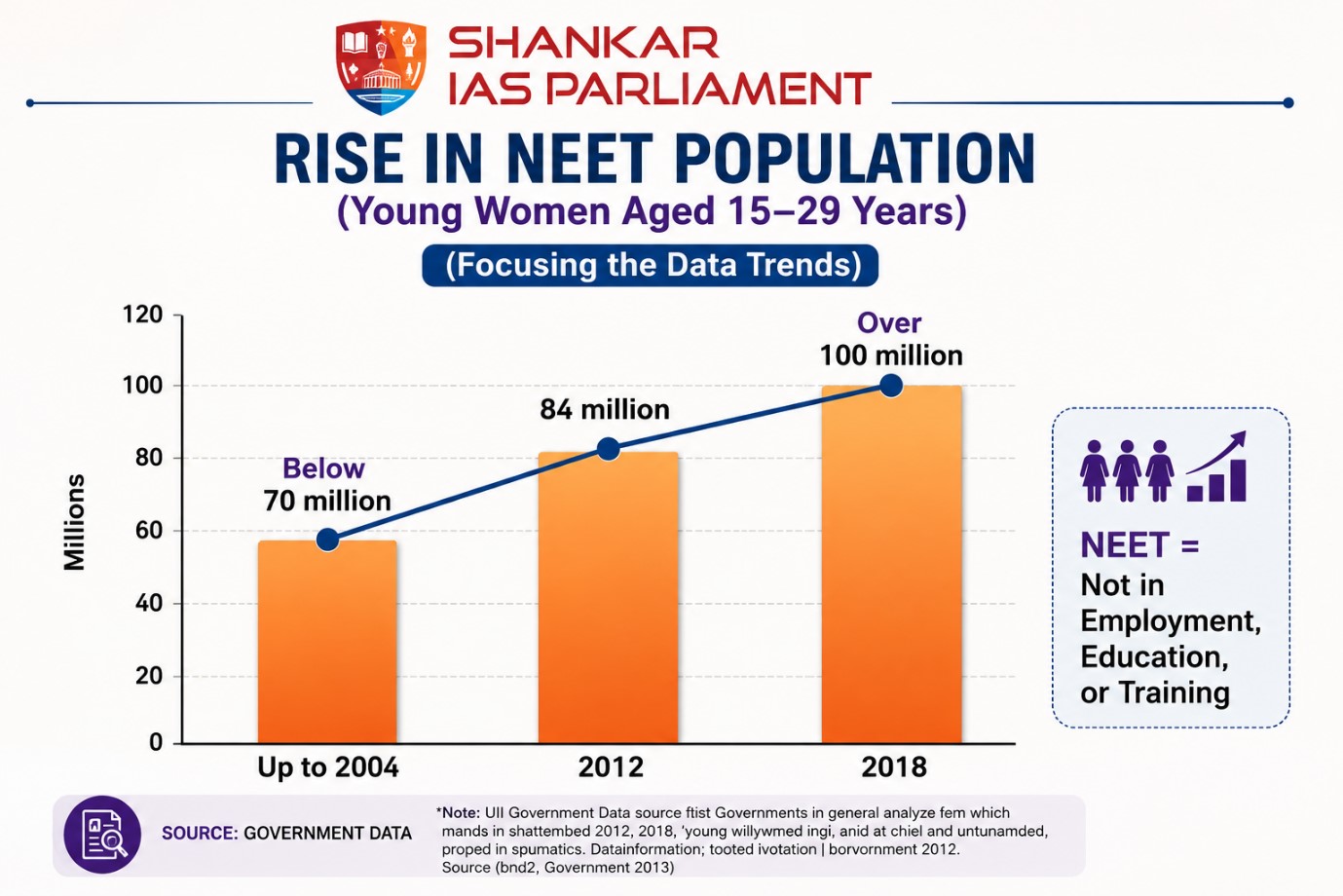
- The number of young women who were neither seeking work nor pursuing education increased steadily, indicating declining labour force participation and limited economic opportunities.
What are the economic contributions of increased female workforce participation rate?
- Workforce Equality – India's economic development cannot be considered complete without a substantial increase in the female Work Participation Rate (WPR).
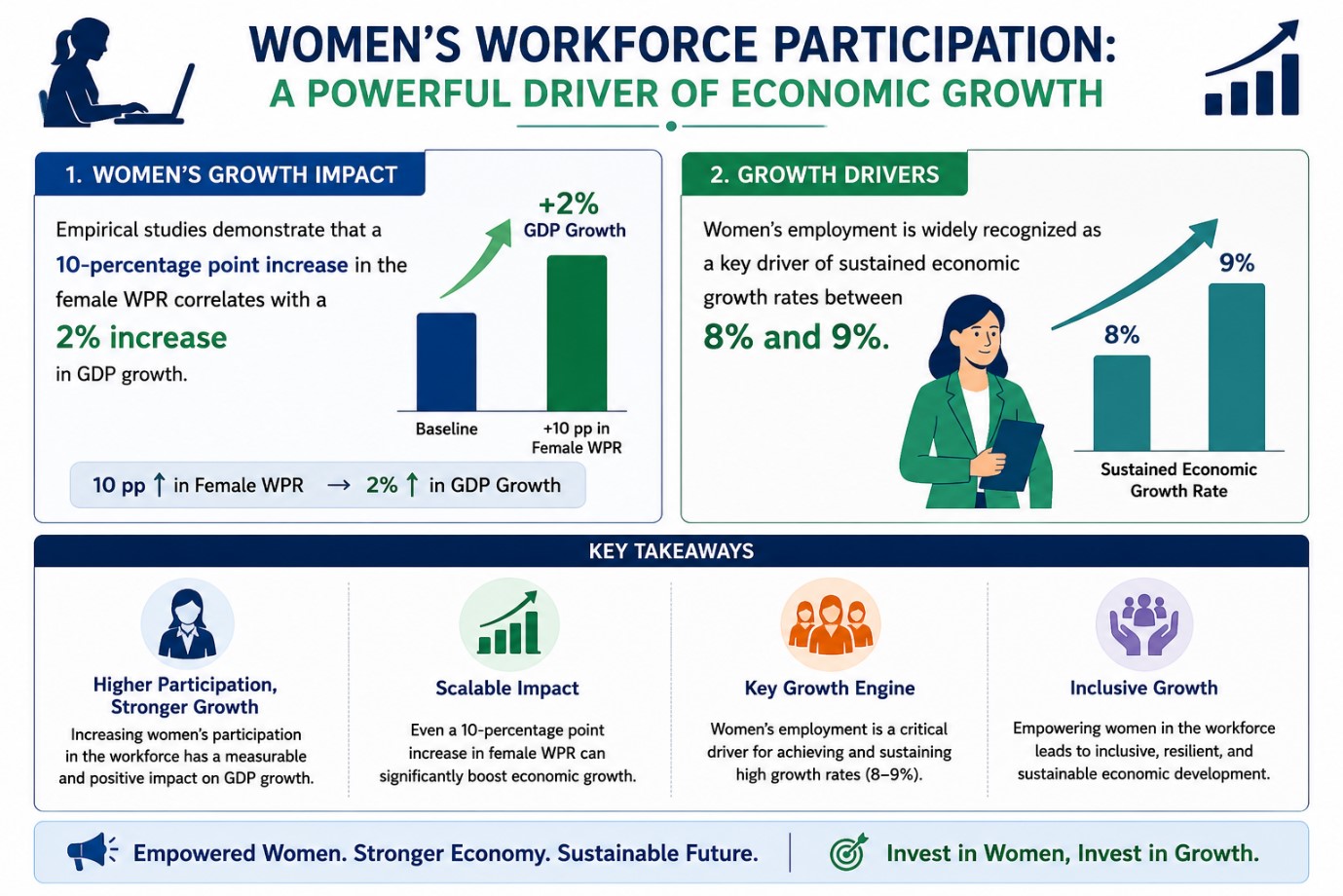
- Labour Supply – An increase in female workforce participation expands the labour supply and enhances productive capacity.
- Income Boost – Higher female workforce participation raises household incomes, which leads to increased consumption and savings.
- Capital Strengthening – Greater female workforce participation improves nutrition, education, and healthcare, thereby strengthening human capital.
- Innovation Drive – Increased female participation in the workforce enhances productivity, fosters innovation, and improves national competitiveness.
- Creative Efficiency – According to Claudia Goldin, gender-diverse workplaces are more efficient and creative.
- The inclusion of women in the workforce should be regarded as a national productivity strategy rather than solely a welfare measure.
What are the distress‑driven feminisation of agriculture in India?
- Economic Distress – The post‑2020 increase in women’s work participation was largely distress‑driven, rooted in the GDP slowdown (since 2017), COVID‑19 economic shock, and large‑scale return migration that pushed women into subsistence agriculture and unpaid family labour.
- Rural Labour Shift – Male workers who were displaced from urban employment returned to rural areas. Concurrently, women assumed greater responsibilities in subsistence agriculture and related activities, frequently as unpaid family labor.
- Nature of Work –women pushed into insecure, unpaid farm work due to shrinking non‑farm jobs and restrictive gender norms.
- Historical Trend – Between 1983–2012, women’s share in unpaid family labour declined, but post‑COVID collapse of non‑farm jobs forced many poorly educated adult women back into agriculture.
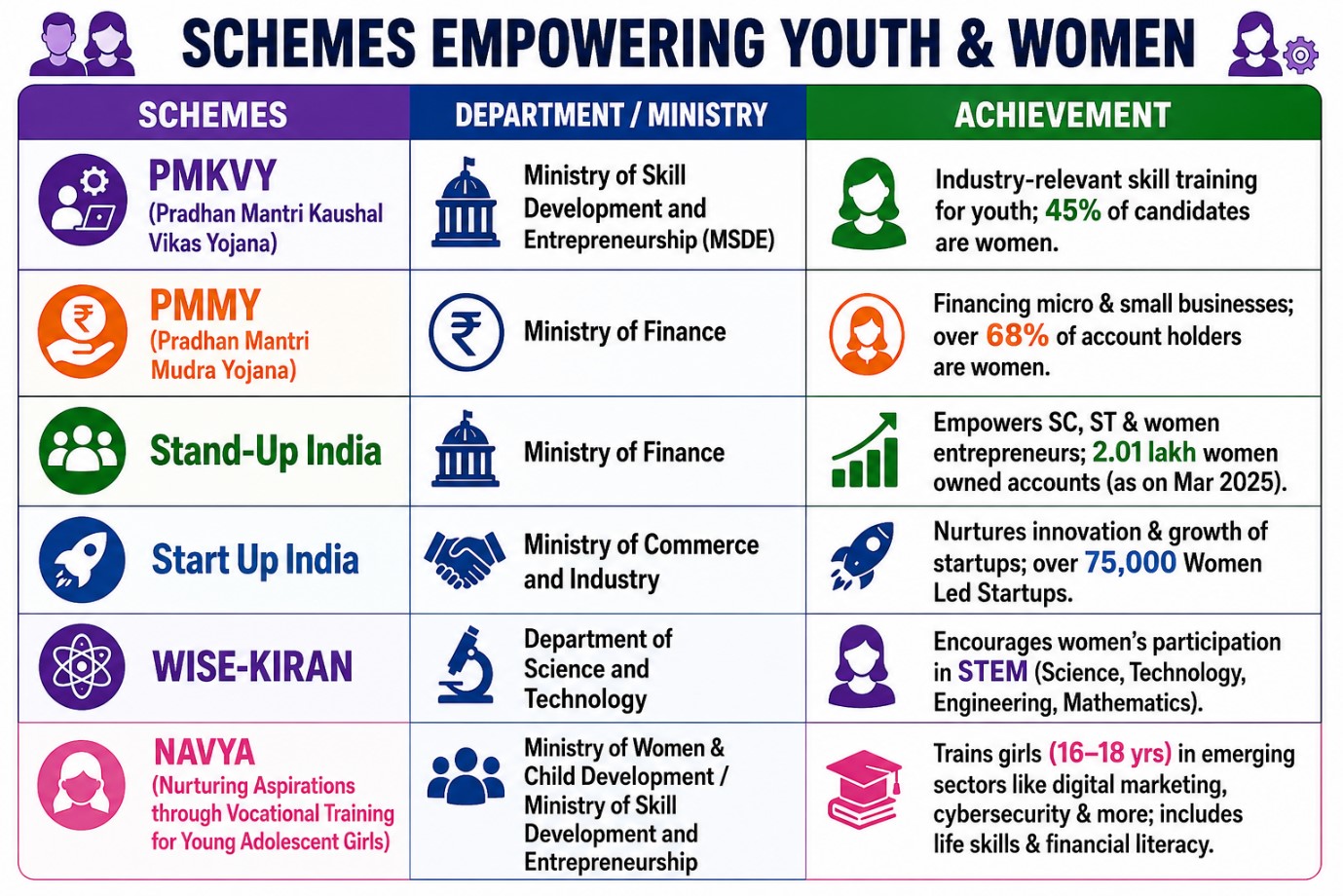
What are the measures taken by government to reduce female unemployment?
What are challenges behind weak female employment generation?
- Capital‑Intensive Growth – Recent GDP growth is concentrated in capital-intensive sectors like finance, IT, and organised manufacturing, which create few jobs and limit women’s employment opportunities
- Decline in Labour‑Intensive Sectors – Textiles, food processing, garments, and small-scale manufacturing experienced an absolute decline in employment between 2013 and 2019.
- Women were disproportionately affected due to their significant reliance on employment within these sectors.
- Collapse of Manufacturing Jobs for Women – By 2019, female manufacturing employment had dropped below 2004 levels, despite initiatives such as “Make in India” and PLI. Employment only returned to 2004 levels by 2022.
- Policy Gaps – Policy support for manufacturing and women’s employment is insufficient, with few gender-sensitive strategies and limited interventions in labour-intensive industries.
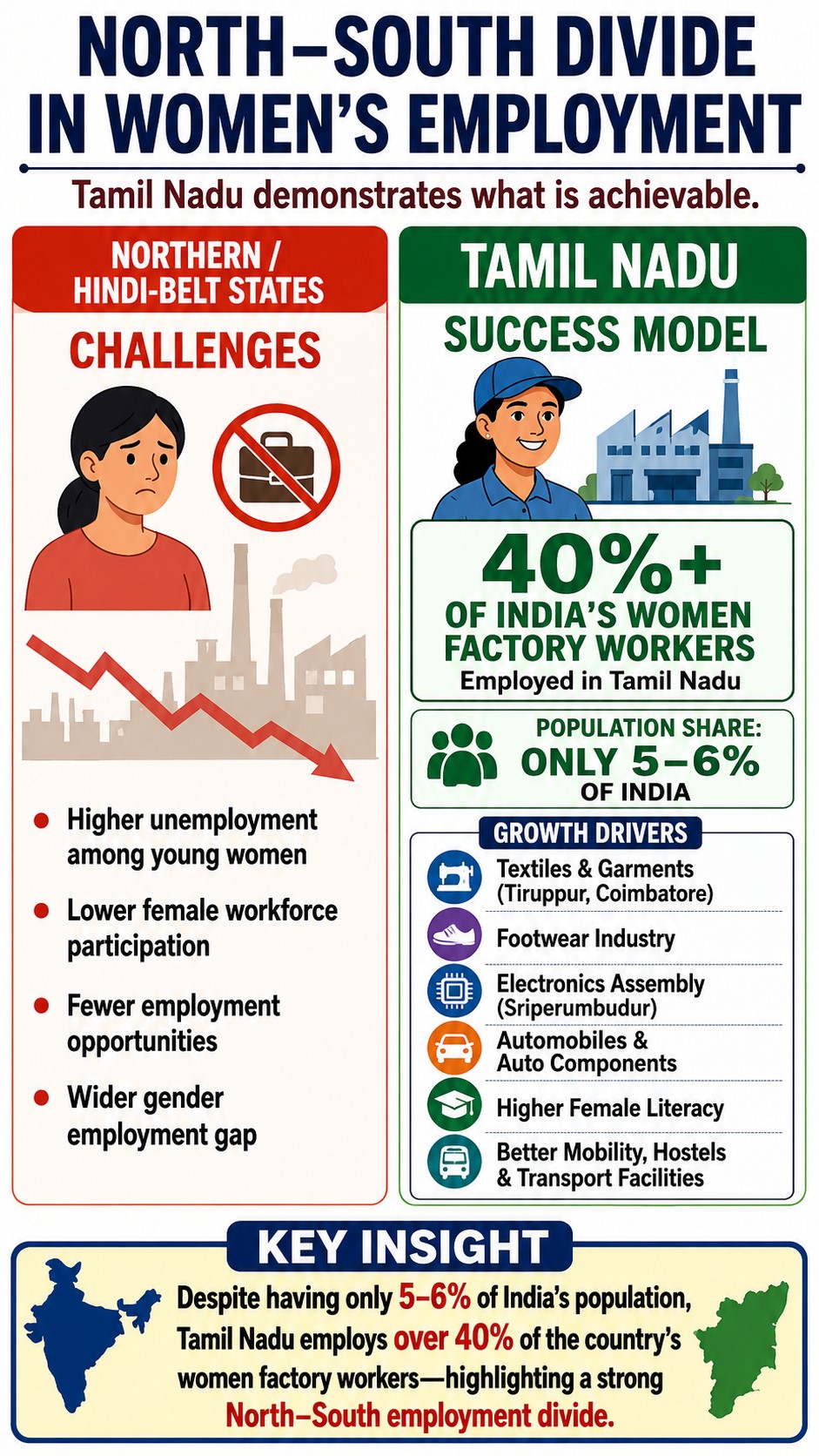
- Regional disparities
- Employment Challenges (North & Post‑2020) – High female unemployment in North India due to barriers in education, healthcare, mobility; modest rise post‑2020 mainly from older women re‑entering agriculture, concentrated in animal husbandry/poultry.
- Structural Gaps (Regional & Health) – Women’s factory jobs heavily concentrated in Tamil Nadu, limited in Hindi belt; malnutrition and stunting in North India restrict productivity and employment outcomes.
What could be done?
- Diversify Growth – Promote labour-intensive sectors such as textiles, garments, food processing, and MSMEs, in addition to capital-intensive industries, to diversify economic growth.
- Gender-Sensitive Policy – Integrate women-focused employment strategies, quotas, and incentives into manufacturing policies to ensure a gender-sensitive industrial approach.
- Scheme Alignment – Align the 'Make in India' and PLI schemes with women’s employment targets, prioritizing industries with a high proportion of female workers.
- Skill Development – Expand vocational training, apprenticeships, and reskilling programs specifically designed for women in the manufacturing sector.
- Supportive Infrastructure – Provide hostels, safe transportation, childcare facilities, and flexible work arrangements to support women’s participation in the workforce.
- Regional Replication – Adopt interventions modelled after Tamil Nadu, such as textile hubs, electronics assembly units, and footwear clusters, in Hindi belt states.
Reference
The Hindu | Women at Work



