Why in News?
Opposition leaders in Parliament have launched campaigns against E20, saying it harms vehicles and that the government is forcing it on people.
What about E20 Petrol?
- E20 Petrol – A fuel blend made of 20% ethanol and 80% conventional petrol.
- Ethanol is a plant-derived biofuel typically produced from sugarcane or grains.
- This blend is used to lower vehicle tailpipe emissions, improve the octane rating, and reduce reliance on imported crude oil.
- Key Characteristics of E20 Fuel
- Cleaner Emissions – Ethanol contains extra oxygen, which helps the fuel burn more completely and reduces carbon monoxide and hydrocarbon emissions.
- Lower Energy Density – Ethanol has less energy per litre than pure gasoline, which can cause a slight reduction (roughly 5–7%) in fuel efficiency or mileage.
- Solvent Properties – Ethanol acts as a solvent and can corrode older rubber hoses, plastic seals, or metal components not engineered to handle high alcohol content.
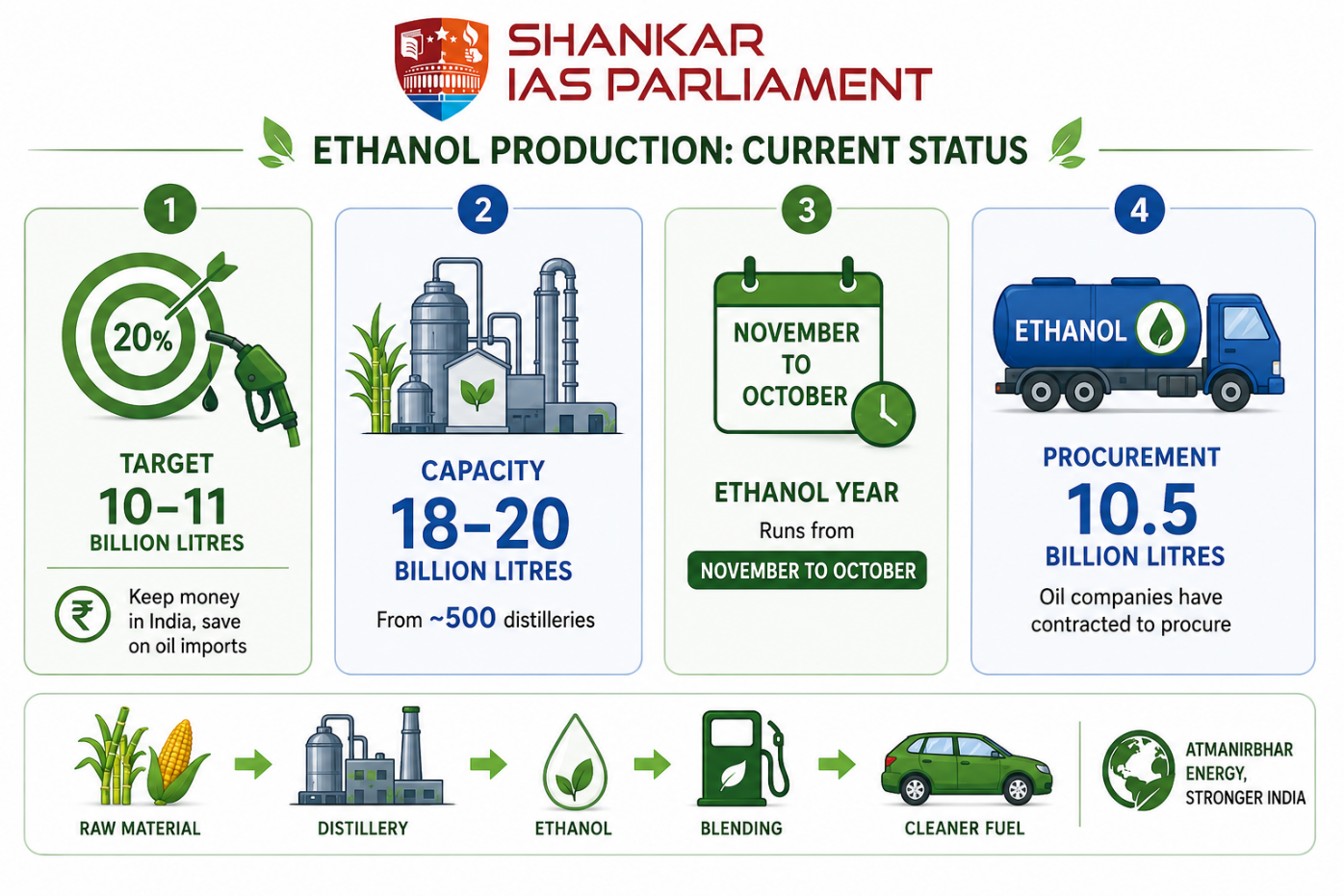
Will the ramp-up lead to a boost in agricultural produce imports from the U.S.?
- No import surge – There is no evidence of a surge in ethanol or maize (corn) imports in Ministry of Commerce statistics.
- In any case, direct ethanol imports for petroleum blending are banned, though the U.S. corn lobby has been aggressively pushing for India to increase corn imports.
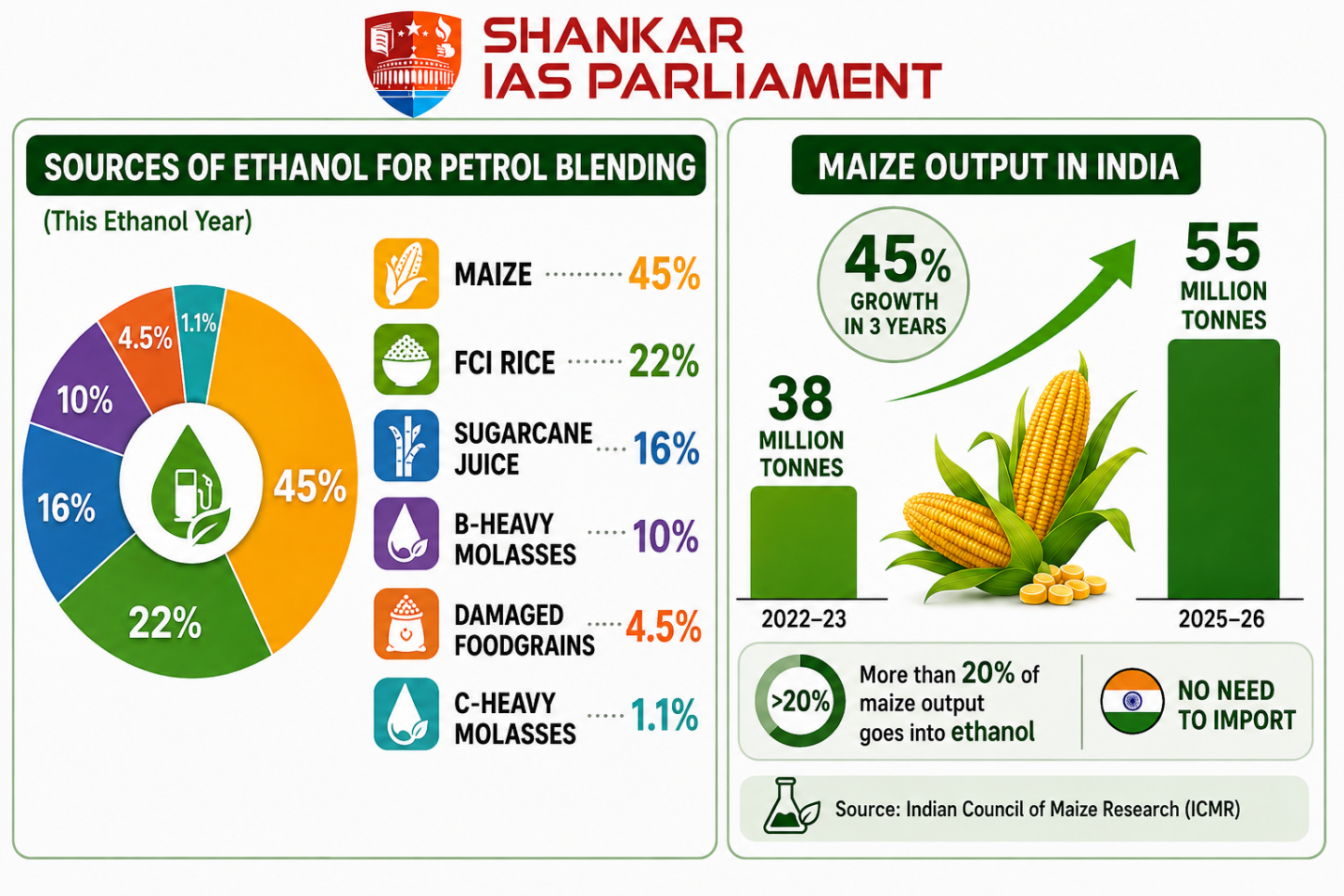
- Sugarcane & molasses diversion – Sugarcane juice and B-heavy molasses go into sugar production, and they are now being diverted to ethanol.
- Indian Sugar Manufacturers’ Association report – The closing stock of sugar in September 2025 was around 5 million tonnes, and this year too, the closing stock is expected to be 5 million tonnes.
- This indicates the diversion to ethanol has not affected sugar availability or stocks.
- Risk associated – In the event of a monsoon failure, crop losses and foodgrain shortages, the diversion of FCI rice, sugarcane juice and B-heavy molasses to ethanol production will come under stress, raising the possibility of corn imports.
Should we be worried about using E20 in our vehicles?
- Vehicles built after April 2023 – With the Bharat Stage 6 Phase 2 (Real Driving Emissions) mandate taking effect.
- Vehicles built after this deadline were factory-engineered for E20 — with ethanol-resistant elastomers, fluorinated fuel lines, upgraded pump seals and recalibrated engine control units.
- These roughly 70 million vehicles, about 23% of India’s active petrol fleet, face little cause for concern.
- Legacy two-wheelers & cars (before 2023) – Remaining 77% — nearly 240 million legacy vehicles built for E5 or E10 — are the genuine worry.
- Issue with older vehicle
- Polar solvent – Degrades older rubber compounds and plastics, hardening and cracking fuel hoses over time.
- Hygroscopic – It absorbs atmospheric moisture, and in vehicles left parked for extended periods, the ethanol-water mixture separates and settles, forming an acidic layer that corrodes tanks, damages fuel pumps and clogs filters with sludge.
- Consumer surveys – Found 66% of pre-2023 owners reporting mileage losses exceeding 10%, and 55% reporting increased maintenance.
- Conflicting evidence – IIT Kanpur’s Engine Research Laboratory maintains that E20 causes no notable damage, with efficiency loss under 5% — attributing most complaints to driving habits and traffic conditions.
- Independent mechanics & automotive communities cite real-world fuel pump and injector failures traced to ethanol’s solvent and low-lubricity properties.
- Government & manufacturer findings – A leading automobile manufacturer had serviced 2.84 crore vehicles in FY 2025-26, including about 1.5 crore legacy vehicles, without finding E20-linked engine damage & another two-wheeler maker reported similar findings.
- Mileage studies – Government & manufacturer studies showed an efficiency penalty of about 2 to 6% in some vehicles designed for E10, though this too was influenced by driving conditions, habits and maintenance.
- Lessons from Brazil – Brazil phased ethanol blending over decades, where the transition to high levels of ethanol along with modifications to vehicles happened over several decades in a stable manner.
- In India, the 10% milestone was reached in 2022. Within three years, the blending was ramped up to 20% with very little information and advisories coming from manufacturers.
Has ethanol blending helped mitigate the oil supply crisis?
- Foreign exchange savings – In August, the government said in the Lok Sabha that so far, the ethanol blending programme has led to savings of around Rs. 2 lakh crore of foreign exchange.
- It also substituted 32 million tonnes of crude oil imports and 10 billion litres of petrol with ethanol, which would mean dispensing with a month of crude imports.
- Petrol Prices vs Crude Prices – The government told Parliament that while crude oil prices had gone up 70% during the war in West Asia, petrol prices at the pump had gone up by only 7 to 8%, although under-recoveries had also increased.
- The OMCs procure ethanol at around Rs. 70 per litre for blending, compared with a pump price of around Rs. 105 per litre of petrol.
- The base price of petrol, which includes the cost of production, transportation and OMC margins, is typically 55-60% of the petrol pump price.
- On the surface, it appears that ethanol is not less costly than petrol, but the issue is complex.
- Complex Costing & Tax Regimes – Ethanol and petrol follow different costing and tax regimes, and it would be difficult to make an independent inference on whether ethanol has helped keep prices down, as the government claims.
Reference
The Hindu | How sustainable is India’s E20 push?



