Prelims: Current events of national and international importance | Species
Why in News?
A recent study published in Zootaxa provides an updated checklist and a comprehensive analysis of the scientific nomenclature of Indian reptiles.
- New study – The checklist encompasses 267 years of zoological records, spanning from 1758 to December 2025.
- India currently possesses 1,047 recognized reptile taxa, comprising the following:
- 839 species
- 30 subspecies
- 178 genera
- This study is significant as it investigates the etymology, specifically the origin and meaning, of Indian reptile names.

|
1758: The beginning of modern zoological nomenclature
|
- The publication of the 10th edition of Systema Naturae by Carl Linnaeus is widely recognized as the origin of modern zoological nomenclature.
- Carl Linnaeus
- Swedish naturalist
- He developed the foundation of modern biological classification.
- He is also associated with the development of binomial nomenclature.
Binomial Nomenclature
- A scientific name generally consists of two components: Genus and species
- For example: Ophiophagus hannah
- Ophiophagus refers to the genus.
- Hannah denotes the species epithet.
|
A toponym refers to a name that originates from a specific geographical location.
An eponym denotes a name that is derived from an individual.
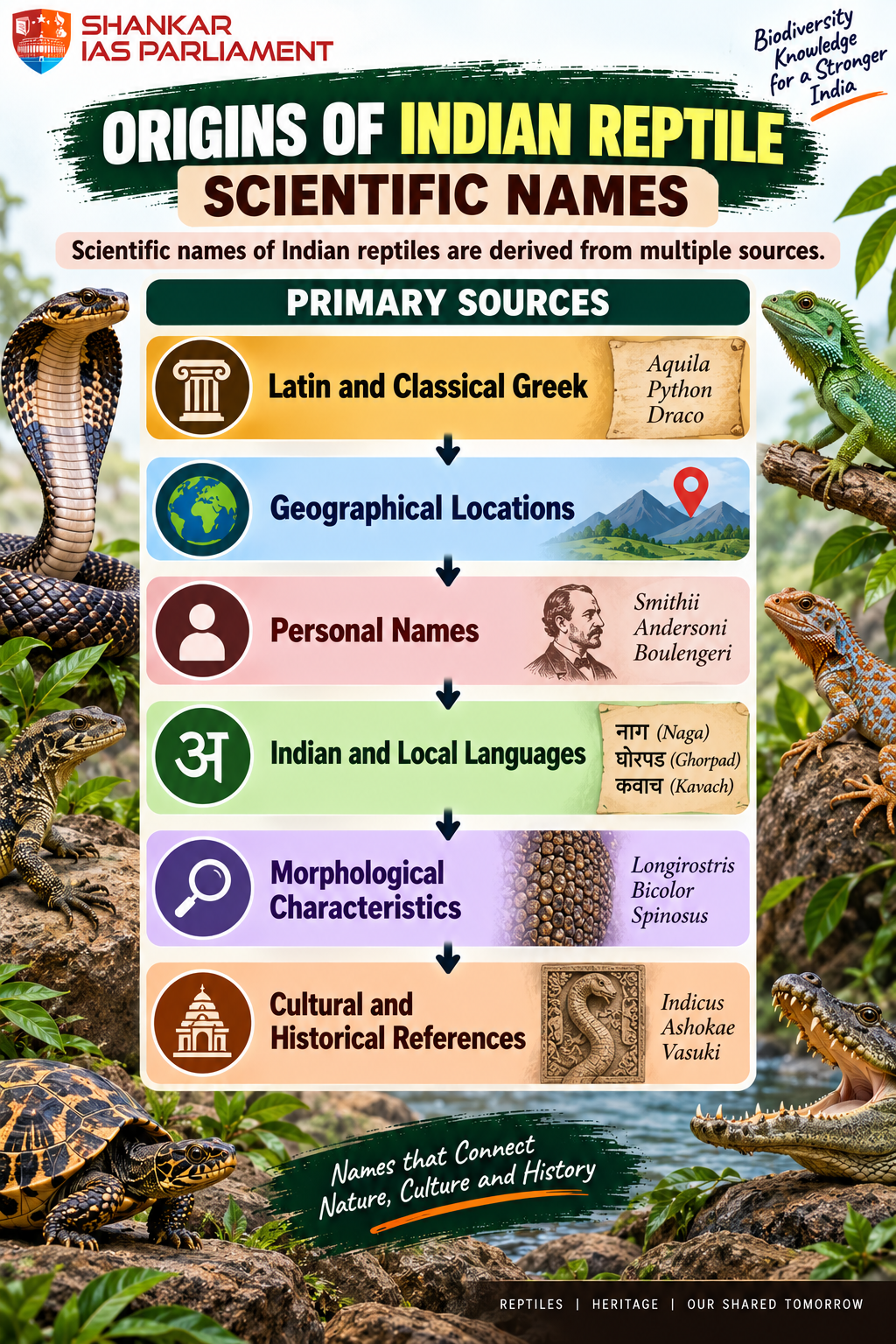
- Local Indian Languages in Scientific Nomenclature – Scientific nomenclature is not exclusively based on Latin or Greek origins.
- The study identified instances where scientific names have origins in local Indian languages, specifically in:
- Examples
- Naja
- Genus representing cobras.
- The name is derived from the Sinhala term "naya," which means cobra.
- Daboia
- This genus is believed to have a Hindi origin.
- It is associated with the Hindi word 'dabohiya,' which can be interpreted as:
- "that lies hidden"
- "the lurker"
- Chitra
- The term is derived from the Sanskrit word "chitra."
- It means variegated or multicoloured.
- The term refers to colour patterns.
- Batagur kachuga
- The term 'kachuga' is derived from the Hindi word 'kachua'.
- It means turtle.
- Ahaetulla laudankia
- The name is derived from the vernacular term used in Odia.
- This is associated with the snake's resemblance to dried stems of the following plants:
Reference
Down to Earth | Indian Reptile Diversity & Scientific Names



