Why in news?
Maritime States (Tamil Nadu, Kerala, Andhra Pradesh, Odisha and Maharashtra) have expressed dissatisfaction over the Indian Ports Bill 2021.
What is the bill about?
- The Indian Ports Bill 2021 seeks to replace more than a century old Indian Ports Act 1908.
- The new Bill incorporates international regulatory developments in the national legislation namely the -
- International Ship and Port Facility Security (ISPS) Code 2004
- International Convention for the prevention of pollution from ships (MARPOL) (1983, 2005)
- International Ballast Water Management (BWM) convention (2017)
What are the welcome features?
- The Bill mandates port authorities to provide adequate “reception facilities” to ships to dispose of their waste.
- It contains provisions for the safety and security of ports and for the prevention and containment of pollution at ports.
- These provisions will apply to all ports in India (major and non-major ports).
- The ports are required to prepare a “Security Plan” and a waste reception and handling plan.
- The Ports will also be subject to periodic audits by the Union government to ensure compliance.
What are the contentious provisions?
Maritime State Development Council
- The Council will be established by the Centre with the Union Minister of Ports, Shipping and Waterways as the Chairperson.
- The Ministers in charge of ports in the Maritime States will be the members.
- It also includes the Secretary and Joint Secretaries of the Ministry dealing with ports.
- But neither the State Maritime Boards nor expert members on port administration and trade interests find a place in the Council.
- The Bill also proposes to make the Council a permanent body with wide-ranging powers to -
- formulate a national plan for development of existing and new ports and revise the plan periodically
- monitor the development of major and non-major ports to ensure their integrated development with the national plan
Powers
- The Union government can make a port non-operational if it is not in consonance with the national plan.
- Heavy penalties for administrative lapses on Port authorities and officials ranging from Rs. 50,000 to Rs. 2 lakh or imprisonment up to 6 months or both.
- The excessive authority and power concentrated in the Union government relegate the maritime States into a secondary position.
What is the changing trend with Indian ports?
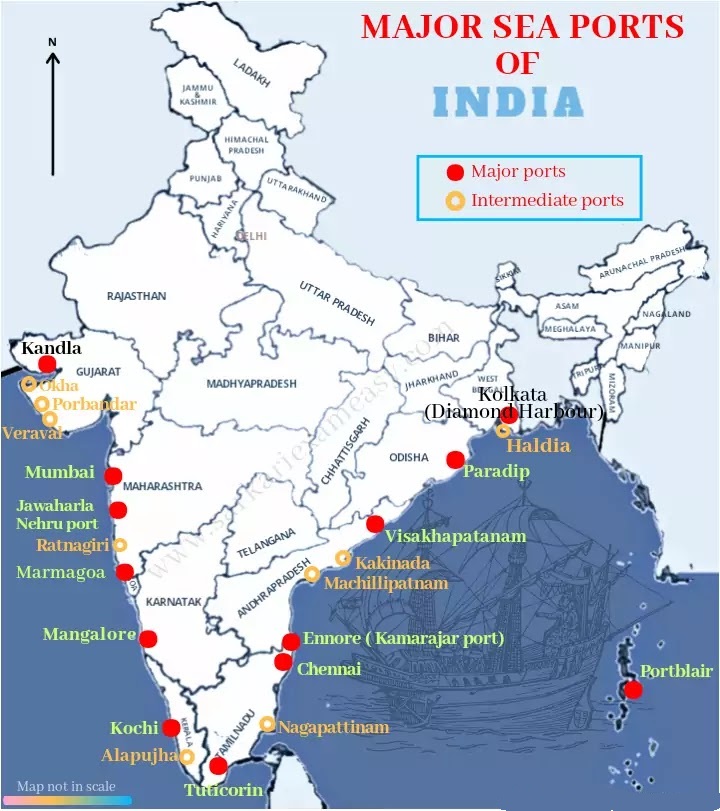
- India has 12 major ports and about 212 non-major ports.
- Major ports come under the direct control of the Centre.
- All non-major ports come under the control of the respective State governments.
- In 2000-01 Indian ports handled total traffic of 369 million tonnes, with 76% share with major ports and 24% with non-major ports.
- In 2020-2021 the total traffic handled at Indian ports reached 1,250 million tonnes.
- But the share of major ports declined to 54% while that of non-major ports increased to 46%.
- In this line, by 2030 non-major ports could overtake the major ports in cargo handling.
- Clearly, the maritime State governments will be the main driving force to effect such developments.
What does this call for?
- Port handling requires more decentralization.
- India’s maritime States have, in the past, executed a number of port development projects successfully.
- E.g. Mundra Port, handling the highest volume of cargo (144.4 MT in 2020-2021), has been developed on a concession granted by Gujarat Maritime Board.
- Krishnapatnam, Kakinada and Gangavaram ports have been developed on a concession by the Andhra Pradesh Maritime Board.
- So, the Centre must step back and give more autonomy to States.
- Major ports can offer “brownfield sites” while the Maritime States can offer “greenfield sites” for development.
- The Union government should thus take the Maritime States with it as equal partners in the growth and development of ports in India.
Source: Business Line



