Prelims: Current events of national and international importance | Bilateral Relations
Why in News?
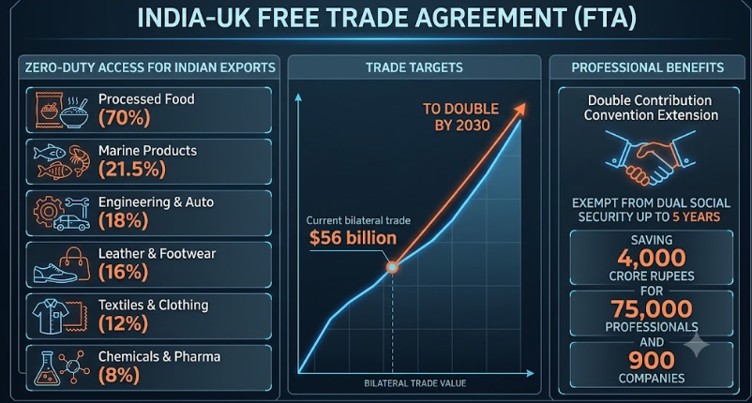
The India‑UK Comprehensive Economic and Trade Agreement (CETA) has come into force, giving 99% of India’s tariff lines duty‑free access to the UK.
Key Highlights of the Agreement
- Indian Exports – Nearly all Indian exports now enjoy zero‑duty access to the UK.
- British Cars – Import duty on fully built UK cars reduced from 110% to 10% over 10 years via a quota system.
- Petrol/diesel models get concessions immediately.
- EVs, hybrids, and hydrogen vehicles get preferential access only from year six.
- Trucks – Duty on fully built trucks cut from 44% to 8.8% by year 5 within quota; beyond quota, duty falls to 22% by year 10.
- Premium Spirits – Duty on Scotch whisky reduced from 150% to 75% immediately, then to 40% over 10 years.
- Gin follows a similar path.
- Other premium spirits duty falls from 150% → 110% (year one) → 75% (year ten).
- Consumer Goods – Tariff reductions on chocolates, biscuits, soft drinks, cosmetics, perfumes, soaps, shaving creams, nail polish, salmon, and lamb.
- Medical Devices – Lower tariffs on UK healthcare equipment (surgical instruments, diagnostic tools, ECG, and X‑ray systems).
- Silver – Import tariff on silver to be reduced to 0 over 10 years; UK expected to gain in silver and aerospace sectors.
- Luxury Goods – Tariff cuts on select British fashion and lifestyle products.
Strategic Significance
- Market Access – Duty‑free entry enhances India’s competitiveness in UK markets.
- Gradual Impact – Tariff cuts on British goods staggered over 5–10 years; consumer price impact will be gradual.
- Quality Standards – Indian exporters must meet the UK's stringent food safety, traceability, and certification norms.
- Global Trade Role – Strengthens India’s position in international trade partnerships.
Reference
Economic Times | Indi-UK FTA



