Prelims: Current events of national and international importance | Energy
Why in news?
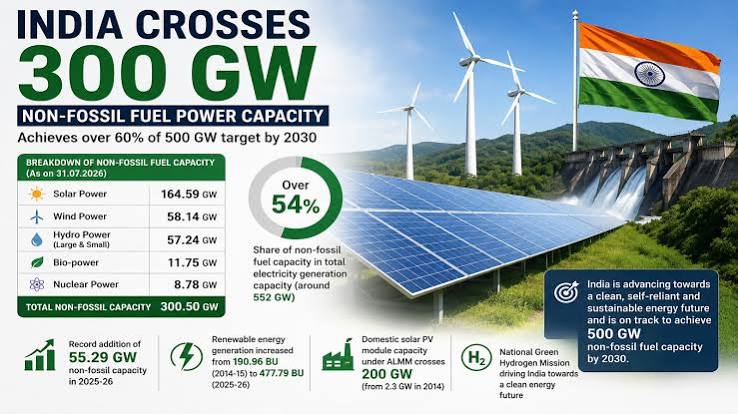
Recently, India crossed 300 GW of installed non-fossil fuel-powered electricity generation capacity.
- Achievement – India has crossed 300 gigawatts of installed non-fossil fuel-powered electricity generation capacity, with the addition of over 55 gigawatts during 2025-26.
- Target – India aims to achieve 500 GW of non-fossil fuel-based power capacity by 2030.
- To meet this target, the central government highlighted Solar and Wind energy as the major contributors in its vision of clean energy dependency.
- Growing need for energy storage – Projection by Central Electricity Authority (CEA): around 74 gigawatts of storage capacity by 2031-32 – Includes
- Around 27 gigawatts from Pumped Storage Projects (PSPs) and
- Over 47 gigawatts from Battery Energy Storage Systems (BESS).
- Government measures – In addition, the government has also taken a series of coordinated policy, regulatory, demand-side and supply-side measures to promote the development and deployment of PSPs.
- Some of the measures include policy clarity, fiscal support, streamlined clearances, competitive procurement and integrated grid planning.
- These measures have created an enabling environment for the accelerated development of Pumped Storage Projects.
- Significance of PSPs – PSPs can play a crucial role in meeting this long-duration storage requirement.
- They can also store electricity by pumping water to an upper reservoir during periods of surplus generation.
To know more about India’s Non-Fossil Fuel Power Capacity, click here
Reference
AIR | India Records 300 GW Non-Fossil Power Capacity



