Mains: GS II – Indian and its Neighborhood
Why in News?
Recently, the remarks by Nepal’s Prime Minister, have opened the possibility of a more pragmatic and constructive approach towards resolving long-standing differences.
What is the background of the boundary dispute?
- Main Disputed Area – The territorial dispute between India and Nepal primarily concerns the areas of Kalapani, Lipulekh, and Limpiyadhura located in the western sector of the India–Nepal border.
- Claims of Nepal – Nepal claims these territories based on its interpretation of the 1816 Treaty of Sugauli, arguing that the Kali River originates from Limpiyadhura and therefore the disputed territory lies east of the river.
- India’s Stand – India, on the other hand, maintains that the boundary follows the alignment inherited from British India in 1947 and that the disputed region forms an integral part of Uttarakhand.
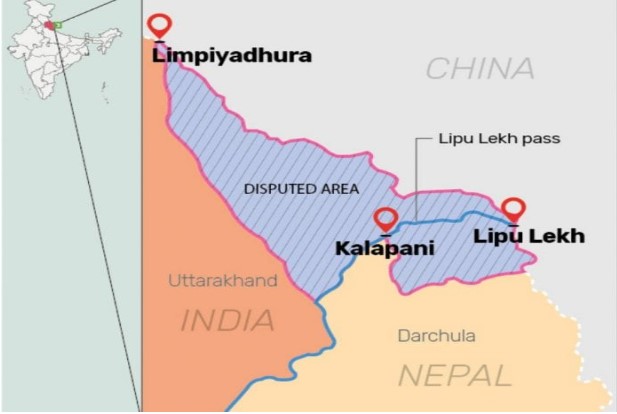
- The issue gained prominence in 2020 when Nepal published a new political map incorporating these territories and later included the map in its constitutional framework and currency notes.
- The dispute has since become a sensitive symbol of nationalism in Nepal and a matter of strategic importance for India due to the region’s proximity to the India-China border.
What are the recent irritants in bilateral relations?
- Objections over Lipulekh Trade Route – Nepal objected to the resumption of India-China trade through the Lipulekh Pass, arguing that the route passes through disputed territory.
- Kailash Mansarovar Yatra Route – Kathmandu raised concerns regarding the use of Lipulekh as a route for the Kailash Mansarovar pilgrimage, while India rejected Nepal’s territorial claims over the area.
- Diplomatic Protocol Issues – The postponement of high-level visits and Nepal’s reluctance to extend traditional diplomatic privileges to Indian officials were interpreted by some observers as signs of changing diplomatic attitudes.
Why the boundary issue cannot be ignored?
- National Sentiments – Territorial integrity is closely linked with national identity in both countries, making the issue politically sensitive.
- Strategic Considerations – The disputed region lies near the India-China border and possesses considerable geopolitical significance.
- Institutional Commitments – Nepal’s constitutional recognition of its territorial claims and India’s adherence to existing administrative boundaries make compromise difficult.
- Risk of Future Escalation – An unresolved dispute can periodically re-emerge and undermine broader cooperation in trade, connectivity, and regional integration.
- Therefore, while diplomacy should continue, indefinite discussions without tangible progress may eventually create frustration and mistrust.
What are the challenges in finding a permanent solution?
- Contradictory Historical Evidence – British-era maps and records are not always consistent. Advances in cartographic technology and differing interpretations have produced competing historical narratives.
- External Factors – Suggestions that China or the United Kingdom should be involved in the resolution process could complicate negotiations and delay outcomes.
- Domestic Political Pressures – Political leaders in both countries face nationalist pressures that limit flexibility in negotiations.
- Security Concerns – India views the region through the lens of national security, while Nepal emphasizes historical and legal claims.
- These factors make a conventional territorial settlement difficult.
What are the pathways towards a practical solution?
- Building on Historical Connectivity – The two countries have shared centuries of cultural, civilizational, and religious interactions. These ties should form the foundation of future engagement.
- Preserving the Open Border – The open border of more than 1,700 kilometres is a unique feature of bilateral relations and has facilitated movement, trade, and social integration for generations.
- Leveraging Military Cooperation – The long-standing trust between the Indian and Nepalese armies offers a valuable institutional framework for confidence-building measures.
- Strengthening Economic Integration – Enhanced cooperation in energy, hydropower, connectivity, tourism, and trade can create incentives for peaceful dispute resolution.
- Pursuing Joint Management Mechanisms – Innovative arrangements such as joint administration, coordinated development projects, or special border management frameworks may help reduce tensions while preserving national interests.
- Role of Political Leadership – History demonstrates that breakthroughs in bilateral relations often require visionary leadership. Former Indian Prime Minister Atal Bihari Vajpayee emphasized dialogue and mutual respect in dealing with Nepal.
- Similarly, contemporary leaders in both countries possess the political capital necessary to pursue bold and pragmatic solutions.
- Recent visits by Nepalese political leaders, including representatives of the ruling coalition, indicate a willingness to maintain high-level engagement with India.
- Such diplomatic interactions should be encouraged and institutionalized.
What are the ethical dimensions involved?
- Respect for Sovereignty and Territorial Integrity – Both India and Nepal have a moral obligation to respect each other's sovereignty and legitimate territorial concerns.
- Ethical diplomacy requires avoiding coercion, unilateral actions, or disregard for the concerns of a smaller neighbour.
- Trust and Good Faith in International Relations – Long-standing bilateral relations depend on honesty, transparency, and good-faith negotiations.
- Unilateral publication of maps or infrastructure development in disputed areas can weaken trust.
- Balancing National Interest with Regional Cooperation – Every government must protect national interests, but excessive nationalism can hinder peaceful solutions.
- Ethical leadership requires balancing patriotism with regional stability and collective welfare.
- Justice and Fairness – Both countries interpret historical documents differently.
- Ethical resolution demands impartial examination of historical evidence rather than selective use of facts.
- Responsibility Towards Border Communities – People living near the disputed region may face uncertainty regarding administration, development, and public services.
- Governments have a moral responsibility to ensure that citizens' welfare is not sacrificed for geopolitical rivalry.
- Peaceful Conflict Resolution – As friendly neighbours with deep cultural ties, both nations have an ethical duty to resolve disputes through dialogue rather than confrontation.
- Ethical Leadership and Political Courage – Political leaders often face domestic nationalist pressures.
- Ethical leadership requires taking difficult but constructive decisions that promote long-term peace rather than short-term political gains.
- Shared Cultural and Civilizational Responsibility – India and Nepal share deep religious, cultural, and people-to-people links.
- Ethical governance requires preserving these bonds and preventing territorial disagreements from damaging social harmony.
- Intergenerational Responsibility – Failure to resolve disputes may pass tensions to future generations.
- Leaders have an ethical duty to leave behind peaceful and cooperative regional relationships.
What lies ahead?
- While the boundary dispute remains complex and sensitive, both countries must ensure that it does not overshadow their extensive shared interests.
- A sustainable solution will require patience, mutual trust, political courage, and a willingness to move beyond narrow nationalist narratives.
- By prioritizing dialogue, economic cooperation, and people-centric engagement, India and Nepal can transform a potential source of conflict into an opportunity for deeper partnership.
- As neighbouring countries linked by geography, history, and culture, India and Nepal have far more to gain from cooperation than confrontation.
- The present moment provides an opportunity to build a more mature, balanced, and enlightened bilateral relationship that can serve as a model for regional cooperation in South Asia.
Reference
The Hindu| India-Nepal Relations



