Why in news?
India joined the elite critical minerals club, Mineral Security Partnership to secure critical mineral supply chains.
What is Minerals Security Partnership (MSP)?
- Minerals Security Partnership (MSP) is a US-led alliance of 14 developed countries launched in June 2022.
- The elite critical minerals club is also known as the ‘Critical Minerals Alliance’.
- It was set up to ensure that critical minerals are produced, processed and recycled in a way that it secures critical mineral supply chains.
- It also aims to weaken China's grip on supplies of critical minerals worldwide.
- Members - The US, Australia, Canada, Finland, France, Germany, Japan, the Republic of Korea, Sweden, UK, the European Commission, Italy and India.
- India is the only developing country to become a part of the MSP.
India’s status of critical minerals?
- India is endowed with and produces over 85 minerals.
- Some of the required critical mineral assets are not yet ready to be mined.
- India is dependent on China and other countries to meet its requirement of critical minerals including Rare Earth Elements (REE)
- Currently, Khanij Bidesh India Ltd. (KABIL), is taking charge of ensuring mineral security through facilitating supply chains, mine asset acquisitions, and G2G collaborations.
- Click here to know about Status of Critical Minerals in India
What does MSP mean to India?
- India is the first major developing country to join the group, giving it a greater international balance.
- Knowledge sharing - MSP membership will help India engage with countries using advanced exploration and extraction technologies and learning from their experience.
Only about 10-20% of India’s critical minerals has been explored.
- It will encourage India to make better use of its great geological potential.
- Strengthening India - MSP and the critical mineral list could ensure India in ensuring self-reliance and addressing vulnerability in the supply chain of minerals.
- Getting into alliances like MSP, along with policy initiatives like critical minerals list is so crucial for India’s energy security.
- Help in India’s ambitious shift towards e-vehicles and its associated battery requirements.
- India’s late attempts to enter the lithium value chain as India found large reserves of Lithium.
- China’s dominance - China produces 60% of the world’s rare earth elements.
- It has also become a dominant player in refining and processing critical minerals that it does not produce.
- It should enhance efforts for supply chain security, at the time of China’s dominance over mining, processing, and refining of many key critical minerals.
What should India do further?
- Critical Mineral List - Individual countries identified critical minerals according to their national priorities and future requirements.
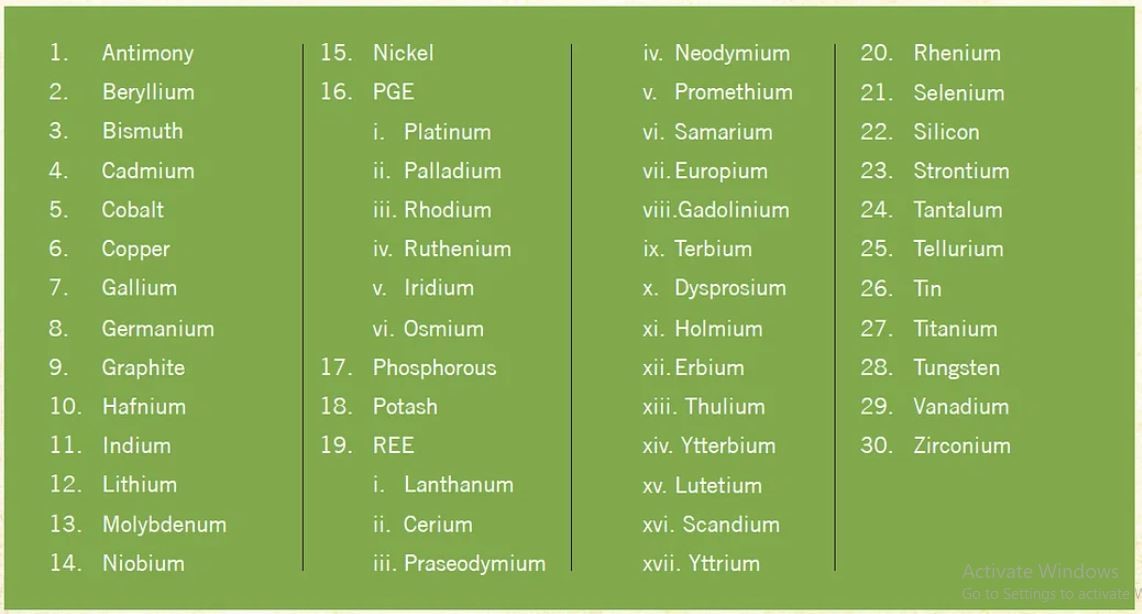
- India came up with such a list of 30 critical minerals that it considers essential for its economic development and national security.
- The list is based on the ‘Report of the Committee on Identification of Critical Minerals’ constituted by the Ministry of Mines.
- Specialised agency - The committee also called for a need for establishing a National Institute or Centre of Excellence on critical minerals.
- Partnerships - India needs to go beyond MSP and build critical mineral partnerships with key countries such as Japan, the US and Australia.
- India already entered into a partnership with Australia, jointly investing in 5 critical minerals exploration projects in Australia.
Australia produces almost half of the world’s lithium, is the second-largest producer of cobalt and the fourth-largest producer of rare earths elements.
- Utilise geological potential - India needs to double down on prospecting and exploration efforts to find critical minerals in India.
- Private players - India should encourage private sector participation in exploration of minerals.
Quick Facts
Critical minerals - A critical mineral is a metallic or non-metallic element that is essential for the functioning of our modern technologies, economies or national security and there is a risk that its supply chains could be disrupted.
Rare earth minerals – Rare earth minerals comprises 17 elements which are classified as light RE elements (LREE) and heavy RE elements (HREE).
Critical Mineral List (30)
References
- The Print - How MSP can help India harness critical minerals potential
- IE - India joins US-led critical mineral club
- Business Standard - Minerals Security Partnership: why is it important?



