Mains: GS II – International Relations
Why in News?
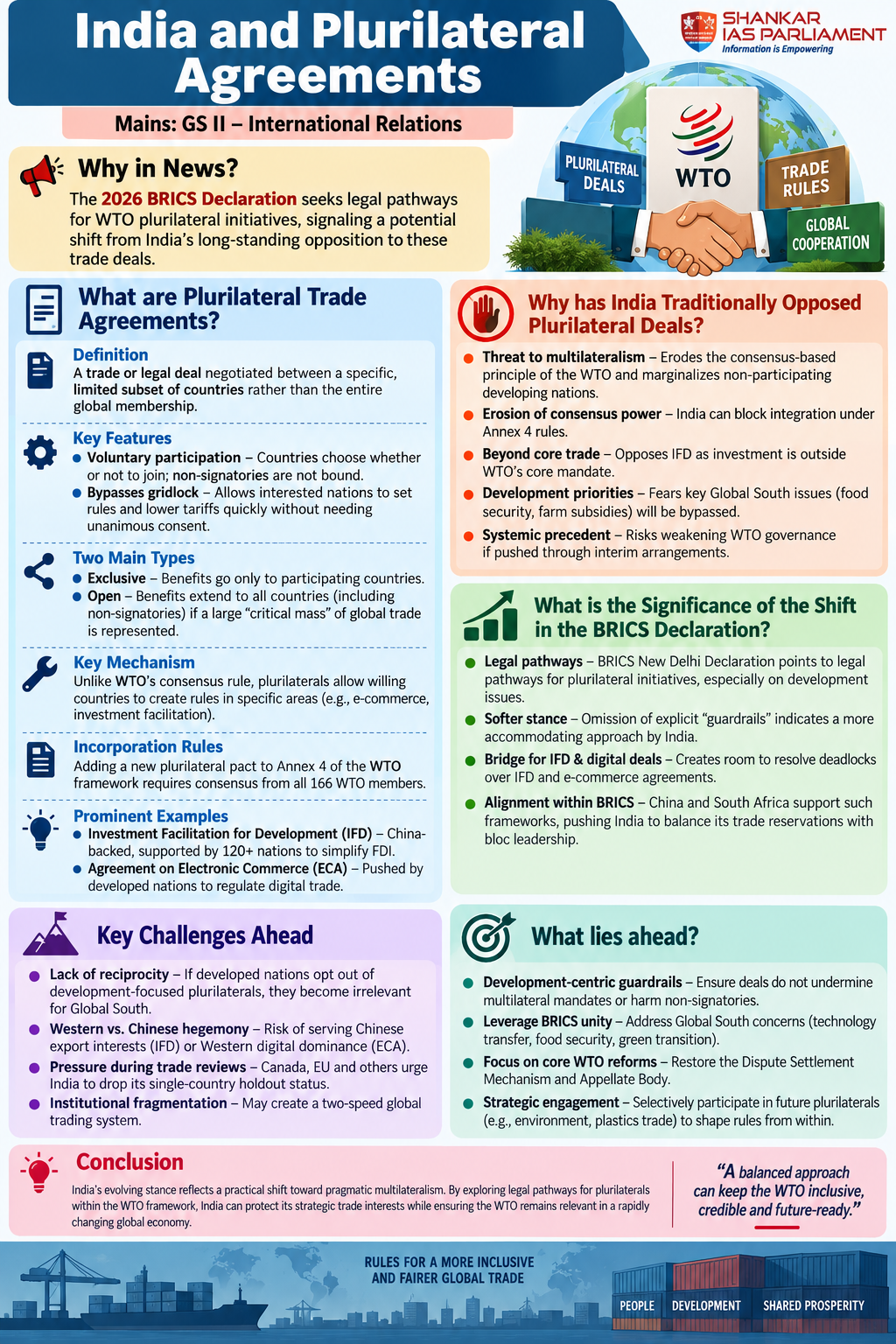
The 2026 BRICS Declaration seeks legal pathways for WTO plurilateral initiatives, signaling a potential shift from India's long-standing opposition to these trade deals.
What are Plurilateral Trade Agreements?
- Definition – A plurilateral agreement is a trade or legal deal negotiated between a specific, limited subset of countries rather than the entire global membership.
- Key Features
- Voluntary Participation – Countries choose whether or not to join; non-signatories are not bound by the rules.
- Bypasses Gridlock – Allows interested nations to set rules and lower tariffs quickly without needing unanimous consent from large organizations like the World Trade Organization (WTO).
- Two Main Types –
- Exclusive – Benefits go only to the participating countries.
- Open – Benefits extend to all countries (including non-signatories) if a large enough "critical mass" of global trade is represented
- Key Mechanisms – Unlike multilateral agreements requiring consensus across all 166 WTO members, plurilaterals allow willing countries to create rules in specific areas (e.g., e-commerce, investment facilitation).
- Incorporation Rules – Under the Marrakesh Agreement, adding a new plurilateral pact to Annex 4 of the WTO framework strictly requires consensus from all WTO members.
- Prominent Examples –
- Investment Facilitation for Development (IFD) – A China-backed initiative supported by over 120 nations aimed at simplifying foreign direct investment.
- Agreement on Electronic Commerce (ECA) – A plurilateral deal pushed primarily by developed nations to regulate digital trade.
Why has India Traditionally Opposed Plurilateral Deals?
- Threat to Multilateralism – India argues that permitting exclusive groups to set rules erodes the foundational, consensus-based principle of the WTO and marginalizes non-participating developing nations.
- Erosion of Consensus Power – Under Annex 4 rules, a single country can block the integration of a plurilateral agreement. India has used this tool to preserve developing-country safeguards.
- Beyond Core Trade – India opposes agreements like the IFD on the grounds that investment regulations fall outside the WTO’s core mandate of trade in goods and services.
- Development Priorities – India fears that key issues affecting the Global South (e.g., public stockholding for food security, farm subsidies) will be bypassed if developed nations focus exclusively on plurilateral priority areas.
- Systemic Precedent – Pushing plurilaterals through "interim arrangements" without full consensus risks weakening WTO governance structures.
What is the Significance of the Shift in the BRICS Declaration?
- Legal Pathways – The BRICS New Delhi Declaration specifically points toward establishing legal pathways for plurilateral initiatives, particularly on development-oriented issues.
- Legal Guardrails – At the WTO MC14 in Cameroon, India advocated for strict legal "guardrails" before accepting plurilateral arrangements.
- The omission of explicit "guardrails" wording in the BRICS text indicates a softer, more accommodating stance.
- Bridge for IFD (Investment Facilitation for Development) and Digital Deals – The shift creates room for resolving deadlocks over the IFD pact and electronic commerce agreements.
- Alignment within BRICS – Major BRICS economies (such as China and South Africa) support specific plurilateral frameworks, pushing India to balance its domestic trade reservations with its leadership of the bloc.
What Are the Key Challenges Facing This Shift?
- Lack of Reciprocity on Core Issues – If developed nations opt out of development-focused plurilaterals (e.g., agriculture or food security), the agreements become irrelevant for developing countries.
- Western vs. Chinese Hegemony – India risks backing agreements that primarily serve Chinese export/investment interests (IFD) or Western digital dominance (ECA).
- Pressure during Trade Reviews – Members like Canada, the EU, and several Global South nations have put pressure on India during WTO Trade Policy Reviews to drop its single-country holdout status.
- Institutional Fragmentation – Creating multi-tiered WTO rules through fragmented deals risks creating a two-speed global trading system.
What lies ahead?
- Development-Centric Guardrails – Establish clear, binding criteria ensuring that plurilateral deals cannot undermine existing multilateral mandates or harm non-signatories.
- Leverage BRICS Unity – Use the BRICS consensus to ensure that any negotiated "pathway" directly addresses Global South concerns like technology transfer, food security, and green transition support.
- Focus on Core WTO Reforms – Prioritize the restoration of the WTO Dispute Settlement Mechanism and Appellate Body alongside any structural rule-making changes.
- Strategic Engagement – Selectively participate in forward-looking plurilateral negotiations (such as environment and plastics trade) to help shape rules from within rather than remaining an outside holdout.
Conclusion
- India's evolving stance reflects a practical shift toward pragmatic multilateralism.
- By exploring legal pathways for plurilaterals within the WTO legal framework, India can protect its strategic trade interests while ensuring the WTO remains relevant in a rapidly changing global economy.
Reference
Indian Express | Plurilateral Agreements



