What is the issue?
Despite DCGI granting Emergency Use Authorisation (EUA) for two vaccines, uncertainty in vaccine availability remains because of the government’s indecision in granting indemnity.
What is a EUA?
- It is a mechanism to facilitate the availability and use of medical countermeasures (like vaccines), during public health emergencies.
- It allows the use of unapproved medical products in an emergency to diagnose, treat, or prevent serious or life-threatening diseases or conditions when certain statutory criteria have been met
What is the status of India’s vaccine program?
- Drugs Controller General of India granted EUA to COVID-19 vaccines manufactured by Moderna and by Johnson & Johnson.
- In addition, India has an opportunity to receive about 10 crore doses of Pfizer-BioNTech’s mRNA-based vaccine by the end of 2021.
- Yet, only 11% of the population has been fully vaccinated and 35.5% has received a single dose.
- Major reason for the underperformance is the insufficient supply of vaccines, which in turn is due to the demand from the manufacturers to grant indemnity.
What is indemnity?
- Vaccines are given EUA after a thorough review of their safety.
- However, there can be rare and serious Adverse Events Following Immunisation (AEFI) like vaccine-induced immune thrombotic thrombocytopenia and Myocarditis.
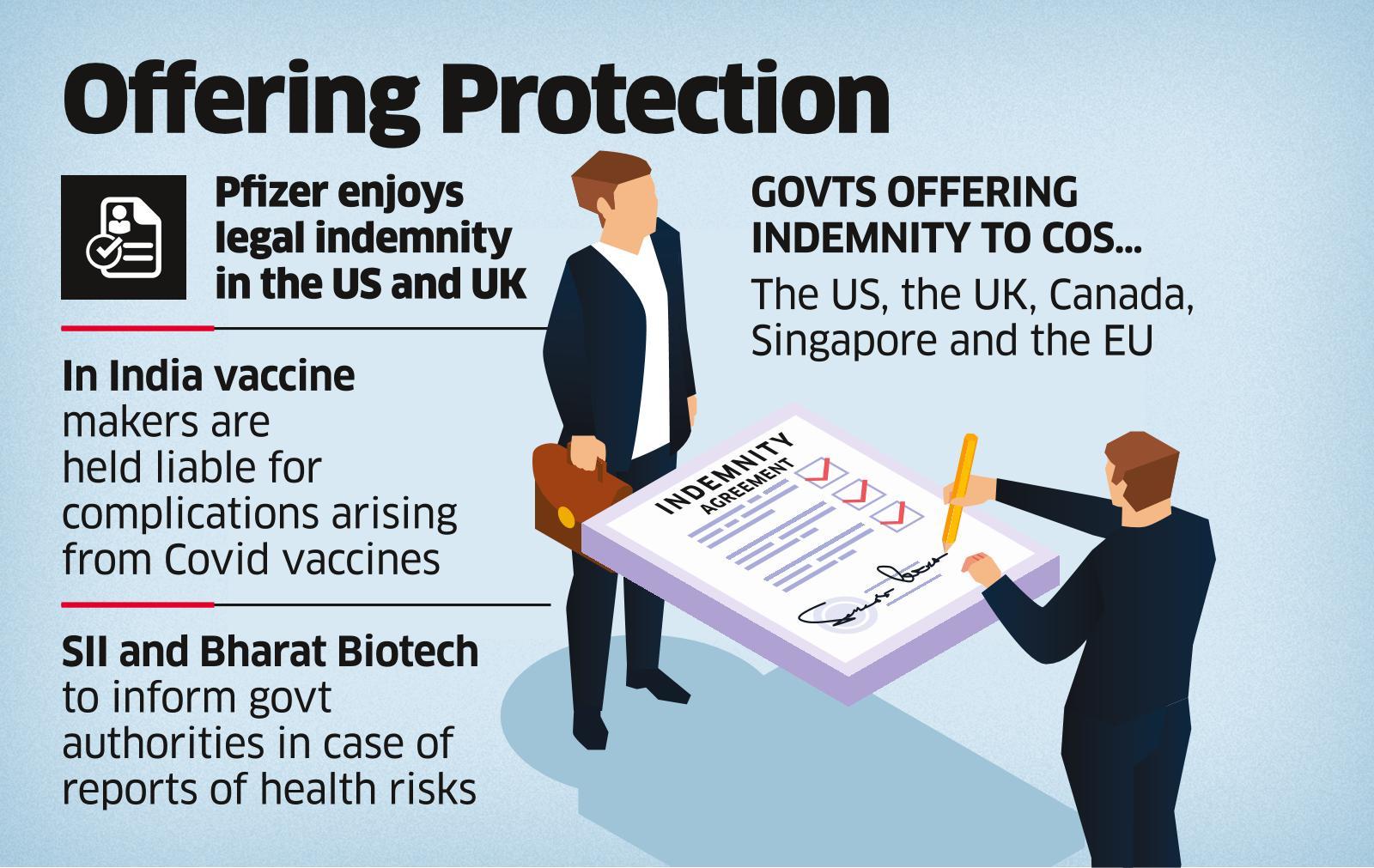
- Grant of indemnity by the government means that the manufactures cannot be sued in those countries by people who may experience AEFIs.
- However, it does not always mean beneficiaries cannot seek compensation for adverse events at all.
- But the bar to seek compensation is very high.
What is the International Practice?
- U.S - Pfizer and Moderna were granted immunity from liability.
- This protects them, until 2024, from lawsuits arising out of any foreseen and unintentional medical complications as a result of vaccination.
- WHO - In February, the WHO started a “No-Fault compensation program” for 92 low- and middle-income countries.
- This is the only global vaccine injury compensation mechanism and is funded by a small levy on each dose supported by the Gavi COVAX Advance Market Commitment.
- It is available for rare but serious adverse events associated with COVAX-distributed vaccines until June 2022.
What is the situation in India?
- The manufacturers of the three vaccines currently being administered in India (Covishield, Covaxin, and Sputnik V) have not been granted indemnity.
- Pfizer and Moderna have supplied their Covid-19 vaccines only to the countries that granted indemnities.
Why is the government hesitant on granting indemnity?
- Accountability - Indian regulations provide for compensation in case of injury or death of a trial subject.
- The idea is to hold the manufacturers accountable.
- Additional Burden - The legal responsibility for any vaccine-related injury in India lies with the manufacturers.
- Therefore, if manufacturers are granted indemnity, this would mean the Government has to provide compensation.
- Misuse - Indemnity might be misused as blanket protection for deliberate acts, fraud or instances of negligence.
- Demand - If some foreign manufacturers are granted indemnity, then manufacturers of the vaccines currently in use are likely to demand similar protections.
What are the existing safety mechanisms?
- Even if indemnity is granted, India has several safety mechanisms.
- DCGI is empowered to take action against companies violating the Drugs and Cosmetics Act, 1940.
- Any individual seeking compensation may directly file petitions before consumer courts and High Courts.
- Recent amendments to the Consumer Protection Act, 1986 disallow individuals but permit the regulatory bodies to initiate class action suits based on complaints.
Class action suits - cases representing groups of people who have suffered from the same loss
What should the government do?
- Examine initiatives such as America’s Countermeasures Injury Compensation Program in granting indemnity.
- Institutionalize legal safeguards from vaccine injuries supplemented by government funding.
- Utilize this opportunity to reduce vaccine ‘licensing to availability gap’ and to increase the vaccine availability
Source : The Hindu



