Why in news?
Foreign ministers from member countries of the Association of Southeast Asian Nations (ASEAN) have planned a meeting to discuss on Myanmar crisis, months after agreeing a peace plan with its military rulers.
How did the power siege happened in Myanmar?
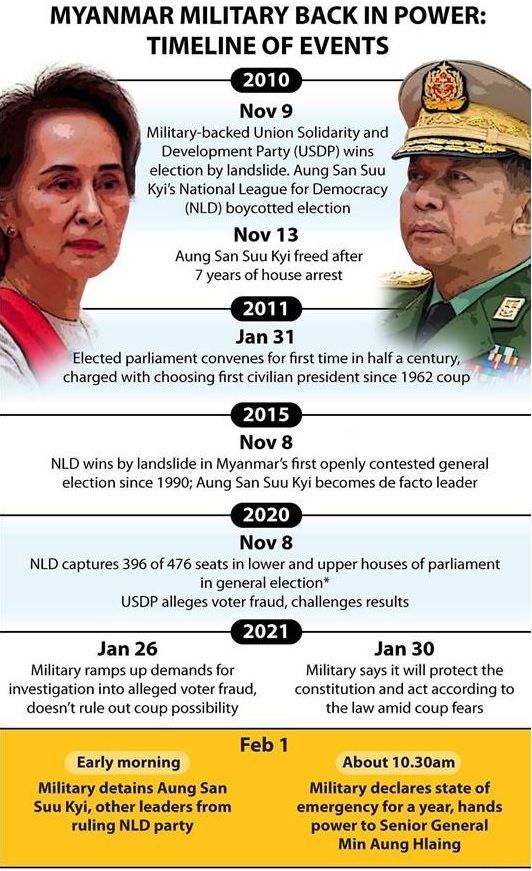
- The military had a tight grip on Myanmar as the constitution guarantees it a quarter of all seats in parliament and control of its most powerful ministries.
- In the last general election, military-backed party (USDP) performed poorly whereas the National League for Democracy (NLD) did even better than in 2015.
- This created tensions between the armed forces and the government.
- The opposition raised allegations of widespread fraud in the election which was not backed by the electoral commission.
- Later, Myanmar's military seized power after detaining Aung San Suu Kyi and other democratically elected leaders.
What about the follow up of the power siege?
- The junta has unleashed a reign of terror claiming thousands of lives.
- In cities, protests turned into armed fighting between pro-democracy protesters and security personnel, while in the jungles, anti-junta groups joined hands with rebels for military training.
- The situation was so grave that the UN Special Envoy warned that Myanmar had descended into a civil war.
- Twenty months on, the junta has not been able to establish full control over the country.
- Many of Myanmar’s ethnic armed organisations have joined armed civilian groups called People’s Defence Force (PDF), which are allied to the self-declared National Unity Government (NUG) in exile.
- In Rakhine State, the military is fighting the Arakkan Army, with the violence sometimes spilling over to Bangladesh.
- Aung San Suu Kyi, who was jailed after the coup, has been convicted in multiple cases and sentenced to 20 years.
What is the effect on India?
- India-Myanmar - India has a 1,643 km border with Myanmar stretching from the India-Myanmar-China trijunction in Arunachal Pradesh to the India-Myanmar-Bangladesh trijunction in Mizoram.
- Border regulations have been formulated keeping in view the ethnic and family ties across the international boundary.
- Under a Free Movement Regime (FMR), citizens of the two countries living within 16 km on their sides of the border can cross over with a permit and stay up to 2 weeks at a time.
- Fallout in India - India has walked a fine line between expressing concern at the interruption of democracy and engaging with the junta to protect its vital interests.
- Security - New Delhi’s justification for engaging with the Myanmar military is that it ensures the security of India’s Northeast by persuading the generals to deny safe havens to insurgent groups.
- Refugee influx - For India, the main concern is the influx of refugees into Mizoram, which is straining the state’s resources.
- Effect on Indian projects - The coup and resultant unrest have arrested Indian projects in Myanmar, such as the trilateral highway to Thailand and the Kaladan waterway project.
- These projects were already well behind their deadlines and their completion looks farther away now.
India is not a signatory to the 1951 United Nations Refugee Convention or its 1962 Protocol and does not have a domestic policy on refugees.
What is the role of ASEAN in this aspect?
- ASEAN’s peace effort is the only official diplomatic process in play, but the junta is unwilling to implement a so-called “five-point consensus” that it agreed to with ASEAN in 2021.
- The agreement includes
- An immediate end to violence in the country
- Dialogue among all parties
- Appointment of a special envoy
- Humanitarian assistance by ASEAN
- Special envoy’s visit to Myanmar to meet with all parties
- The United Nations has backed the ASEAN plan, but there is a suspicion that the generals are buying time to consolidate power and crush opponents before a 2023 election.
How has the junta responded?
- The military government has accused critical ASEAN members of meddling and warned them not to engage with the NUG.
- It has accused its opponents of trying to sabotage the ASEAN plan and has justified military offensives as necessary to secure the country and enable political talks.
- Instead of advocating for the five-point ASEAN plan, the generals have been pushing a five-step roadmap of their own towards a new election, with few similarities.
What approaches might ASEAN take?
- Suspending Myanmar as an ASEAN member would be extremely unlikely, as would any trade sanctions
- The junta has demonstrated it will not respond to threats.
- Modifying the plan could be interpreted as concessions to the military.
- ASEAN has so far opted to bar the generals from key summits and invited non-political representatives instead, which the junta has declined.
References
- The Indian Express│The violent chaos in Myanmar
- The Indian Express│ASEAN holding a special meeting on Myanmar
- Human Rights Watch│ASEAN’s Failed ‘5-Point Consensus’
Quick facts
ASEAN
- The Association of Southeast Asian Nations (ASEAN) was established in 1967 in Bangkok, Thailand.
- It came in with the signing of the ASEAN Declaration (Bangkok Declaration) by the founding members: Indonesia, Malaysia, Philippines, Singapore and Thailand.
- Brunei Darussalam, Vietnam, Lao PDR, Myanmar and Cambodia joined in the course of time.



