Why in news?
The recent edition of World Economic Outlook (half yearly report) has been published by International Monetary Fund (IMF).
What has the report projected?
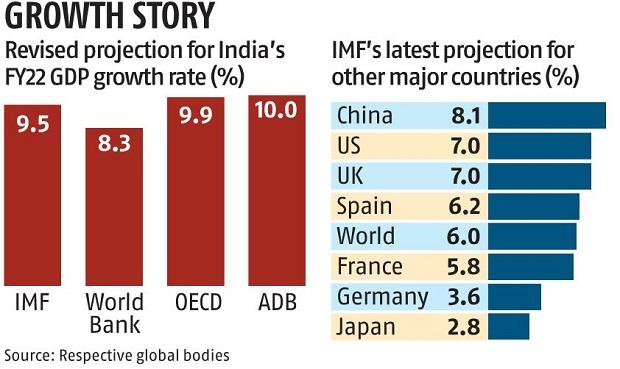
- For India, the Fund has lowered the real GDP growth rate for 2021-22 to 9.5% from the earlier 12.5%.
- Its forecast for 2022-23 was 6.9% earlier and has been upgraded to 8.5%.
- For India, the medium-range forecasts is up to 2026-27.
- The report has cited that the global economic recovery momentum had weakened due to the pandemic-induced supply disruptions.
- The dangerous divergence in economic prospects which is due to large disparities in vaccine access, and differences in policy support remains a major concern.
- The IMF has become relatively more pessimistic on the Indian rupee versus US dollar (USD) in October.
- It has also noted that the employment growth likely to lag the output recovery
What explains the IMF’s turn for pessimism on the Indian rupee?
- The IMF sees the rupee depreciating from Rs.70.9 to Rs.89.4 in 2020-21 against the US dollar by 2026-27.
- In April, the implied exchange rate forecast for 2026-27 was Rs.85.8.
- So, the US dollar is stronger by 4.2% at the end of 2026-27 as per the October 2021 forecast.
- This will lower India’s nominal GDP in USD terms in 2026-27 to $140 billion.
Why recovery in employment may lag the recovery in GDP?
- Employment around the world remains below its pre-pandemic levels due to
- Reflecting a mix of negative output gaps
- Worker fears of on-the-job infection in contact-intensive occupations,
- Childcare constraints
- Labor demand changes as automation picks up in some sectors
- Frictions in job searches and matching
- The employment lag output growth in India might be due to the already existing massive unemployment crisis and informal or unorganised sectors
- The gap between recovery in output and employment is likely to be larger in emerging markets and developing economies than in advanced economies.
- Also young and low-skilled workers are likely to be worse off than prime-age and high-skilled workers, respectively.
What does the IMF call for?
- The top priority is to vaccinate at least 40% of the population of every country by the year-end and 70% by the middle of next year.
- The IMF called for stronger commitments at the United Nations COP26 in Glasgow and said advanced economies needed to deliver on their $100-billion-per-year international climate finance pledge to developing countries.
- It has asked the Group of Twenty (G20) to speed up the restructuring of unsustainable debt of poorer countries.
- The IMF has earlier cited that there’s still room for the Government of India to provide more support without disturbing the fiscal deficit.
- There need to be a credible medium-term strategy for India to reduce the debt-to-GDP ratio to make room for future development and infrastructure needs.
References
- https://www.livemint.com/opinion/columns/what-explains-the-imf-s-turn-for-pessimism-on-the-indian-rupee-11636390299345.html
- https://indianexpress.com/article/explained/imf-world-economic-outlook-employment-growth-7580706/
- https://www.thehindu.com/business/imf-pegs-india-growth-at-95-urges-lower-debt-to-gdp-ratio/article36973976.ece



