Why in news?
India Meteorological Department (IMD) has recently released its annual summer forecast.
What are the key aspects?
- Summer - ‘Normal’ temperatures refer to the mean temperatures during a particular period (months) between 1981 and 2010.
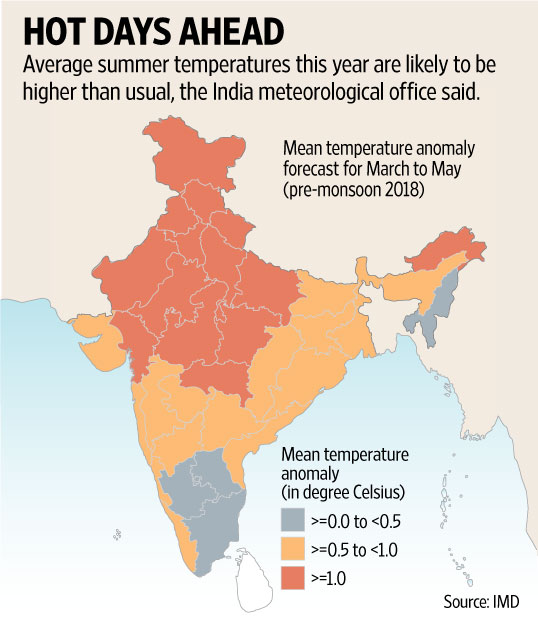
- IMD has forecasted a “warmer” than normal summer months from March-May.
- Heat Waves - The IMD’s climate summary in January said that 2017 was the “fourth warmest year on record since 1901”.
- Several parts of India, from Palakkad in Kerala to Mumbai, reported heat wave conditions.
- They recorded day time temperatures greater than 35°C.
- Increasing trends in the frequency and duration of heat waves over the country is also indicated.
- This is attributed to increasing trends in the greenhouse gases emission.
- The warming of the sea surface temperatures over the equatorial Indian and Pacific oceans is also a reason.
- Regions - A harsh summer is awaiting certain states, with mean seasonal temperature-spikes likely to be greater than 1 °C.
- These are J&K, Punjab, HP, west and east Rajasthan, Uttarakhand, west and east UP, west and east MP, Vidarbha, Gujarat and Arunachal Pradesh.
- Certain parts would witness temperature rise between 0.5°C and 1°C from their historical normal.
- These include Tamil Nadu, south interior Karnataka and Rayalaseema.
- La Nina - La Nina is a weather condition that generally brings heavy rains to India.
- Currently, the sea surface temperature conditions over equatorial Pacific suggest moderate La Nina conditions.
- The IMD forecast indicates that La Nina conditions are likely to be moderate till spring (May-end).
- They are likely to start weakening after spring.
- But even if La Nina weakens, it is sure that El Nino (which negatively effects monsoon) will not immediately develop.
- Given these, the prospects of a normal monsoon are more.
- However forecasts before spring are prone to error, with better accuracy after May.
Why is the forecast significant?
- A scientific estimate of annual mortality attributable to heat waves between 2010 and 2015 ranges between 1,300 and 2,500.
- For many States, the summer of 2018 may pose a public health challenge.
- Even a marginal rise above the normal may lead to enormous heat stress for millions of Indians, given the deprived conditions of life.
- A heat event can lead to fatal heat stroke in some, and exhaustion, cramps and fainting in many.
- Moreover, there are distinct groups at particular risk for health-related problems during a heat wave.
- These include senior citizens and people with pre-existing disease, mental illness or disability.
What does it call for?
- The IMD's forecast is a timely alert for State authorities to review their summer preparedness.
- Interventions - States must facilitate for community-level interventions.
- This is to deal with heat stress and particularly to help the vulnerable groups.
- All stakeholders, including the health-care system, should be prepared to deal with the phenomenon.
- Alerts - The World Health Organisation recommends that countries adopt heat-health warning systems.
- This includes daily alerts on weather conditions.
- This could ensure that people are in a position to deal with adverse weather, starting with reduction of exposure.
- Water stress- Water stress is a common and often chronic feature in many States.
- Arrangements should be made by the State authorities to meet possible water scarcity.
- GHG - The average temperature caused by climate change and the frequency and intensity of extreme weather events are perceivably linked.
- Thus, taking a long-term view, India has to pursue mitigation of greenhouse gases.
Source: The Hindu
Quick Fact
La Nina
- La Nina is associated with the cooling of the eastern equatorial Pacific Ocean.
- It favourably impacts the four-month long (June to September) south-west monsoon in India.
- This is particularly critical to the rain-fed farming season which begins in June.



