0.1045
7667766266
x

Human Evolution – Tree Climbing to Habitual Bipedalism

iasparliament Logo
September 24, 2026

Prelims: Current events of national and international importance | Science & Technology

Why in News?

A new study provides evidence that archaic humans had largely shifted from regular tree climbing to habitual upright walking on the ground.

Key Finding
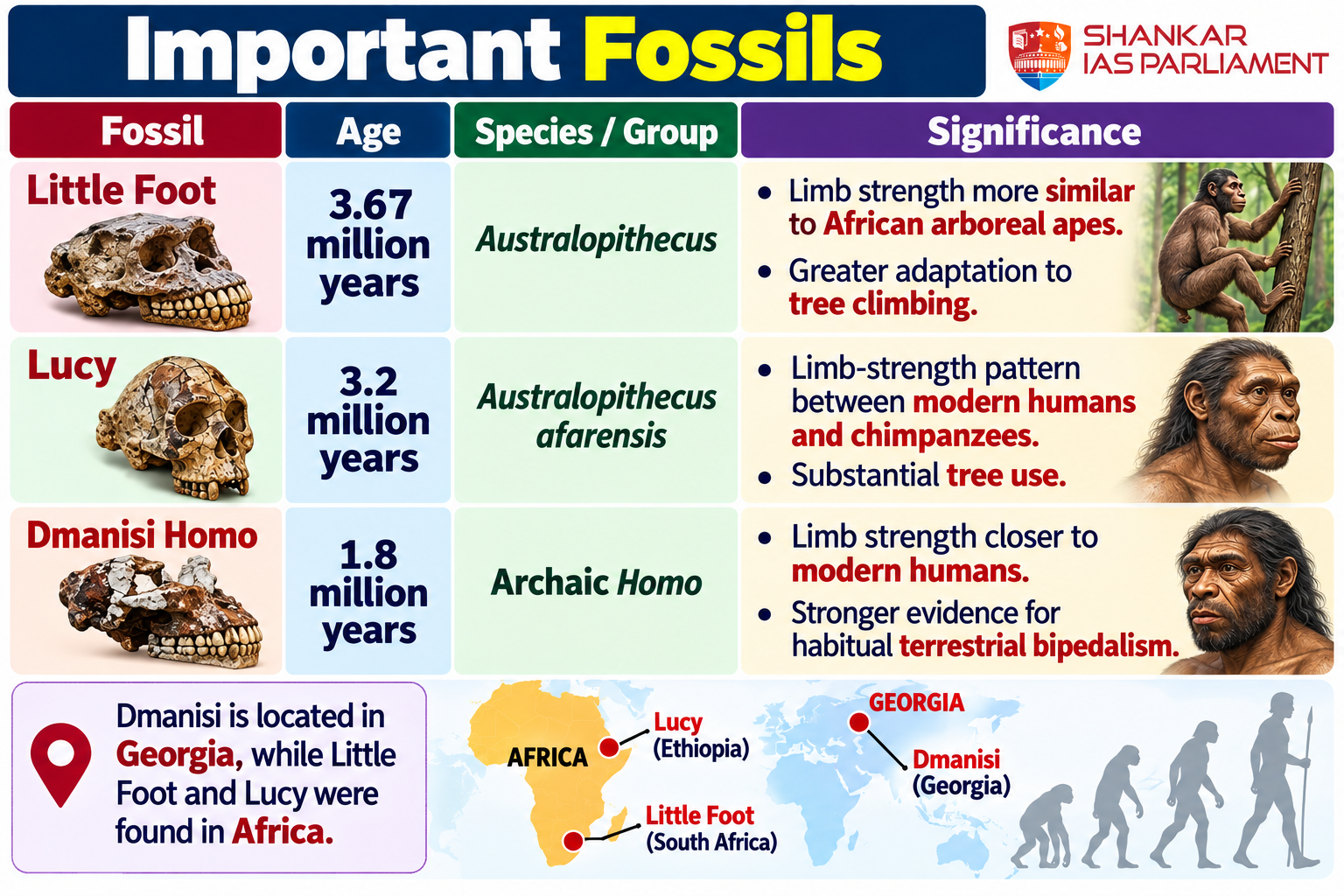
  • Major evolutionary transition – Arboreal lifestyle to Terrestrial bipedalism
  • Approximate period – 1.8 million years ago
  • Evidence used – Internal strength of limb bones
  • Fossils studied – Little Foot and Dmanisi Homo
  • Researchers – University of the Witwatersrand + University of Southern California

human evolution - fossil studies

  • Methods Used by Scientists to Determine Findings
    • Previous research primarily analyzed the morphology and proportions of fossilized limbs.
    • The recent study concentrated on assessing the internal structural strength of bone shafts.
  • Analytical Framework – Bone strength reflects the physical loads experienced, which in turn inform interpretations of locomotor behavior and habitat utilization.
    • Increased forelimb loading indicates greater use of the arms, including activities such as tree climbing.
    • Stronger adaptation of the lower limbs suggests a greater reliance on terrestrial locomotion.
  • Researchers compared the strength ratios of fossil limb bones with those observed in the following extant species:
    • Modern humans
    • Chimpanzees
    • Gorillas
    • Orangutans

Reference

The Hindu | Human Evolution

There are no reviews yet. Be the first one to review.

ARCHIVES

sidetext


