Prelims: Current events of national and international importance | Species
Why in News?
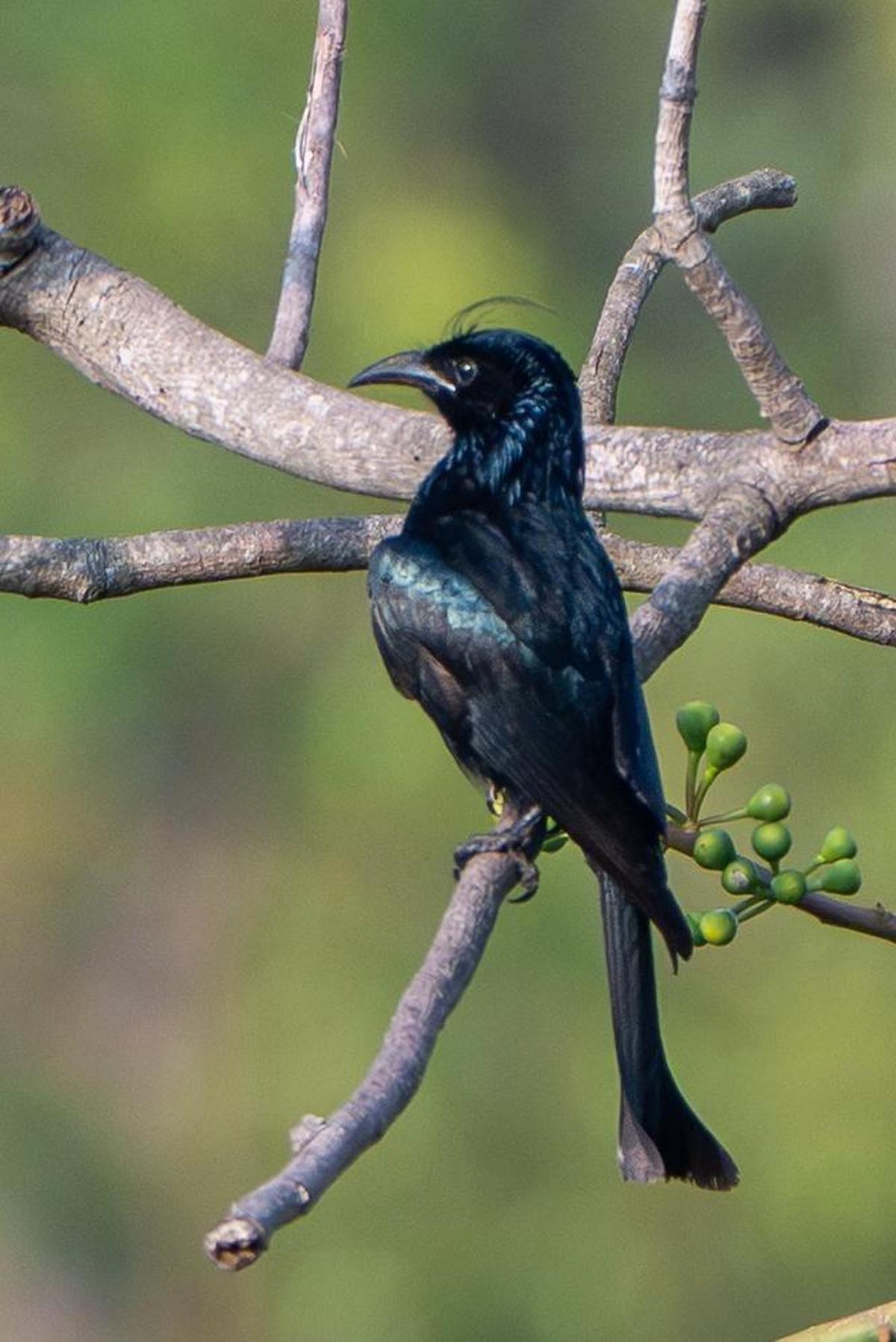
Recently, a hair-crested drongo was sighted for the first time at the foothills of Manjamalai near Palamedu in Madurai district, Tamil Nadu.
Scientific name – Dicrurus hottentottus
Family – Dicruridae (Drongos)
Habitat – It is a terrestrial landbird that inhabits broadleaf evergreen and moist deciduous forests.
It also exhibitsforest edges, secondary growth, thick scrub, degraded forests and plantations.
Distribution – Very large range across India, South & Southeast Asia, such as India, Nepal, Bhutan, Bangladesh, Myanmar, Thailand, China, Cambodia, Laos, Vietnam, Malaysia, Indonesia, Philippines, Brunei.
Indian Range – Peninsular India (Western & Eastern Ghats, northern Tamil Nadu), Himalayan foothills, Northeast India.
Characteristics – Colour – Glossy black body with metallic blue/green spangles.
Tail – Unlike other drongos, its tail is rectangular/lyre-shaped with upward curls, rather than deeply forked.
Diet – Omnivorous; primarily feeds on insects (often caught in flight) and nectar.
Conservation Status –
IUCN Red List – Least Concern.
Wildlife (Protection) Act, 1972 – Schedule II
Behaviour – It is partially migratory within India.
Known for being highly vocal and a brilliant mimic.
Theyoften move in small flocks or follow other species to catch insects disturbed by them.
Uniqueness – Hair-like crest feathers on the forehead and deeply forked tail make it easily distinguishable.
Threats – Forest loss due to logging, agriculture, mining and road construction, habitat degradation, and trapping for the songbird trade.
Ecological Significance – Pollinator – Visits flowers for nectar, aiding in pollination.
Biological pest controller – Feeds on insects, helping control agricultural and forest pests naturally.