Prelims: Current events of National and International Importance | Science and Technology
Why is in news?
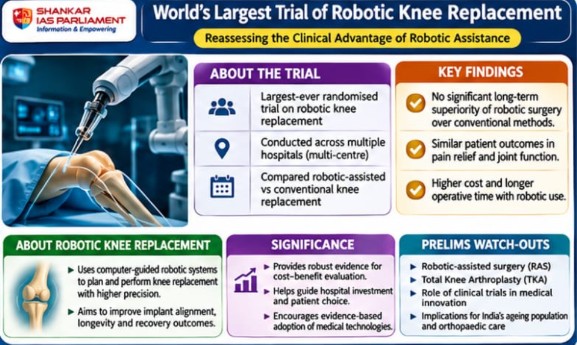
The RACER-Knee trial, coordinated by the University of Warwick and University Hospitals Coventry and Warwickshire NHS Trust, found that robot-assisted knee replacement offered greater surgical precision but did not produce meaningful improvements in pain, mobility or recovery compared with conventional surgery after one year.
The findings were published in The Lancet.
About the RACER-Knee trial
- It is the world’s largest double-blinded, randomized controlled trial comparing conventional total knee replacement with robot-assisted surgery using the Stryker Mako robotic system.
- The UK-wide study involved 339 patients, 33 surgeons and 10 hospitals.
- The trial compared patient-reported outcomes and clinical measures after robotic-assisted and conventional total knee replacement.
Key findings
- At 12 months, both groups showed comparable levels of pain relief, mobility and recovery.
- There was no meaningful difference in the primary outcome measure, the Forgotten Joint Score, which assesses how much a patient is conscious of an artificial joint during everyday activities.
- Other outcomes—including walking ability, pain during hospitalisation and recovery, and likelihood of another operation—were also comparable.
- Robotic assistance improved the precision with which surgeons could position instruments and make bone cuts, but this technical advantage did not translate into better patient outcomes during the first year.
- No increased risk of serious adverse events was found in the robotic-assisted group.
How does robotic knee replacement work?
- Total knee replacement is a surgical procedure in which damaged joint surfaces are replaced with artificial components, commonly to treat severe knee arthritis.
- In conventional surgery, the orthopaedic surgeon uses standard instruments and clinical experience to position the artificial joint.
- In robotic-assisted surgery, the surgeon controls a robotic arm that helps guide instruments and allows greater accuracy in the angles and depth of bone cuts.
- The technology can help tailor the procedure to an individual patient’s anatomy; the robot assists the surgeon and does not independently perform the operation.
Cost and limitations
- Robotic-assisted operations took, on average, 10.5 minutes longer and cost approximately £950 more per procedure in the trial.
- At prevailing NHS spending thresholds, the technology was not considered cost-effective during the first year after surgery.
- Researchers will monitor participants for ten years to examine whether longer-term differences emerge, including whether robotic assistance reduces the need for revision surgery.
Significance
- The study highlights the distinction between technological precision and meaningful patient-centred outcomes.
- It underlines the importance of evidence-based adoption of medical technologies, health-technology assessment and cost-effectiveness before large-scale public procurement.
- It does not rule out future benefits; better personalisation and further research may help convert precision into improved recovery and mobility.
Reference
The Hindu | Robotic knee replacement trial and its findings



