0.1289
7667766266
x

World’s First Working Nuclear Clocks

iasparliament Logo
October 10, 2026

Prelims: Current events of national and international importance | Science & Technology

Why in News?

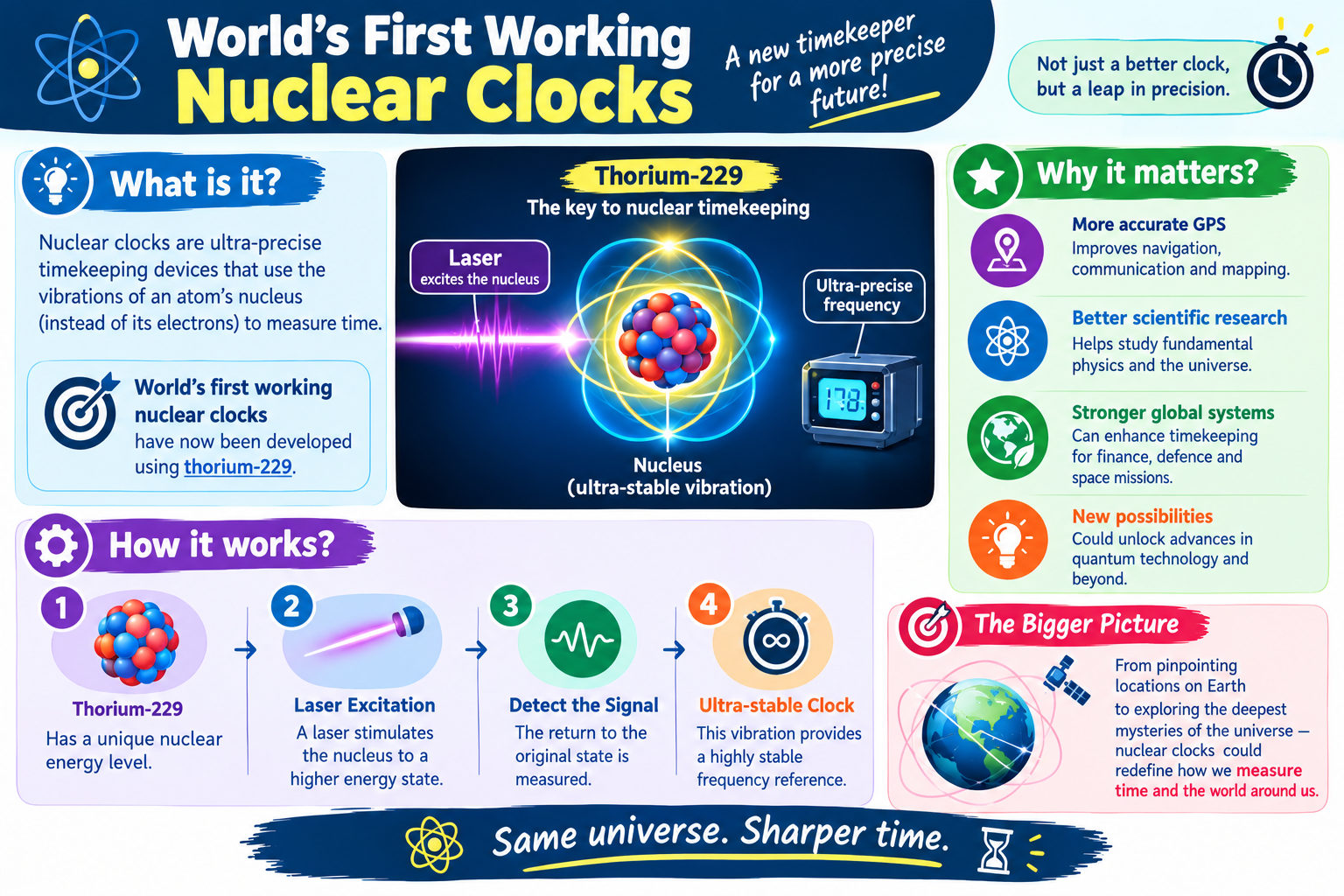
Recently, two independent research groups one led by TU Wien (Vienna, Europe) and the other by Tsinghua University (Beijing, China) published studies about the world's first operational nuclear clocks.

  • The scientists established a working nuclear feedback system, marking a historic transition from electron-based timekeeping to nuclear metrology.
  • Methodology – It is done successfully bylocking laser frequencies to quantum transitions inside the atomic nucleus of Thorium-229 (​229Th).

Atomic Clocks vs. Nuclear Clocks

Feature

Optical / Microwave Atomic Clocks

Nuclear Clocks (229Th)

Quantum Mechanism

Excites outer shell electrons between discrete atomic energy levels using microwaves or visible light.

Excites protons and neutrons between energy states directly inside the atomic nucleus using UV lasers.

Susceptibility to Noise

Highly sensitive to ambient electromagnetic noise, stray thermal radiation, and stray magnetic fields.

Exceptionally resilient; the tightly bound, tiny nucleus is heavily shielded by surrounding electron clouds.

Anomalously Low Energy Gap

Typically requires high energy (keV to MeV) beyond laser range for nuclear excitation.

Utilizes ​229Th, the only known isotope with an ultrasmall isomer energy gap (~8.4 eV / 148 nm Vacuum UV range) accessible by current lasers.

System State / Medium

Requires complex optical lattices or laser-trapped ions suspended in ultra-high vacuum chambers.

Operates by embedding ​229Th ions directly into solid calcium fluoride (CaF2) crystals.

Key Technological Achievements

  • Closed-Loop Feedback - The European team demonstrated continuous, automated operation exceeding 24 hours by using laser absorption feedback from ​229Th-doped CaF₂ crystals to dynamically realign and stabilise the driving laser frequency.
  • Complementary Breakthroughs
    • TU Wien / European Collaboration - Achieved superior optical quality and higher thorium doping concentration in calcium fluoride crystals.
    • Tsinghua University Team - Developed ultra-precise, higher-power vacuum ultraviolet (VUV) laser stabilisation circuits, lowering frequency instability.

Significance

  • New Probe for Fundamental Physics
    • Because nuclear forces are governed by strong interactions, nuclear clocks are up to 106 times more sensitive to temporal variations in fundamental constants (e.g., fine-structure constant α, strong interaction strength) than standard atomic clocks.
    • Enables novel high-precision searches for ultra-light dark matter candidate fields.
  • Next-Generation Metrology
    • Potential to surpass the accuracy of optical strontium/cesium atomic clocks by orders of magnitude once VUV laser linewidths are optimized.
    • Solid-state crystal design promises robust, portable frequency standards for deep-space navigation, high-speed telecommunications, autonomous synchronization, and relativistic geodesy.

World’s First Working Nuclear Clocks

Reference

The Hindu | World’s first working nuclear clocks

There are no reviews yet. Be the first one to review.

ARCHIVES

sidetext