0.1222
7667766266
x

WMO Greenhouse Gas Bulletin 2026

iasparliament Logo
October 30, 2026

Prelims: Current events of national and international importance | Environment

Why in News?

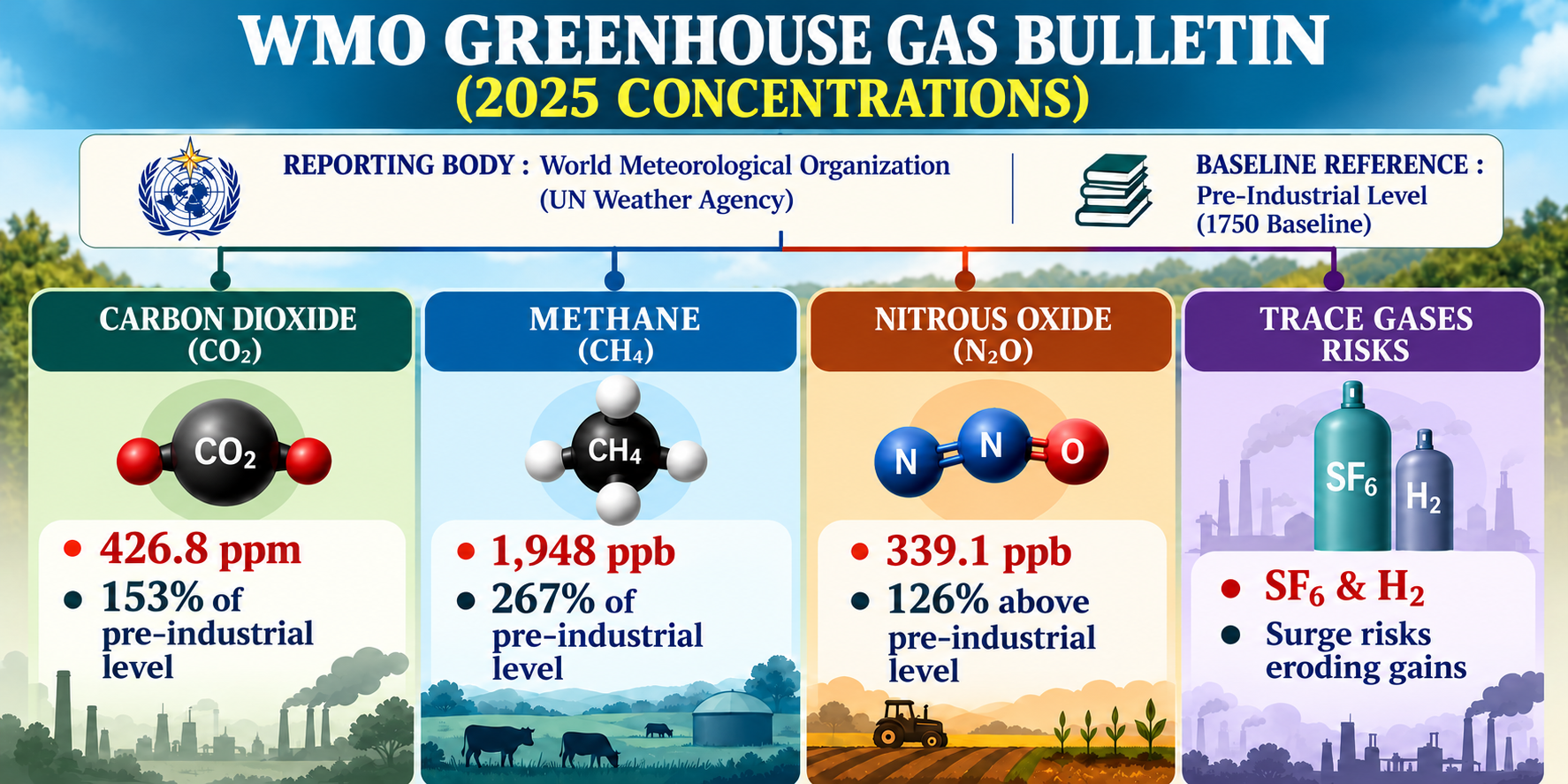
Recently, the World Meteorological Organization (WMO) published those atmospheric concentrations of the 3 primary long-lived greenhouse gases Carbon Dioxide (CO2), Methane (CH4), and Nitrous Oxide (N2O) reached unprecedented record highs in 2025.

  • Released ahead of - The UN Climate Conference (COP31 in Antalya, Turkiye).
  • The report warns that long atmospheric lifetimes commit the planet to multi-decadal temperature increases and heightened extreme weather risks.

Key Benchmarks (2025 Data)

Greenhouse Gas

2025 Average Concentration

Percentage of Pre-Industrial (1750) Level

Primary Anthropogenic Drivers

Carbon Dioxide (CO2)

426.8 ppm (parts per million)

153%

Fossil fuel combustion, cement production, deforestation, land-use change.

Methane (CH4)

1,948 ppb (parts per billion)

267%

Ruminant livestock, rice paddies, fossil fuel extraction/leaks, landfills, biomass burning.

Nitrous Oxide (N2O)

339.1 ppb (parts per billion)

126% above baseline

Synthetic nitrogen fertilizers, manure management, industrial chemical processes.

Emerging Dynamics

  • Role of Land Sinks
    • Approximately 50% of annual CO2emissions remain trapped in the atmosphere, while the rest is absorbed by terrestrial ecosystems (forests, soil) and oceans.
    • The annual CO2growth rate in 2024–2025 (+2.8 ppm) showed slight moderation compared to the 2023–2024 spike, reflecting partial recovery of land carbon sinks following the end of the severe 2023/2024 El Niño cycle.
  • Emerging Atmospheric Threats 
    • Sulphur Hexafluoride (SF6) - Used extensively as an insulating gas in electrical switchgear and grid distribution.
    • It possesses a Global Warming Potential (GWP) 24,300 times greater than CO2over a 100-year timescale, with emissions steadily rising over the past three decades.
    • Molecular Hydrogen (H2) - Rapid expansion in green hydrogen production presents potential leakage risks.
    • Uncontrolled H2leakage extends the atmospheric lifetime of methane by competing for hydroxyl (OH) radicals, indirectly intensifying warming.

WMO Greenhouse Gas Bulletin 2026

Reference

Down to earth | Greenhouse gases hit record highs in 2025

There are no reviews yet. Be the first one to review.

ARCHIVES

sidetext