Prelims: Current events of national and international importance | Geography
Why in News?
A research paper authored by scientists from the India Meteorological Department (IMD) and the Indian Institute of Tropical Meteorology (IITM), published in the IMD journal MAUSAM, reports changes in India's climate zones.
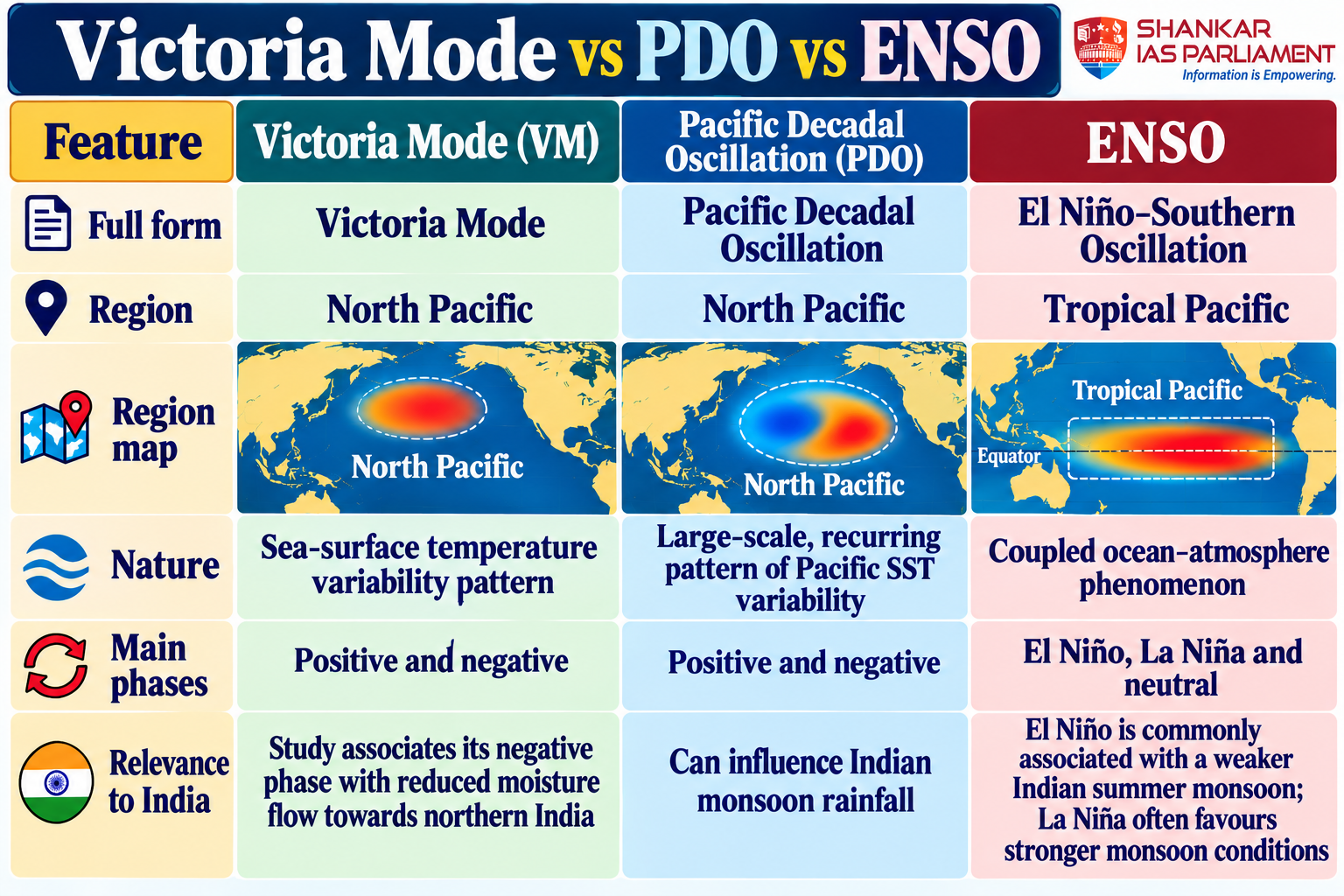
- The study attributes the observed drying trend in northern India in part to the negative phase of the Victoria Mode (VM), a recurring pattern of sea-surface temperature variability in the North Pacific Ocean.
Victoria Mode (VM)
- Victoria Mode is defined by recurring patterns of warm and cool sea-surface temperature anomalies in the North Pacific Ocean.
- This mode constitutes a form of oceanic climate variability that is distinct from the more widely recognised Pacific Decadal Oscillation (PDO).
- According to the study, the negative phase of Victoria Mode is linked to reduced moisture transport toward northern India, thereby contributing to regional drying.
Note – The study does not explicitly establish a direct link between Victoria Mode and El Niño, although previous research has found that many VM events were followed by El Niño events.
- Key Findings
- Shifts in India's Climate Zones – The study analysed climate classifications over two 30-year periods: 1951–1980 and 1991–2020.
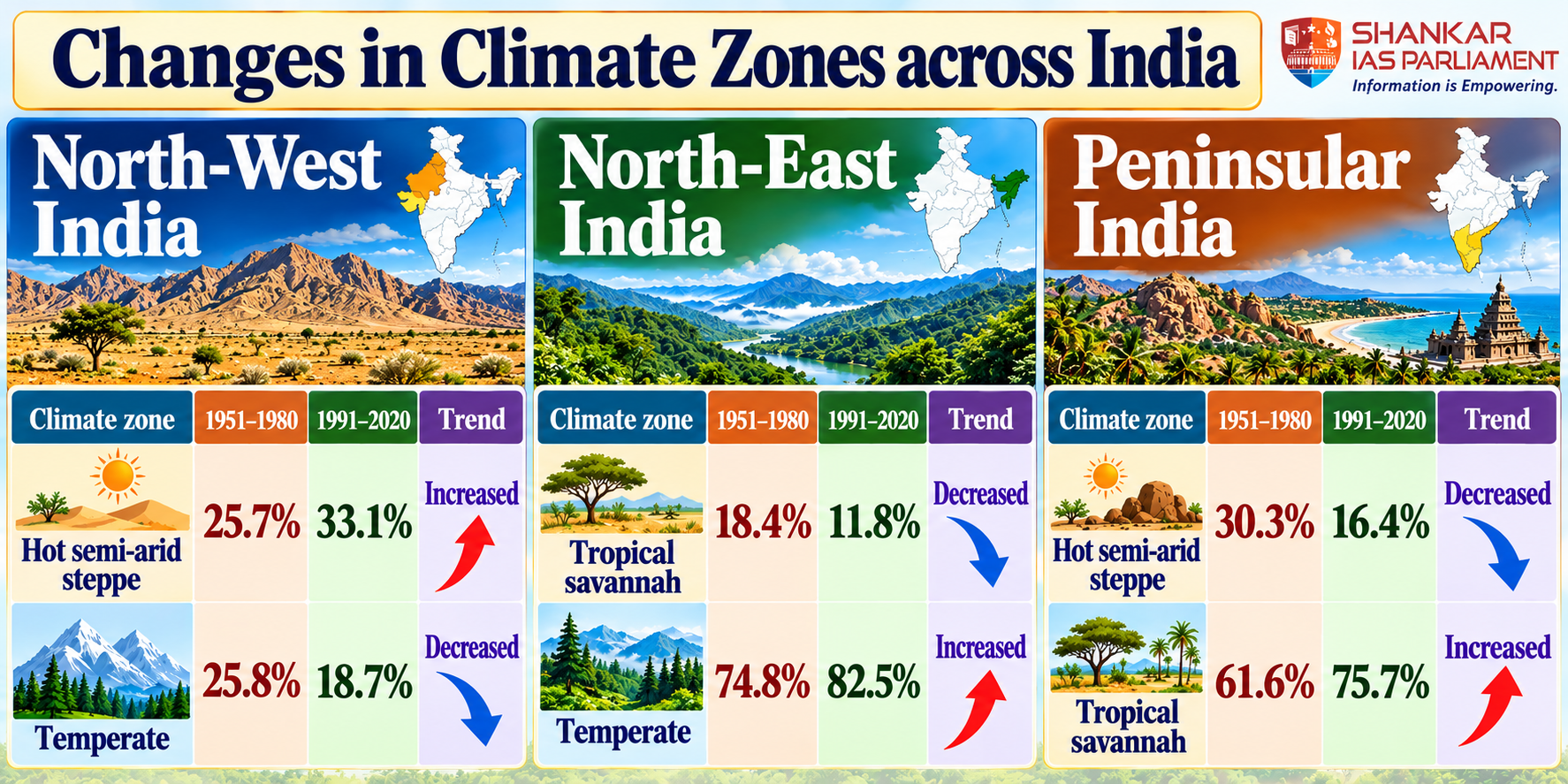
- North-West India
- The eastern boundary of the steppe zone shifted from western Uttar Pradesh to eastern Uttar Pradesh.
- West Vidarbha and Marathwada transitioned predominantly from tropical savannah to semi-arid steppe.
- Western Saurashtra and Kutch shifted from fully arid to semi-arid conditions.
- North-East India – Gangetic West Bengal shifted from tropical savannah to a temperate classification.
- Peninsular India
- Tropical monsoon zones expanded in Konkan and Goa, coastal Karnataka, as well as Kerala and Mahe.
- These findings demonstrate that climate-zone changes are heterogeneous across India.
- Northern regions exhibit a shift toward drier classifications, whereas southern and western coastal areas display an expansion of tropical savannah or monsoon climates.
Reference
The Hindu | Victoria Mode and Climate Change in India



