Prelims: Current events of national and international importance | Environment
Why in News?
Recent, UNCCD COP17 concluded with new drought resilience and land restoration initiatives, but once again stalled on adopting a global drought framework despite intensifying drought threats.
United Nations Convention to Combat Desertification: COP17
- Held at – Ulaanbaatar, Mongolia, on August 17–28, 2026.
- Theme – “Restoring Land. Restoring Hope.”
- Participants – Representatives from 197 Parties, scientists, Indigenous Peoples, pastoralists, and youth groups.
- Objective – To convert global land pledges into tangible financing, drought resilience, and rangeland management.
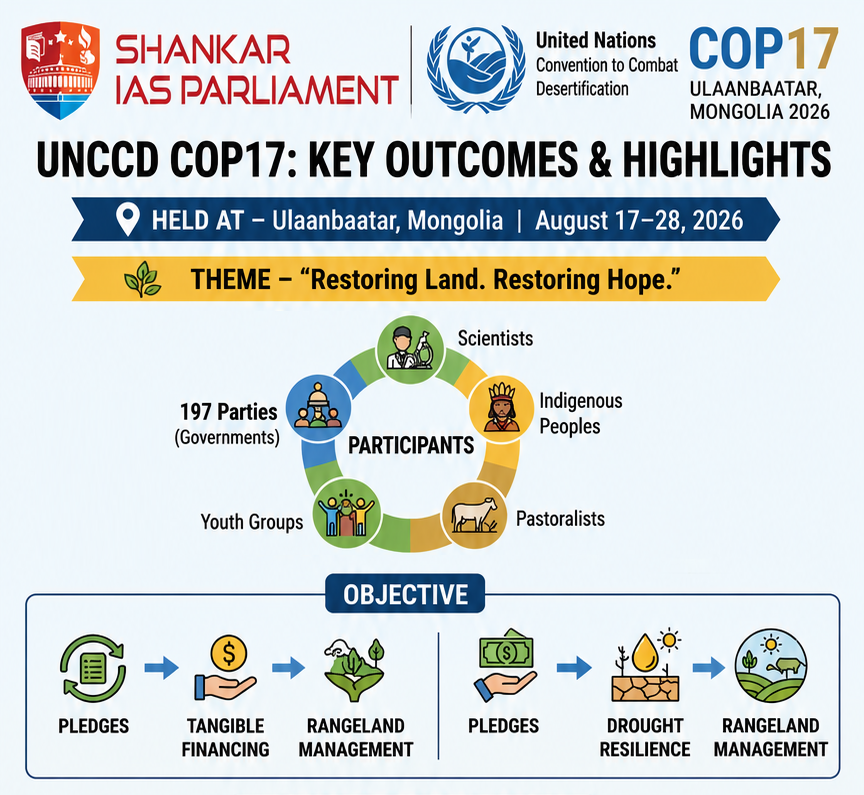
- UNCCD COP17 outcome
- Global drought Framework Stalled – Despite two years of talks and worsening droughts, Parties at COP17 failed to agree on a global drought framework, binding or voluntary.
- Parties decided to continue negotiations at COP18, keeping drought as a stand‑alone agenda item at future sessions.
|
Reasons for the Global Drought Framework Stalling
|
- Sovereignty Argument – The US insisted drought is a national/domestic issue, not requiring a global instrument, and should be managed through national policies or bilateral cooperation.
- Existing Tools Sufficient – Pointed to the UNCCD Drought Toolbox and WMO early‑warning system, arguing these should be used before creating new frameworks.
- Red Line Position – Categorically opposed any international drought instrument (binding or voluntary), blocking consensus.
- Broader Objections – Also resisted agenda items on gender, civil society participation, and Rio Convention synergies, reflecting opposition to new multilateral commitments.
|
- Drought Resilience Investment Facility (DRIF) – Launched by UNCCD, Luxembourg, and IDRA as a global catalytic platform.
- Objective – It aims to mobilise up to $400 million in public and private capital for water security, sustainable agriculture, nature‑based solutions, and land restoration.
- Riyadh Global Drought Resilience Partnership – Moved toward implementation; the first Assembly advanced a pooled fund concept to support ~70 low/lower middle-income countries.
- Drought Resilience Index (DRI) – Introduced as a technical monitoring tool to help countries assess vulnerabilities and guide investments.
- Land restoration and rangelands: major funding push
- Global Portfolio – Governments, banks, and companies announced a $1.3 billion package for land restoration and drought resilience across 23 countries on five continents.
- Funding – This includes $644.5 million in new finance and $216.4 million already confirmed for implementation.
- Rangelands Flagship Initiative – Launched with ~$1.2 billion across 45 projects to support resilient rangelands and pastoralist livelihoods, aligned with the 2026 International Year of Rangelands and Pastoralists.
Reference
Down to Earth | UNCCD COP13



