Mains: GS Paper I | Geography || GS Paper III | Disaster Management.
Why in News?
The newly installed 33 spillway crest gates of the Tungabhadra Dam were inaugurated recently.
What are the origin & course of the Tungabhadra River?
- Nomenclature - The Tungabhadra takes its name from two streams, as it is formed by the confluence of the Tunga and the Bhadra, both of which rise in the Western Ghats.
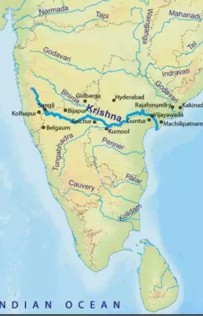
- Origin - The river, formed near Shivamogga in Karnataka, flows for about 531 km before joining the Krishna at Sangamaleshwaram in Andhra Pradesh.
- The combined waters then flow eastwards and enter the Bay of Bengal at Hamsaladeevi.
- Course - 382 km lies in Karnataka, 58 km forms the boundary between Karnataka and Andhra Pradesh, and 91 km flows through Andhra Pradesh.
- Tributaries- Major tributaries include the Varada, Hagari (Vedavathi), and Kumudavathi.
- Wildlife sanctuaries – The region comprises Tungabhadra Wildlife Sanctuary, Tungabhadra Otter Conservation Reserve, Bhadra Wildlife Sanctuary & Tiger Reserve.
- The river is largely dependent on the south-west monsoon.
What is the Tungabhadra Reservoir Project?
- Commissioned in - The early 1950s with its original crest gates installed in 1955, the Tungabhadra Dam is a vital multi-purpose, inter-state project.
- Geography & River Course - Built across the Tungabhadra River (a major tributary of the Krishna River) near Hosapete, Karnataka.
- Riparian Stakeholders - It is an inter-state project jointly involving Karnataka, Andhra Pradesh, and Telangana.
- Socio-Economic Lifeline - The reservoir irrigates over 16.38 lakh acres of agricultural land—comprising 9.26 lakh acres in Karnataka, 6.25 lakh acres in Andhra Pradesh, and 87,000 acres in Telangana.
- It also serves as the primary drinking water source for several towns and cities across 6 chronically drought-prone districts
- Ballari, Koppal, and Raichur in Karnataka, alongside Anantapur, Kadapa, and Kurnool in Andhra Pradesh.
What is the role of the Krishna Water Disputes Tribunal (KWDT)?
- Constituted by - The Union Government in 1969 under the Inter-State River Water Disputes Act, 1956, the KWDT adjudicated the water sharing formula for the Krishna basin.
Inter-state water disputes in India are governed by Article 262, empowers Parliament to enact laws to adjudicate conflicts over the use, distribution, and control of interstate rivers.
- In 1976, the tribunal fixed the net water utilization (including evaporation losses) in a 65:35 ratio between Karnataka and the undivided Andhra Pradesh.
- Net Allocations - Karnataka holds a share of 151.49 tmcft, Andhra Pradesh has an assured allocation of 78.51 tmcft, and Telangana’s post-bifurcation share stands at 15.9 tmcft.
- Dual Filling Assumption - While the physical structural capacity of the dam stands lower at 134 tmcft, the KWDT allocated 230 tmcft for cumulative annual utilization.
- It accounts for the ecological fact that the reservoir historically fills twice a year.
- The Tungabhadra Board - Established on the recommendations of the KWDT.
- It is an inter-state statutory body that regulates water release to member states, monitors flows/evaporation losses, and manages common works like the Right Bank High Level and Low-Level Canals.
What are the key challenges confronting the project?
- Structural Aging and Dam Safety Vulnerabilities - Built in the mid-20th century, many crest gates and structural components suffer from material fatigue and corrosion.
- It requires proactive, holistic replacement rather than reactive, temporary repairs.
- Upstream vs. Downstream Conflict (The Upper Bhadra Issue)- The implementation of the Upper Bhadra Project by Karnataka (a lift irrigation scheme located upstream) has become a primary point of contention.
- Andhra Pradesh has approached the Supreme Court, arguing that upstream impoundment will intercept the water volumes allocated to it before they can reach the Tungabhadra dam.
- It heavily impacts the downstream canals feeding its drought-prone Rayalaseema region.
- Allocation Deficits and Inter-State Friction - Telangana has raised operational grievances, stating that it faces a recurring deficit of 5 to 6 tmcft against its sanctioned 15.9 tmcft allocation.
- It contends that uncoordinated, excess withdrawals by Andhra Pradesh reduce downstream flows to the critical Srisailam reservoir, straining relations between the newly bifurcated states.
- Siltation and Storage Capacity Loss - Decades of agricultural runoff and catchment deforestation have led to severe sedimentation in the Tungabhadra reservoir.
- This silt accumulation has progressively reduced its gross storage capacity, testing the 1976 KWDT allocation models that relied on a clean reservoir filling twice annually.
Ethical Dimensions
- Environmental Ethics - Neglecting siltation and structural decay passes down degraded, high-risk assets to future generations.
- Moving beyond resource extraction to maintain minimum river flows that sustain riparian ecosystems.
- Duty to Vulnerable Communities - Guaranteeing reliable water to drought-prone regions to safeguard marginalized agrarian livelihoods.
- Fulfilling the state's moral obligation to manage vital natural resources as a shared asset, not a political tool.
- Balancing Development & Ecology - Structuring upstream projects to meet localized growth without cutting off the survival needs of downstream regions.
- Substituting zero-sum resource hoarding with collaborative sharing to serve the collective public good.
What is the way forward?
- Institutionalize Dam Safety - Transition from reactive repairs to strict asset-vulnerability mapping under the Dam Safety Act, 2021, using the 2026 gate replacement as a baseline protocol.
- Deploy Real-Time Telemetry - Install satellite-linked automated sensors along inter-state canals to establish a single source of transparent data and eliminate water-drawing disputes.
- Practice Collaborative Federalism - Utilize the Apex Council and Catchment Area Treatment programs to resolve upstream-downstream conflicts contractually while mitigating ecological reservoir siltation.
Reference
The Hindu | Tungabhadra reservoir project



