Prelims: Current events of national and international importance | Indian Society | Geography
Why in News?
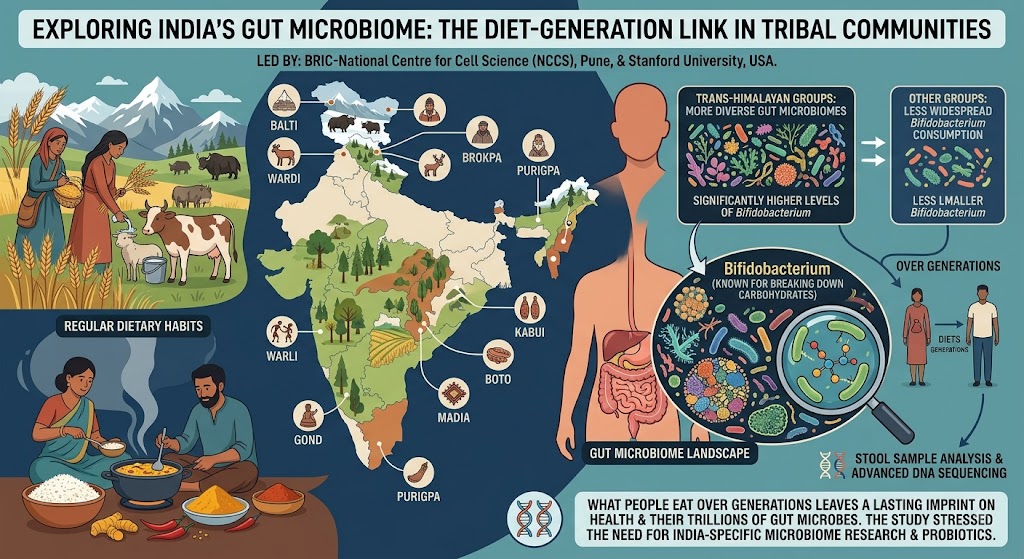
Researchers have found that traditional diets, particularly those rich in dairy and grains in trans-Himalayan populations, were associated with distinct gut bacteria and locally adapted microbial strains.
- The study stressed the need for India-specific microbiome research and probiotics.
- Led by - Researchers from BRIC-National Centre for Cell Science (NCCS), Pune, and Stanford University, USA.
- It concentrated on 8 Indian tribal communities.
- It showed that what people eat over generations may leave a lasting imprint not just on their health but also on the trillions of microbes living inside their gut.
- The study analysed healthy adults from the Warli, Gond, Madia, Kabui, Boto, Balti, Brokpa and Purigpa communities across 4 geographically diverse regions of India.
- Researchers examined stool samples alongside dietary habits of participants using advanced DNA sequencing.
- The 4 trans-Himalayan groups regularly consumed milk, homemade butter, wheat and barley, as also rice, turmeric and chilli.
- The research showed that the communities had more diverse gut microbiomes and significantly higher levels of Bifidobacterium compared to people who didn’t widely consume the aforementioned food.
Bifidobacterium – It is a group of bacteria known to break down carbohydrates and commonly used in probiotic products.
- Researchers also found that gut microbes in the trans-Himalayan participants carried distinct and diverse genes involved in digesting lactose, galactose and grain-derived carbohydrates, suggesting that the microbial communities had adapted to foods these populations consumed traditionally.
- It noted that other than food, geography, altitude and lifestyle may also influence gut microbes.
- Moreover, the most striking finding was that strains of Bifidobacterium adolescentis isolated from these participants were genetically distinct from many strains commonly found in industrialised countries.
- Although belonging to the same bacterial species, the Indian bacterial strains carried unique combinations of carbohydrate-processing genes, indicating adaptation to local diets.
- An important question raised by the findings was whether probiotics developed in Western countries were equally effective for Indian populations.
- Researchers cautioned against assuming that all probiotic strains behaved similarly simply because they belonged to the same bacterial species.
- Consumers should not assume that all members of a probiotic species are interchangeable.
- Rather than rejecting imported probiotics, the study highlighted the need to evaluate them in Indian populations and develop indigenous probiotic strains based on healthy Indian microbiomes.
Reference
Times of India | Tribal community diets



