0.3023
7667766266
x

The Vision Document on Drug Control (2026–2029)

iasparliament Logo
June 29, 2026

GS Paper II: Governance | GS III Internal Security 

Why in News?

Recently, the Union Home Minister launched the Vision Document on Drug Control (2026–2029) during the 10th Apex-Level Meeting of the Narco-Coordination Centre (NCORD), organised by the Narcotics Control Bureau (NCB).
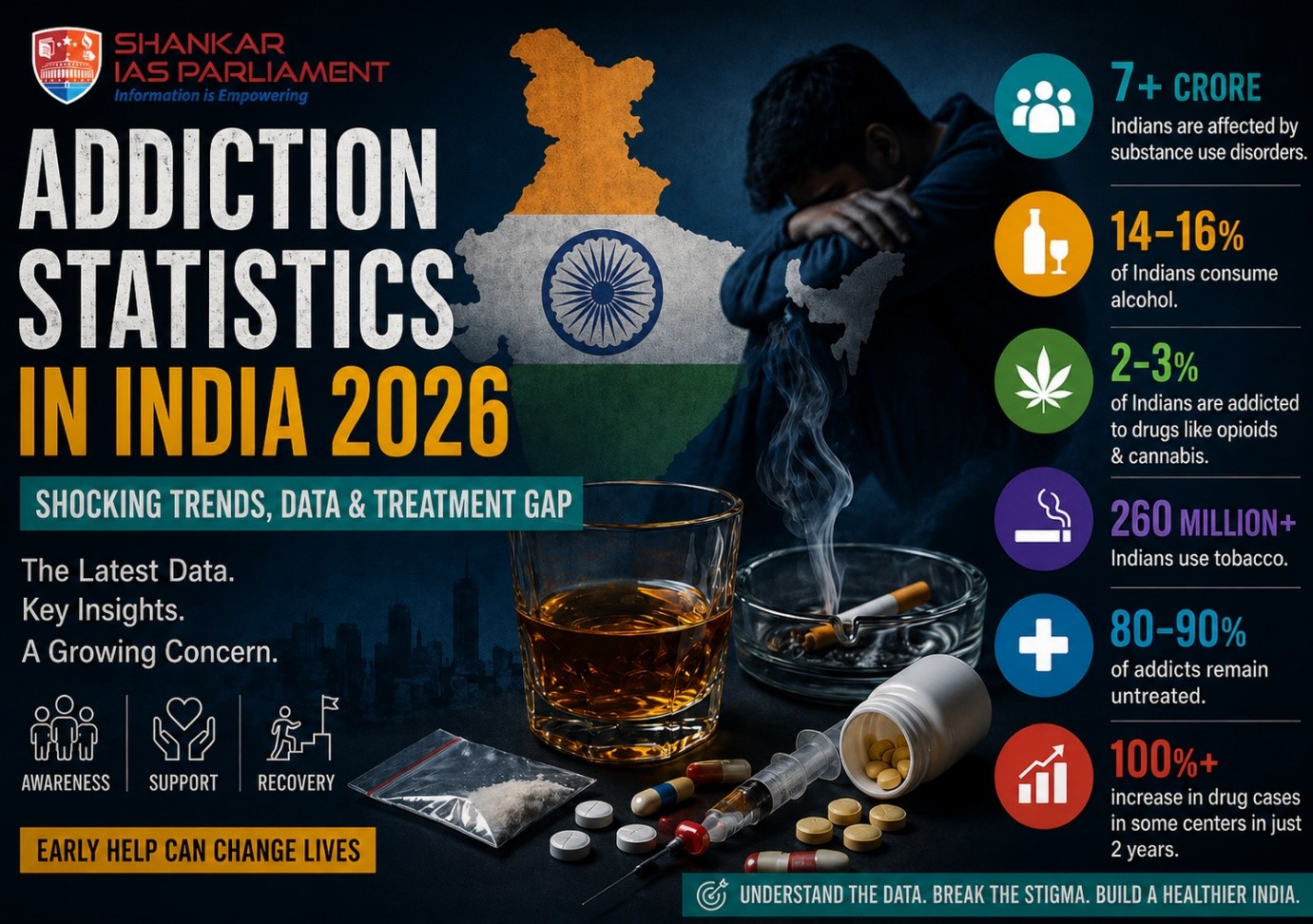
What is the status of drug abuse in India?

  • Increases in cases – India has witnessed a significant increase in drug trafficking and substance abuse over the past decade due to evolving trafficking routes, synthetic drug production, and digital platforms facilitating illegal trade.

Drug 1

  • Major concerns – Rising abuse of heroin, methamphetamine, mephedrone, and other synthetic drugs.
  • Expansion of online drug markets through Telegram, WhatsApp, and Signal.
  • Growing involvement of organised criminal syndicates
  • Diversion of pharmaceutical drugs for illicit consumption
  • Increasing addiction among youth and students
  • Expansion of cross-border trafficking networks
  • Drug abuse has become not only a law enforcement issue but also a major public health and socio-economic concern.

What are the key features of the vision document?

  • Foundation The Vision Document is built upon a three-pronged strategy:
    • Detect trafficking networks through intelligence.
    • Disrupt supply chains and financial networks.
    • Destroy organised narcotics ecosystems through coordinated enforcement.
  • National Strategy Against NarcoticsThe document provides a time-bound national strategy to dismantle the entire narcotics ecosystem by targeting, drug trafficking, drug abuse, illicit financial networks, organised criminal syndicate and cross-border trafficking.
  • Dismantling Major Drug CartelsDismantling of, 100 major inter-state and transnational drug cartels through intelligence-led investigations coordinated multi-agency operations, financial disruption and strong prosecution.
  • The focus shifts from arresting individual couriers to eliminating entire criminal networks.
  • Enhanced Stakeholder CoordinationThe Vision Document aims to integrate the efforts of over 40 Ministries and agencies, including:
    • Central Government departments
    • State Governments
    • District administrations
    • Educational institutions
    • Civil society organisations
    • Citizens
  • This whole-of-government approach seeks to ensure better coordination and information sharing.
  • Financial Disruption of Drug NetworksRecognising that drug trafficking is driven by financial gains, the document proposes, Mandatory financial investigations in major drug cases.
  • Attachment and confiscation of assets acquired through drug proceeds
  • Tracking money laundering linked to narcotics trade
  • This approach weakens criminal organisations by targeting their economic foundations.
  • Greater Use of the 1988 actThe vision document recommends wider application of the PITNDPS act, 1988.
  • States are encouraged to use this legislation against drug kingpins and organised trafficking syndicates.

The PIT-NDPS Act, 1988 (Prevention of Illicit Traffic in Narcotic Drugs and Psychotropic Substances Act) is a key Indian law providing for preventive detention to combat organized drug trafficking. It aims to incapacitate habitual offenders and major drug syndicates.
  • Adoption of Advanced TechnologyThe document emphasises technology-driven enforcement through the following:
    • Artificial Intelligence (AI)-enabled profiling
    • Anti-drone technologies
    • Advanced surveillance systems
    • Container scanning
    • Data analytics
    • Enhanced inter-agency intelligence sharing
  • These measures aim to improve interdiction across land, air, and maritime routes.
  • Focus on Synthetic DrugsSpecial attention has been given to emerging synthetic drugs such as, Methamphetamine, Mephedrone, and Other Amphetamine-Type Stimulants (ATS).
  • Industry ParticipationThe chemical and pharmaceutical sectors are encouraged to adopt, voluntary compliance mechanisms, reporting of suspicious transactions, cooperation with enforcement agencies and prevention of diversion of prescription medicines.
  • De-addiction and RehabilitationThe Vision Document balances enforcement with public health measures by focusing on, expansion of de-addiction centres, counselling services.
  • It also focuses on treatment facilities, rehabilitation programmes, social reintegration of recovering addicts, the objective is to reduce demand alongside supply reduction efforts.
  • Public AwarenessA nationwide awareness campaign aims to reach over 50 crore citizens through, schools and colleges, community organisations, youth clubs, sports institutions, civil society.
  • The objective is to transform drug prevention into a people's movement.
  • Drug-Free Educational InstitutionsHigher educational institutions are expected to promote drug-free campuses, student counselling, early intervention programmes, preventive drug screening (pilot initiatives), comprehensive student wellness programmes.
  • Addressing Digital Drug MarketsThe document highlights the growing misuse of digital platforms such as, Telegram, WhatsApp, and Signal.

What are the existing and emerging narcotics routes affecting India?

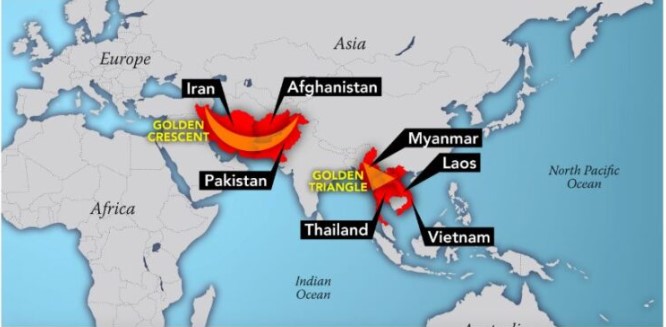
  • Myanmar RouteIndia's eastern border has emerged as the country's most significant narcotics trafficking challenge.
  • Following the Taliban's ban on opium cultivation in Afghanistan in 2022, Afghan production declined substantially.
  • Global supply shifted towards the Golden Triangle.
  • Myanmar emerged as a major producer of opium and methamphetamine.
  • Opium cultivation in Myanmar reportedly expanded significantly between 2021 and 2023, particularly in Shan State under the control of ethnic armed groups.

Drug 2

  • National Highway routes – The NH, 102 through Manipur – Champhai–Aizawl–Barak valley route via mizoram, routes facilitate the movement of, heroin, methamphetamine, and synthetic drugs.
  • The porous border, difficult terrain, and the erstwhile Free Movement Regime have enabled these regions to become important staging points for narcotics distribution.
  • Northeastern StatesThe States facing the highest exposure include, Manipur, Mizoram and Nagaland.
  • Mizoram recorded the highest seizure of Amphetamine-Type Stimulants in 2025, highlighting the increasing importance of India's eastern frontier in narcotics control.
  • Western CoastThe western coastline, particularly, Gujarat and Maharashtra is vulnerable to heroin and synthetic drugs originating from the Afghanistan–Pakistan–Iran corridor.
  • Southern and Eastern CoastlinesThe southern and eastern seaboards face increasing trafficking through, Sri Lanka, Maldives, and Golden Triangle-linked maritime routes.
  • Drug traffickers increasingly use, Fishing vessels, Coastal boats, and Low-signature maritime platforms
  • These vessels often evade conventional surveillance systems.
  • Tamil Nadu CoastThe NCB Annual Report 2025 records several significant maritime drug interceptions, including seizures of Amphetamine,
  • Ganja and Hashish oil.
  • These seizures indicate an emerging maritime shift in trafficking patterns along India's southern coastline.

What are the ethical issues involved?

  • Drug use in India raises several ethical concerns. It involves a conflict between individual autonomy and the State's duty to protect public health.
  • Criminalising addicts instead of treating addiction as a health issue challenges the principles of compassion and human dignity.
  • Drug abuse disproportionately affects vulnerable groups, violating social justice and equity.
  • Organised drug trafficking fuels crime, corruption, and terrorism, undermining rule of law.
  • The use of surveillance technologies raises concerns over privacy and civil liberties.
  • Ethical governance requires a balanced approach that combines strict enforcement against traffickers with rehabilitation, de-addiction, awareness, and social reintegration of drug users.

What measures authorities can take?

  • Enhance Border & Port Security – Strengthen surveillance at international borders and maritime entry points using advanced technology (drones, scanners) to intercept illegal narcotics.
  • Crack Down on the Darknet – Expand specialized cyber-units targeting the rising trend of darknet markets and cryptocurrency transactions used for illicit drug trade.
  • Inter-Agency Coordination – Strengthen real-time intelligence sharing between the Narcotics Control Bureau (NCB), state police forces, and border guarding forces.
  • School & College Programs – Implement early intervention and educational programs (such as the Navchetna modules) to educate youth on the ill effects of substance abuse.
  • Community Campaigns – Utilize local bodies (Panchayati Raj Institutions, youth clubs, and Self-Help Groups) to drive community-led campaigns under the Nasha Mukt Bharat Abhiyaan.
  • Media & Helplines – Run widespread, stigma-free awareness campaigns on mass media and promote nationwide helplines (e.g., Toll-free: 14446) for families seeking help.
  • Expand Infrastructure – Increase the number of Addiction Treatment Facilities (ATFs) in government hospitals and establish community-based Outreach and Drop-In Centers (ODICs).
  • Training Medical Professionals – Train general medical officers and counselors in government hospitals to identify and treat substance dependence effectively.
  • Rehabilitation & Livelihood Support – Provide vocational training, skill development, and livelihood assistance to recovering addicts to support their full reintegration into society.
  • Strict Pharmaceutical Monitoring – Enhance the regulatory oversight of the Central Drugs Standard Control Organisation (CDSCO) to prevent the diversion of prescription drugs and psychotropic substances for recreational use.
  • Fund Grassroots NGOs – Scale financial assistance programs provided by the Ministry of Social Justice and Empowerment (MoSJE) to NGOs operating community-based de-addiction and rehabilitation centers.

What lies ahead?

  • The Vision Document on Drug Control (2026–2029) marks a significant shift from isolated law enforcement actions to a comprehensive national strategy against narcotics.
  • By integrating enforcement, technology, financial disruption, rehabilitation, industry participation, and citizen engagement, it aims to dismantle organised drug networks while addressing the social dimensions of substance abuse.
  • Successful implementation through cooperative federalism and active public participation will be critical to achieving the goal of a safer, healthier, and drug-free India.

Quick facts

Narco-Coordination Centre (NCORD)

  • The Narco-Coordination Centre (NCORD) is a four-tier coordination mechanism established by the Ministry of Home Affairs to ensure effective cooperation among:
    • Central Ministries
    • State Governments
    • Law enforcement agencies
    • Intelligence agencies
    • Pharmaceutical and chemical industries
    • Financial institutions
    • Educational institutions and civil society
  • It provides a common platform for coordinated action against drug trafficking and substance abuse.

To take mains test click here

Reference

The Hindu| Strategy Document on Drug Abuse

Login or Register to Post Comments
There are no reviews yet. Be the first one to review.

ARCHIVES

MONTH/YEARWISE ARCHIVES

sidetext
Free UPSC Interview Guidance Programme
sidetext