0.1211
7667766266
x

The need of BRICS carbon market partnership

iasparliament Logo
November 05, 2026

Mains: GS-II – International Relations

Why in news?

Following the reaffirmation of the BRICS Carbon Markets Partnership under the New Delhi Declaration, attention has shifted from high-level political commitments to practical implementation.

What are the fragmented domestic carbon markets?

  • Divergent Cap Systems - China and India implement output-based emissions-intensity benchmarks (capping emissions per unit of economic output rather than placing an absolute ceiling on total emissions).  
  • India’s Carbon Credit Trading Scheme (CCTS) focuses heavily on compliance/voluntary structures across designated sectors.
  • Brazil has advanced toward an absolute cap-and-trade system under its domestic greenhouse gas emissions trading legislation (SBCE).
  • Inward-Looking Offset Rules- Most member systems restrict offsets to domestic projects or recognize narrow national categories (e.g., China restricting to CCERs; India prioritizing newer timelines), preventing cross-border fungibility.
  • Varying Legal Definitions - Carbon units are governed differently across jurisdictions regulated as securities instruments in some nations while functioning via power exchanges or administrative permits in others.

Comparative Framework

Dimension

Common Trading Platform (Premature)

Common Rulebook & MRV (Recommended)

Focus

Direct cross-border exchange of carbon credits and financial clearing

Harmonizing measurement, reporting, verification standards, and registries

Feasibility

Low, due to differing domestic caps, intensity vs. absolute targets, and capital account restrictions

High, as it builds on existing frameworks (e.g., ISO 14064 standards)

Response to External Pressures

Fails to protect exporters against external carbon taxes without verified data

Directly equips exporters with credible documentation to minimize Carbon Border Adjustment Mechanism (CBAM) liabilities

Institutional Load

Requires massive new multinational financial infrastructure

Leverages existing institutions like the New Development Bank (NDB)

What are the external pressures?

  • The urgency for a unified BRICS carbon accounting framework is heightened by external trade measures such as the European Union’s Carbon Border Adjustment Mechanism (CBAM) (which entered its definitive phase) and upcoming rules from the United Kingdom:
  • Risk of Double Penalization - Exporters of carbon-intensive goods (such as steel, aluminum, and cement) face severe levies unless they can prove that an equivalent carbon price was paid at origin.
  • The Need for Credible Data - While external bodies (like the UK) have begun recognizing domestic systems like India’s CCTS under strict verification parameters, exporters lacking robust, transparent measurement data face punitive default values.
  • A cohesive BRICS standard would strengthen the bloc's collective negotiating power against unilateral trade barriers.

What the BRICS carbon market partnership needs?
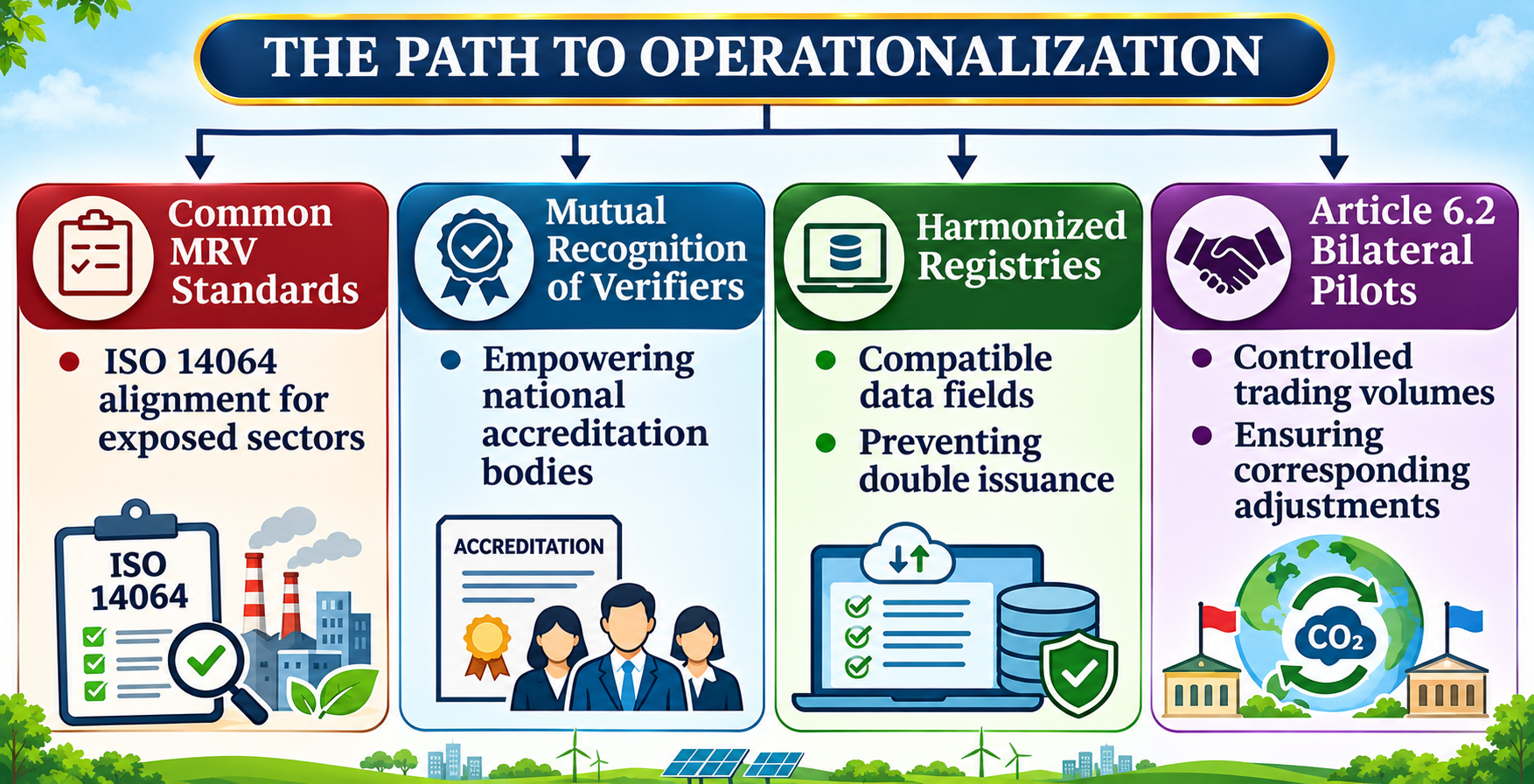
  • Prioritizing Common Measurement, Reporting, and Verification (MRV) - Establishing shared rules for carbon accounting aligned with international frameworks (like ISO 14064) ensures that a ton reduced in one member state carries equivalent credibility in another.
  • Mutual Recognition of Verifiers - Formally recognizing accredited validation and verification bodies across national boundaries prevents redundant compliance checks for cross-border businesses.
  • Harmonized Registry Data Architecture- Adopting compatible digital fields across national registries prevents double counting and mitigates the risk of dual issuance of credits.
  • Targeted Article 6.2 Pilots - Rather than full market linkage, a subset of members can initiate small-scale bilateral or trilateral trading pilots under Article 6.2 of the Paris Agreement, utilizing institutions like the New Development Bank (NDB) to host shared registry infrastructure.

BRICS carbon market partnership

What is the way forward?

  • The success of the BRICS Carbon Markets Partnership depends on shifting its focus away from broad political declarations toward technical convergence.
  • By establishing transparent carbon accounting rules, addressing capital-account transfer complexities, BRICS can turn its vast carbon market potential into a functional instrument for sustainable development.

Reference

The Hindu | BRICS carbon market partnership

There are no reviews yet. Be the first one to review.

ARCHIVES

sidetext


