0.1040
7667766266
x

The National Food Security Act (NFSA) 2013

iasparliament Logo
July 10, 2026

Mains: GS II – Food Security

Why in News?

Recently, Tamilnadu and Kerala opposed the proposed amendments to the NFSA 2013.
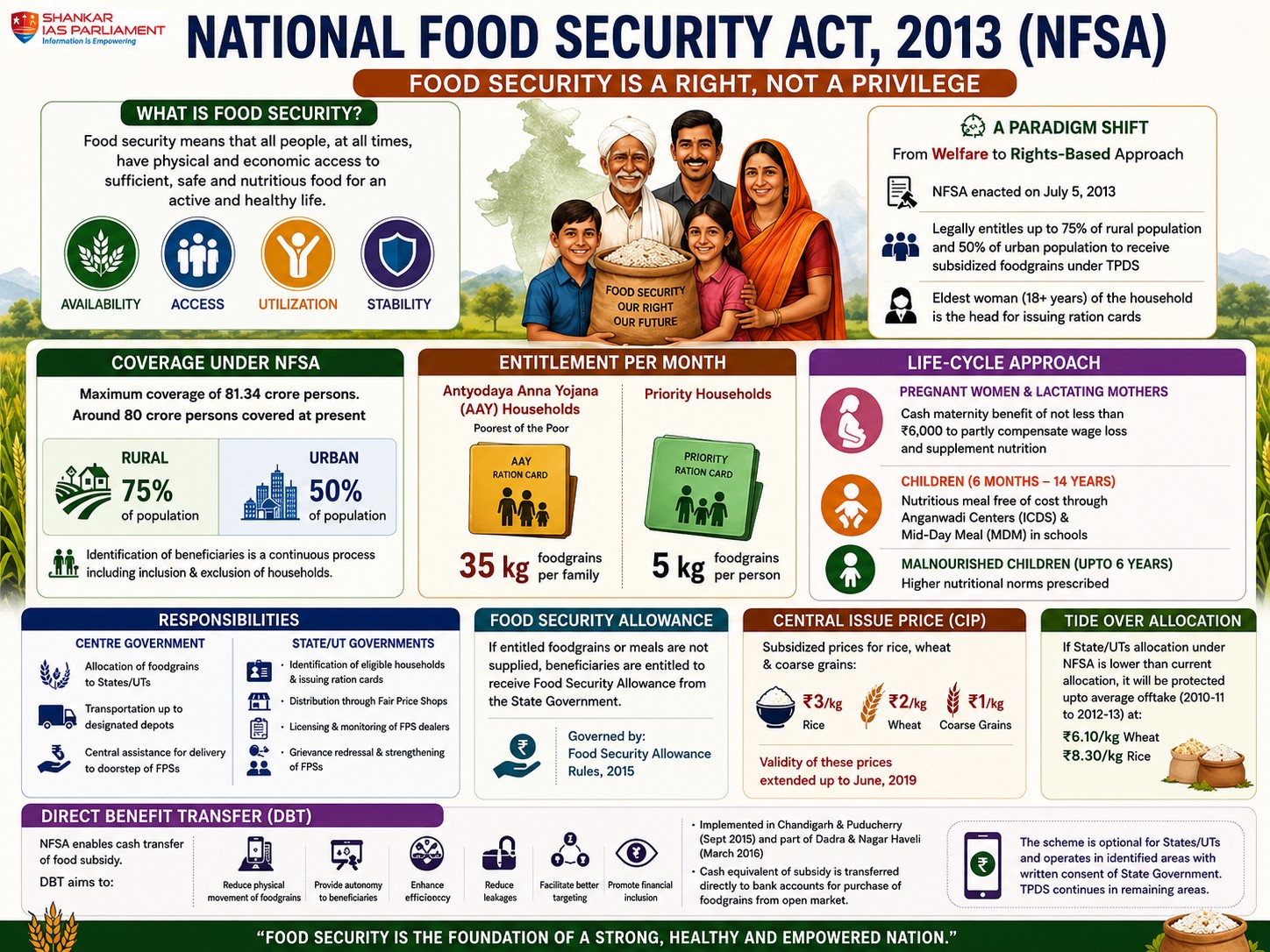
What is the National Food Security Act (NFSA) 2013?

  • NFSA – It is an Indian legislation that legally entitles up to 75% of the rural population and 50% of the urban population to subsidized or free foodgrains under the Targeted Public Distribution System (TPDS).
  • It provides a rights-based approach to food security, covering about two-thirds of the nation's total population.
  • Key Provisions and Entitlements
  • Foodgrains for Households:
    • Antyodaya Anna Yojana (AAY) – The poorest of the poor households are entitled to 35 kg of foodgrains per family per month.
    • Priority Households (PHH) – These households are entitled to 5 kg of foodgrains per person per month.
    • Pricing – Under the Pradhan Mantri Garib Kalyan Anna Yojana (PMGKAY), which was merged with the NFSA, these foodgrains are provided free of cost to beneficiaries.
  • Nutritional Support for Women and Children:
    • Maternity Benefits – Pregnant women and lactating mothers are entitled to free meals at local Anganwadis and a maternity benefit of not less than Rs.6,000 to support proper nutrition and wage compensation.
    • Child Nutrition – Children aged 6 months to 6 years receive free meals through Anganwadis.
    • Children aged 6 to 14 years are provided meals through the PM POSHAN scheme (formerly the Midday Meal Scheme).
  • Implementation and Governance
    • Identification – Individual State and Union Territory (UT) governments are responsible for identifying eligible Priority Households and AAY beneficiaries.
    • Recognizing the head – For the issuance of ration cards, the eldest woman of the household (18 years or older) is designated as the head of the household.
    • Grievance Redressal – The Act mandates mechanisms for accountability, including the appointment of District Grievance Redressal Officers and the establishment of State Food Commissions to monitor implementation.
    • Security Allowance – If entitled foodgrains are not supplied, the eligible beneficiaries are entitled to a food security allowance.

NFSA 2013

What is the proposed amendment to the NFSA?

  • The Union Government has proposed amending Section 3(1) of the NFSA.
  • Existing ProvisionEvery AAY household receives 35 kg of foodgrains per month, irrespective of family size.
  • Proposed amendmentsEvery member of an AAY household will receive 7 kg of foodgrains per month.
  • However, the total entitlement cannot exceed 35 kg per household.
    • For Instance, A family of two members would receive only 14 kg.
    • A family of three members would receive 21 kg.
    • A family of four members would receive 28 kg.
    • Families with five or more members would continue to receive 35 kg.

Why has the government proposed the amendment?

  • Intra-category inequalitiesSmaller households receive more benefits.
    • For example, a two-member family gets 35 kg, equivalent to 17.5 kg per person.
    • A three-member family receives around 11.7 kg per person.
  • Larger households receive lessA six-member family also receives 35 kg, which translates to only 5.8 kg per person, even lower than the entitlement of Priority Households.
  • Governments arguments – The Government argues that the amendment aims to:
    • Remove inequities within AAY households.
    • Ensure fairer per capita distribution.
    • Rationalise foodgrain allocation.
    • Align distribution with nutritional requirements.
    • Improve subsidy efficiency.

Why are Tamil Nadu and Kerala opposed to the amendment?

  • Smaller Family Size in Southern StatesBoth Tamil nadu and Kerala have, lower fertility rates, higher literacy, better health indicators, and greater prevalence of nuclear families.
  • Most AAY households in these States consist of three or four members.
  • Under the proposed system, these families would lose between 7 and 21 kg of foodgrains every month.
  • Thus, instead of promoting equity, the amendment would significantly reduce their food entitlement.
  • Reduction In Foodgrain AllocationTamil nadu has estimated that, monthly allocation under aay would decline from 65,261 tonnes to 42,040 tonnes.
  • Further, around 15.75 lakh out of 18.64 lakh aay families have fewer than five members.
  • Consequently, nearly 85% of aay households in tamil nadu are expected to receive reduced foodgrain allocations.
  • Kerala fears similar reductions because of its predominantly nuclear family structure.
  • Increased Financial Burden on Poor Households Rice forms the staple diet of both States.
  • A reduction in subsidised rice would compel poor households to purchase additional foodgrains from the open market, leading to, Higher household expenditure, Reduced food security, Nutritional vulnerability, Increased dependence on market prices.
  • Since AAY beneficiaries belong to the poorest sections of society, even modest reductions could significantly affect household welfare.

Historical Context – Politics of Food in Tamil Nadu and Kerala

Kerala's Legacy

  • Kerala has one of India's oldest Public Distribution Systems.
  • Its food security initiatives date back to the princely State of Travancore and later expanded into a formal PDS in 1962, even before the establishment of the Food Corporation of India (FCI).
  • Universal access to subsidised food became an important component of Kerala's welfare model.

Tamil Nadu's Experience

  • Tamil Nadu has historically witnessed political consequences arising from food shortages.
  • The rice shortages of, 1952, 1967, led to major political changes in the State.
  • Since then, successive governments have treated food security as a politically sensitive issue.
  • Tamil Nadu eventually introduced universal free rice distribution through ration shops irrespective of income levels.
  • Therefore, any reduction in foodgrain allocation is viewed as politically and socially unacceptable.

What could be done?

  • A balanced approach is necessary to reconcile equity with food security.
  • Retaining a minimum household entitlement (e.g., 30 kg) irrespective of family size.
  • Providing 7 kg per capita beyond the minimum threshold.
  • Conducting wider public consultations before amending welfare legislation.
  • Undertaking State-wise impact assessments considering demographic variations.
  • Updating beneficiary lists to remove inclusion and exclusion errors.
  • Strengthening cooperative federalism by involving States in policy design.
  • Such an approach would balance fiscal prudence with the constitutional objective of ensuring food security.

What lies ahead?

  • The debate over the proposed amendment to the NFSA illustrates the complexities of designing welfare policies in a diverse country like India.
  • While the Centre seeks to correct per capita inequities among AAY households, Tamil Nadu and Kerala contend that the amendment ignores demographic realities and could reduce food support to millions of poor households.
  • The controversy also highlights the importance of cooperative federalism, regional diversity, and evidence-based policymaking.
  • A carefully calibrated solution that combines equity, fiscal sustainability, and protection for vulnerable families would better serve the objectives of the National Food Security Act and India's broader commitment to inclusive development.

References

  1. GOV| NFSA
  2. The Hindu| Amendments to NFSA 2013


Login or Register to Post Comments
There are no reviews yet. Be the first one to review.

ARCHIVES

MONTH/YEARWISE ARCHIVES

sidetext
Free UPSC Interview Guidance Programme
sidetext