Prelims: Current events of national and international importance | Science & Technology
Why in News?
The National Institute of Ocean Technology (NIOT), under the Ministry of Earth Sciences (MoES), established the Centre for Marine Autonomous and Robotic Systems (CMARS).
Underwater Swarm Robotics
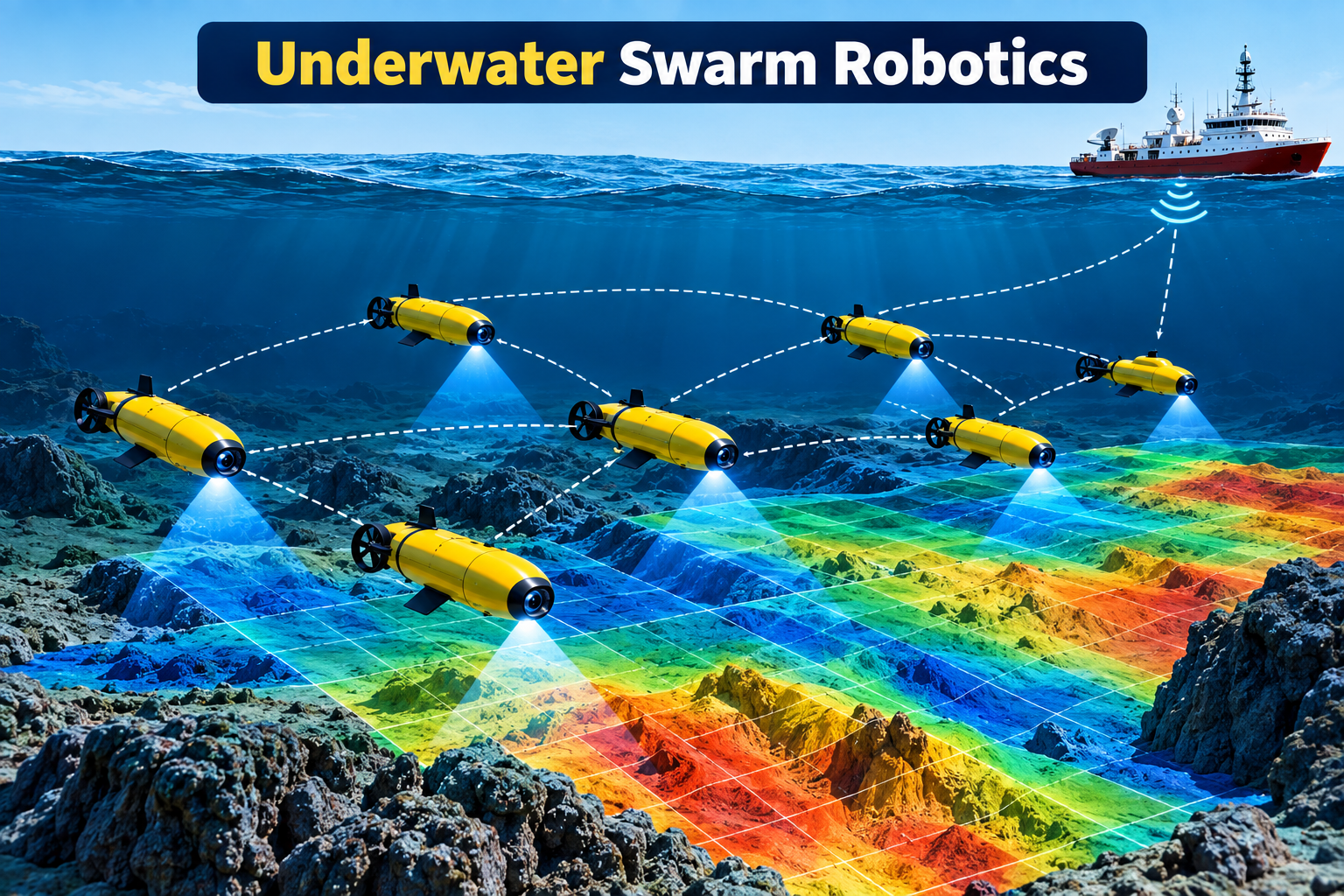
- Scientists are developing an indigenous platform of swarms of small Autonomous Underwater Vehicles (AUVs) and micro-submersibles designed to map the ocean floor collaboratively.
- Traditional seabed mapping relies on single, expensive, heavy submersibles (such as deep-sea ROVs or large AUVs).
- Swarm robotics replaces these with a coordinated network of multiple low-cost, lightweight autonomous units working concurrently.
- The swarm navigates grid pathways across the sea floor, sharing spatial data in real time via acoustic and optical communication links.
- This reduces survey time across vast oceanic areas while increasing spatial mapping resolution.
Key Technological Components
- Bio-Inspired Swarm Intelligence- Uses distributed swarm algorithms (such as bio-inspired fish swarm and marine predator algorithms).
- It is to enable self-organization, obstacle avoidance, and dynamic task allocation without constant operator intervention from surface vessels.
- Hybrid Communication Framework
- Acoustic Modems - Enable long-range, low-bandwidth communication among swarm nodes across deep waters.
- Optical (Blue-Green) / Visual Markers - Facilitate precise, high-speed short-range localization and coordination when units operate close to the seabed or near each other.
- Integrated Sensor Payload - Micro-AUVs are equipped with side-scan sonars, altimeters, and micro-bathymetric sensors to construct high-resolution 3D topography of benthic environments.
Significance
- Supports the technological objectives of India’s Deep Ocean Mission (DOM).
- Provides dual-use capabilities for the Indian Navy and Coast Guard.
- It aids in underwater surveillance, detection of unexploded ordnance (UXO), protection of critical subsea infrastructure (cables/pipelines), and mine countermeasures (MCM).
- Facilitates marine spatial planning, habitat classification, offshore energy site surveys, and environmental impact assessments prior to deep-sea resource extraction.
Reference
WION | Marine Autonomous Robots



