Why in News?
Recently, in the Union Budget 2026–27 has announced a comprehensive set of measures, including targeted reforms for Special Economic Zones (SEZs) affected by global trade disruptions.
What about the Special Economic Zones (SEZs)?
- SEZs – These are designated areas within a country that operate under a distinct regulatory and fiscal framework to promote trade and investment.
- Also, is a specifically delineated duty-free enclave and deemed to be a territory outside the customs territory of India for authorized operations.
- SEZ units are set up for the manufacture of goods, for rendering of services and providing warehousing services through Free Trade Warehousing Zones.
- Objective – To generate additional economic activity, boosting exports, attracting domestic and foreign investment, creating employment opportunities, and developing world-class infrastructure, SEZs serve as engines of export-led growth.
- Role in India’s Economy
- Boost Export – Since the enactment of the SEZ Act in 2005, these zones have significantly accelerated export growth while fostering industrial expansion across sectors.
- Holistic Local Development – Beyond foreign exchange and infrastructure, SEZs have created direct & indirect jobs, enabled new business ecosystems and improved socio- economic outcomes in local economies.
- Fiscal & Regulatory Advantages – By offering fiscal incentives, streamlined regulatory processes, and modern infrastructure, SEZs have enhanced India’s global competitiveness.
- Industrial Growth & Innovation – SEZs have built specialized industrial clusters, encouraged innovation and technological progress, and positioned India as a reliable global investment destination.
- Present status
- SEZs – Currently, there are 368 notified SEZs across India as of 28th February, 2026.
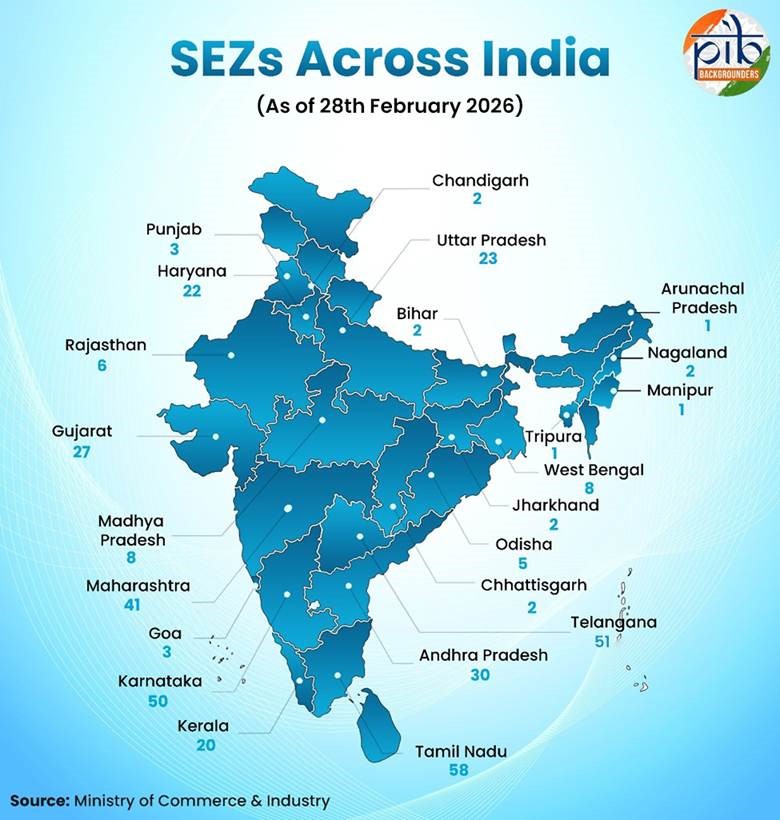
- Employment – Shows a rise, with SEZs employing over 31.73 lakh people as of December 2025.
- Total investment – Amounted to Rs.7.86 lakh crores (as of December 2025).
- Exports – Totaled over 11.70 lakh crores in 2025-26 (till December, 2025), a 32.02% increase from the corresponding period in 2024-25.
What are the measures announced in the Union Budget 2026–27 to focus on SEZ?
- One-Time Concessional DTA Sales (New special measure) – It has been proposed that eligible SEZ manufacturing units will be permitted to sell a prescribed proportion of their output in the DTA at concessional duty rates instead of standard customs duties.
- The quantity of such sales will be limited to a prescribed proportion of their exports and necessary regulatory changes will ensure fair competition with DTA units.
- Aim – To improve capacity utilization, achieve economies of scale, lower export costs, strengthen resilience of SEZ ecosystem and boost global investor confidence.
- Domestic Tariff Area (DTA) – It means the whole of India (including the territorial waters and continental shelf) but does not include the areas of the SEZs.
- Section 30 of the SEZ Act, 2005 – Stipulates that goods and services cleared from SEZ to DTA are treated as imports into the country and attracts all applicable duties and levies.
- Section 2(m) of SEZ Act, 2005 – The supplies from DTA to SEZ are treated as exports to SEZ and are eligible for applicable export benefits.
- Technology & Infrastructure Incentives – Extension of tax incentives for cloud & data-centre operations within SEZs is expected to attract global manufacturers & technology firms, strengthening India’s investment ecosystem.
What is the Evolution & Policy Framework of SEZs in India?
- Early Phase – India was among the first Asian countries to adopt the Export Processing Zone (EPZ) model to promote exports, establishing Asia’s first EPZ at Kandla in 1965.
- Challenges – Multiple regulatory controls, procedural delays, inadequate infrastructure, and an unstable fiscal regime limited its effectiveness.
- SEZ Policy, 2000 – It was announced in April 2000 to overcome EPZ shortcomings and attract greater foreign investment.
- Aim – To transform SEZs into engines of economic growth by providing world-class infrastructure, an attractive fiscal framework at both Central and State levels, and a simplified regulatory environment.
- Operated under – The Foreign Trade Policy (November 2000 to February 2006), with fiscal incentives implemented through relevant statutory provisions.
- SEZ Act, 2005 & SEZ Rules, 2006 – This introduced a simplified regulatory framework with single-window clearances for matters relating to both Central and State Governments.
- Guiding principles –
- Generation of economic activity,
- Infrastructure development
- Employment creation.
- Ensured environmental compliance
- The performance & impact of SEZs are monitored via monthly reports by Development Commissioners, who are appointed by the Government to oversee the functioning of SEZ units.
- Semiconductor & Electronics SEZs – The SEZ Rules, 2006 were amended in June 2025 to allow the establishment of SEZs exclusively for the manufacturing of semiconductors and electronic components.
- 2 new SEZs – At Sanand, Gujarat (semiconductors), and Dharwad, Karnataka (electronic components).
- Relaxations – Minimum land requirement norms, encumbrance rules (mortgaged/leased land to Govt allowed), DTA supply of semiconductor products and inclusion of free‑of‑cost goods in Net Foreign Exchange (NFE) calculations.
- Incentives & Facilities to Attract Investment – SEZs offer a competitive & investor-friendly environment to promote exports, attract domestic and foreign investment, and enhance ease of doing business.
- Incentives and facilities offered includes
- Duty free import/domestic procurement of goods for development, operation and maintenance of SEZ units.
- Exemption from Central Sales Tax, Service Tax and State sales tax (now subsumed under GST).
- Supplies to SEZs are zero rated under IGST Act, 2017.
- Other levies, if exempted by the respective State Governments.
- Single window clearance for Central and State level approvals.
What lies ahead?
- From Ports to Sectoral Hubs – From port-led hubs such as Mundra Port and Kandla Port to sector-focused ecosystems like Sri City and GIFT City, each SEZ offers a distinct value proposition for global and domestic investors alike.
- Strong Foundations – With world-class infrastructure, stable policy support, and seamless access to domestic and international markets, SEZs create a strong foundation for sustainable, long-term growth.
- They ease market entry, accelerate operationalization, and integrate businesses into India’s expanding trade and industrial networks.
- Strategic Role in India’s Economy – As India sharpens its focus on exports, advanced manufacturing, and financial leadership, the SEZ framework poised to drive the next wave of investment and reinforce the country’s global economic stature.
Reference
PIB | Strengthening SEZs for Global Competitiveness & Growth



