0.2926
7667766266
x

Strait Of Hormuz – Central to Global Energy Security

iasparliament Logo
February 21, 2026

Mains: GS - II – International relations

Why in News?

Iran’s Islamic Revolutionary Guard Corps began a new round of military exercises in the Strait of Hormuz, the drills, launched on the eve of talks with the United States, were aimed at preparing for “potential security and military threats” in the strait.

Where is the location of the Strait of Hormuz?
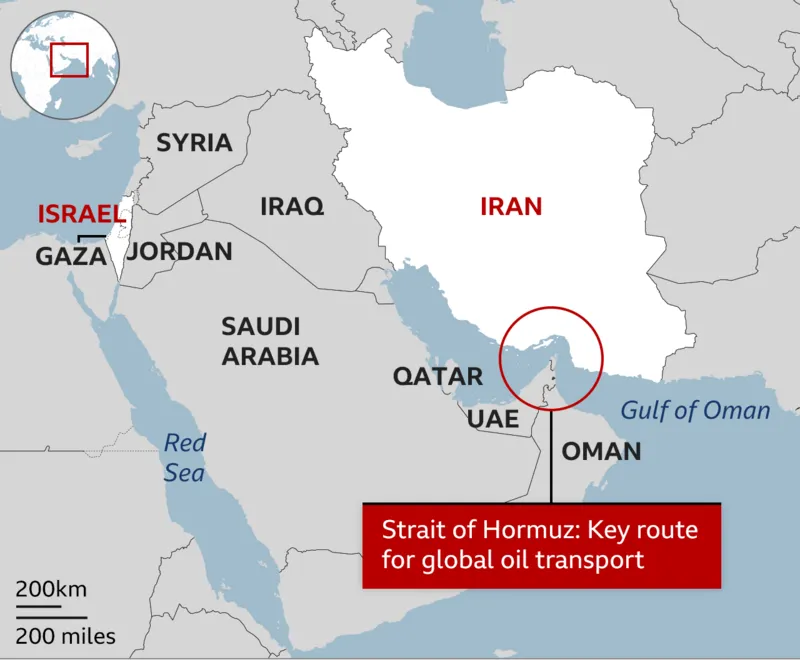
  • Location – It is a tiny strip of water between Oman and the UAE on one side and Iran on the other.
  • It is in the territorial waters of Iran and Oman.
  • Width – It is 33 km wide at its narrowest point, with the designated shipping lane just 3 km wide in either direction, separated by a buffer zone.
  • Shipping lanes – It flows into the Gulf of Oman, where ships can then travel to the rest of the world.
  • Connectivity – It links the Persian Gulf in the north with the Gulf of Oman to the south, and the Arabian Sea beyond.
  • Strategic Importance – Despite its modesty in width, the strait is one of the most strategically important waterways in the world.

Strait of Hormuz

Why the Strait of Hormuz remains central to global energy security?

  • Energy flows – Every day, enormous volumes of tankers carrying crude oil, petroleum products and liquefied natural gas (LNG) pass through it.
  • Share of global consumption – According to the U.S. Energy Information Administration (EIA), roughly 17–20 million barrels of oil and petroleum liquids transit the strait daily, which is close to 20% of global petroleum consumption.
  • OPEC exports – Members of OPEC (Organisation of the Petroleum Exporting Countries), which are Saudi Arabia, Iran, the UAE, Kuwait and Iraq, export most of their crude via the strait, mainly to Asia.
  • Qatar’s LNG – Qatar, one of the world’s largest LNG exporters, also sends most of its gas exports through this route.
  • Impact of disruption – The EIA classifies Hormuz as the world’s most important oil chokepoint, where even temporary disruption can have far-reaching consequences, including substantial supply delay and a sharp increase in energy prices.

What is the strategic importance of the region with regards to Iran?

  • Iran’s leverage – The geographical location of the strait gives Iran considerable leverage in the region.
  • Its coastline runs along the entire northern side of the passage, and the narrowness of the shipping lanes means that the commercial vessels that pass through it must come in close contact with the Iranian waters.
  • Recurring hotspot – This has turned the Hormuz into a recurring hotspot during periods of regional tensions in the past.
  • Historical Flashpoints – During the Iran-Iraq war of the 1980, both countries targeted oil tankers and commercial vessels in what came to be known as the “tanker war”.
  • Naval mines were deployed, and shipping lanes were temporarily disrupted.
  • Shipping lanes disrupted; U.S. and allies escorted tankers to secure oil flow.
  • Repeated threats – Since then, Iran has repeatedly threatened to close the strait during periods of heightened regional tensions and confrontations with the U.S. and its allies, but never executed a full blockade.
  • Recent restraint – Even during last year’s 12day war with Israel, despite U.S. strikes on Iranian nuclear and military facilities, Tehran did not shut the strait.
  • Strategic Reality – Blocking the Strait would pressure oilimporting countries, but it would also hurt Iran’s own exports and risk triggering an international military response.

What is the global economic impact caused by the disturbances in this region?

  • Critical chokepoint – Both strategically and geographically, the Strait of Hormuz is one of the most important oil chokepoints in the world.
  • The stability of this narrow maritime corridor underpins global oil flows and the international economy.
  • Insurance & freight costs – Even a partial disruption, whether due to military escalation, mines, missile threats, or tanker seizures, can drive up shipping insurance costs and freight rates.
  • Ripple effect – It could also increase the price of goods and services globally.
  • Major importers hit – It hit some of the biggest economies, including China, Japan and India, which are some of the biggest importers of crude oil through the strait.
  • Oil Market reaction – Global oil markets react immediately to any sign of instability in the strait, which often leads to an increase in oil prices merely on expectations.
  • Impact on Asia
  • Flows to Asia – Roughly 82% of crude oil and condensate that passes through the strait went to countries in Asia in 2022.
  • Top importers – China, India, Japan and South Korea together accounted for roughly two-thirds of these flows.
  • Therefore, a sustained disruption would hit major Asian economies particularly hard.
  • Impact on India
  • Net importer – India is a net importer of crude oil; more than 40% of its oil supplies come from Gulf countries that use the Strait of Hormuz for these oil exports.
  • Immediate consequence – Any minor disruption in this region would likely increase global crude prices, in turn leading to an increase in the prices of domestic petrol, diesel and LPG.
  • India’s vulnerability – As a country heavily dependent on energy imports, any instability here translates into inflationary pressures and economic strain.

What are the few alternatives?

  • Limited Alternatives – Saudi Arabia operates the East-West pipeline to the Red Sea & UAE has a pipeline to the port of Fujairah outside the Gulf.
  • Capacity issue – However, these routes do not have the capacity to fully replace the volumes that transit the strait daily.
  • For most exporters in the Persian Gulf, the strait continues to be the main gateway to international markets.
  • Vulnerability – Even a minor disturbance in the Strait of Hormuz will have a profound impact on big economies around the world.

What are the latest tensions?

  • Iran’s drills – The recent Iranian military exercises and naval drills were conducted in the midst of heightened regional tensions and the presence of U.S. naval assets in the area.
  • Interpretation – Military drills in the strait, or in the vicinity, are often interpreted as signals, or threats, demonstrating the capability of Iran during diplomatic stand-offs.
  • Economic Sensitivity – While a full closure is still unlikely because of the economic and military risks involved, the simple possibility of disruption is enough to increase global oil prices.
  • Global Vulnerability – In a complex and interwoven international economy, which is already strained by various geopolitical conflicts and fragile supply chains, the Strait of Hormuz represents a pivotal vulnerability.

What lies ahead?

  • The strategic relevance and importance of the Strait of Hormuz are immense, and its stability is vital for global economic strength and security.
  • For India and other major economies around, what happens in this narrow oil chokepoint is not distant geopolitics but a direct determinant of energy costs, inflation, and economic stability.

Reference

The Hindu | Why the Strait of Hormuz remains central to global energy security?



Login or Register to Post Comments
There are no reviews yet. Be the first one to review.

ARCHIVES

MONTH/YEARWISE ARCHIVES

sidetext
Free UPSC Interview Guidance Programme
sidetext

