Mains: GS-II- Polity & Governance
Why in news?
The recent rift within ECI and reports of exclusion of eligible voters from Goa’s electoral roll has renewed a spotlight on the ‘right to vote’, the foundational processes of India’s electoral machinery, and the genesis of India’s ‘universal adult suffrage’ (UAS).
What shaped adult suffrage in India?
- Universal adult suffrage – It is a democratic principle that grants all adult citizens the right to vote without discrimination based on race, gender, religion, wealth, or social status.
- India’s uniqueness with Western Democracies – India’s constitutional promise of the ‘right to vote’ differs significantly from that of many Western democracies.
- Thinkers like J.S. Mill believed that voting should be reserved for the “enlightened” and restricted the franchise to male property owners.
- United Kingdom – Universal male suffrage emerged only in 1918, and women were granted the ‘right to vote’ a decade later in 1928.
- USA – In the U.S., although the 15th and 19th Amendments extended voting rights to African Americans (1870) and women (1920), systemic barriers such as poll taxes and literacy tests continued to disenfranchise many for decades thereafter.
- India’s early commitment – Unlike many countries, India’s choice of immediate, universal inclusion and expansion of the right to vote ensured ‘democratic equality’ without the long struggles experienced elsewhere.
- Constitutional Guarantee – Article 326 of the Constitution granted every adult citizen the ‘right to vote’, regardless of gender, caste, religion, education, or property.
- Initially set at 21 years of age, this threshold was lowered to 18 by the 61st Constitutional Amendment in 1989.
- Judicial Support – This commitment to a robust, inclusive democracy found further constitutional reinforcement in a series of Supreme Court judgments.
- Kesavananda Bharati v. State of Kerala, 1973 – Established democracy as part of the ‘basic structure’ doctrine.
- For this ideal to function meaningfully, people should be able to freely decide the fate of their government.
- Legal Framework for Electoral Democracy
- Representation of the People Act (RPA), 1950 – Governs the preparation and revision of electoral rolls.
- Representation of the People Act (RPA), 1951 – Regulates election conduct, candidature, and electoral offences.
- CEC Sukumar Sen’s Innovation – India’s first general election faced the task of enrolling 173 million largely illiterate voters.
- To overcome this, election symbols for political parties and candidates were introduced, turning a logistical hurdle into a democratic breakthrough.
- Role of ECI – The EC has the responsibility to reach the last citizen, wherever they may be, to actualise their ‘right to elect’ and repeatedly introduced administrative innovations to realise this ‘constitutional promise’.
What is the legal status of the right to vote?
- Debate on status of right to vote – The legal status of the ‘right to vote’ in India has long been debated.
- Whether it is classified as a statutory, constitutional, or fundamental right determines how easily it can be changed, how it is enforced, and the level of legal protection it receives.
- Constituent Assembly’s decision – Although Dr B.R. Ambedkar and K.T. Shah proposed including it in the Constitution’s fundamental rights part, the Constituent Assembly’s Advisory Committee ultimately rejected the idea.
- Kuldip Nayar v. Union of India, 2006 – The Supreme Court held that the ‘right to elect’ is a statutory right under Section 62 of the RPA, 1951, and not a fundamental or constitutional right.
- Rajbala v. State of Haryana, 2015 – A two-judge Bench described the ‘right to vote’ as a constitutional right, but the larger bench ruling in Kuldip Nayar prevails.
- Anoop Baranwal v. Union of India, 2023 – The top court declined to pronounce on the issue, noting that it had already been settled by the five-judge Bench in the Kuldip Nayar judgment.
- Dissent in Anoop Baranwal case – Justice Ajay Rastogi asserted that the ‘right to vote’ is an expression of Article 19(1)(a) and reflects the essence of Article 21.
- Yet, this view remains a minority opinion; the ‘right to elect’ continues to be recognised as a statutory right
- Voting as a democratic imperative – Even though the right to vote is not a fundamental right, courts have regarded it as an inseparable part of democracy.
Why do we need accurate poll rolls?
- Importance of accurate poll rolls – Free and fair elections rest on accurate electoral rolls under the RPA, 1950.
- Inaccuracies such as mass omissions, ineligible inclusions, duplicates, or incorrect entries undermine the “one person, one vote” principle by enabling impersonation, disenfranchisement, or dilution of votes, ultimately distorting the people’s mandate.
- ECI’s responsibility – The EC is empowered under Section 21 of the 1950 Act to prepare and revise these rolls to ensure integrity.
- Deriving its authority from Article 324, the EC serves as the constitutional guardian of elections, with powers of superintendence, direction, and control.
- ECI’s decision-making – The Chief Election Commissioner and Other Election Commissioners (Appointment, Conditions of Service and Term of Office) Act, 2023 lays down how the EC must transact its business.
- Section 17 – Commission’s business to be conducted in accordance with the Act.
- Section 18 – Procedure and allocation of business may be regulated by unanimous decision.
- Requires business to be transacted as far as possible unanimously, but where the CEC and other Commissioners differ, the matter is decided by majority.
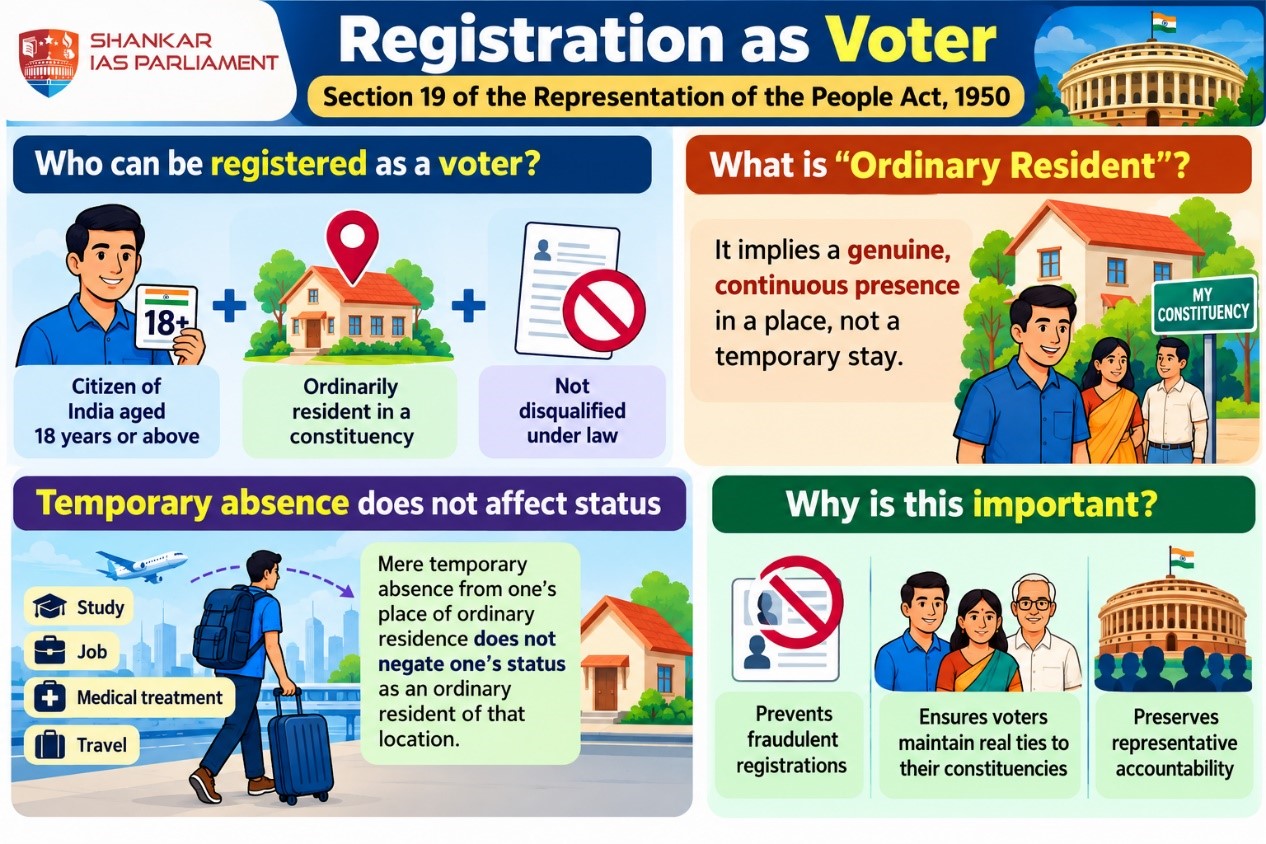
- Registration as voter – Section 19 of the RPA, 1950, mandates that any citizen aged 18 or above, “ordinarily resident” in a constituency and not disqualified, is entitled to be registered as a voter.
- Judicial view on errors – Discrepancies may arise; courts have consistently held that minor mistakes or isolated disenfranchisement are insufficient.
- Only substantial and systemic errors that demonstrably “materially affected” the election outcome can compromise the sanctity of the electoral roll.
- Role of political parties – The right to inclusion or objection in electoral rolls is conferred on individuals, not political parties.
- Lakshmi Charan Sen v. A.K.M. Hassan Uzzaman, 1985 – The court observed that in a largely illiterate and politically unaware electorate, parties should take steps to ensure eligible voters are included, and ineligible ones are removed.
- Given India’s party-based Parliamentary system, such vigilance will help in preserving ‘electoral integrity’.
What lies ahead?
- Elevating the ‘right to vote’ to fundamental status would not diminish the EC’s authority to purify rolls.
- It would instead subject that
- Authority to the heightened standard of judicial review reserved for fundamental rights,
- Ensuring that the drive to centralise electoral administration is always weighed against,
- Rather than allowed to override, the citizen’s claim to be counted.
- In a democracy where software now mediates the relationship between the voter and the ballot, the constitutional status of the ‘right to vote’ can no longer remain a matter of legislative grace.
Reference
The Hindu | Should voting be a fundamental right?



