Prelims: Current events of national and international importance | Science & Technology
Why in News?
A team of researchers, has re-examined the celestial object UBC 63 previously classified as a single open star cluster and discovered that it is actually a double cluster system comprising two distinct stellar populations.
Key Highlights
- The study utilized archival data from the European Space Agency’s (ESA) Gaia mission, machine learning techniques, and advanced dynamical simulations.
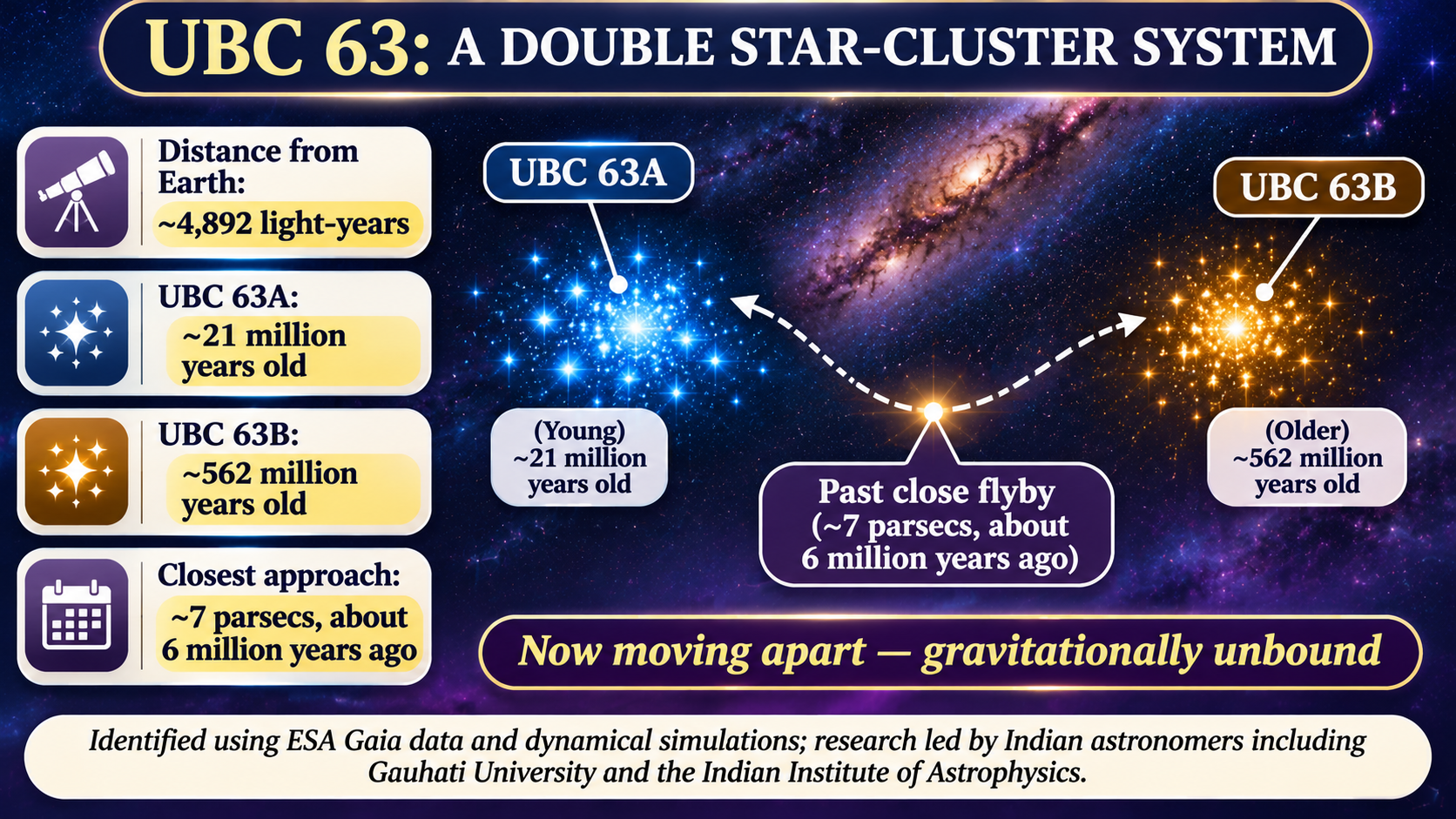
- Two Distinct Populations- Detailed analysis of stellar movements revealed two separate systems designated UBC 63A and UBC 63B.
- Contrasting Ages- The two clusters have dramatically different evolutionary timelines, proving they did not originate from the same molecular cloud:
- UBC 63A: Approximately 21 million years old.
- UBC 63B: Approximately 562 million years old.
- The Close Encounter (Flyby) - Orbital integrations and N-body simulations showed that the two clusters came remarkably close to one another about 6 million years ago, reaching a minimum separation of roughly 7 parsecs (~23 light-years).
- Unbound Motion - Today, the two clusters are positioned roughly 26 parsecs (~85 light-years) apart.
- Because they are not gravitationally bound to each other, they are actively drifting apart following their historic close flyby.
Open Star Clusters
- Open clusters are loosely bound collections of up to a few thousand stars that formed together from the same giant molecular cloud.
- Unlike globular clusters (which are densely packed and ancient), open clusters gradually disperse as they interact with galactic gravitational fields and pass close to other stellar systems over millions of years.
Reference
PIB | Star cluster UBC 63



