Mains: GS III – Environment
Why in News?
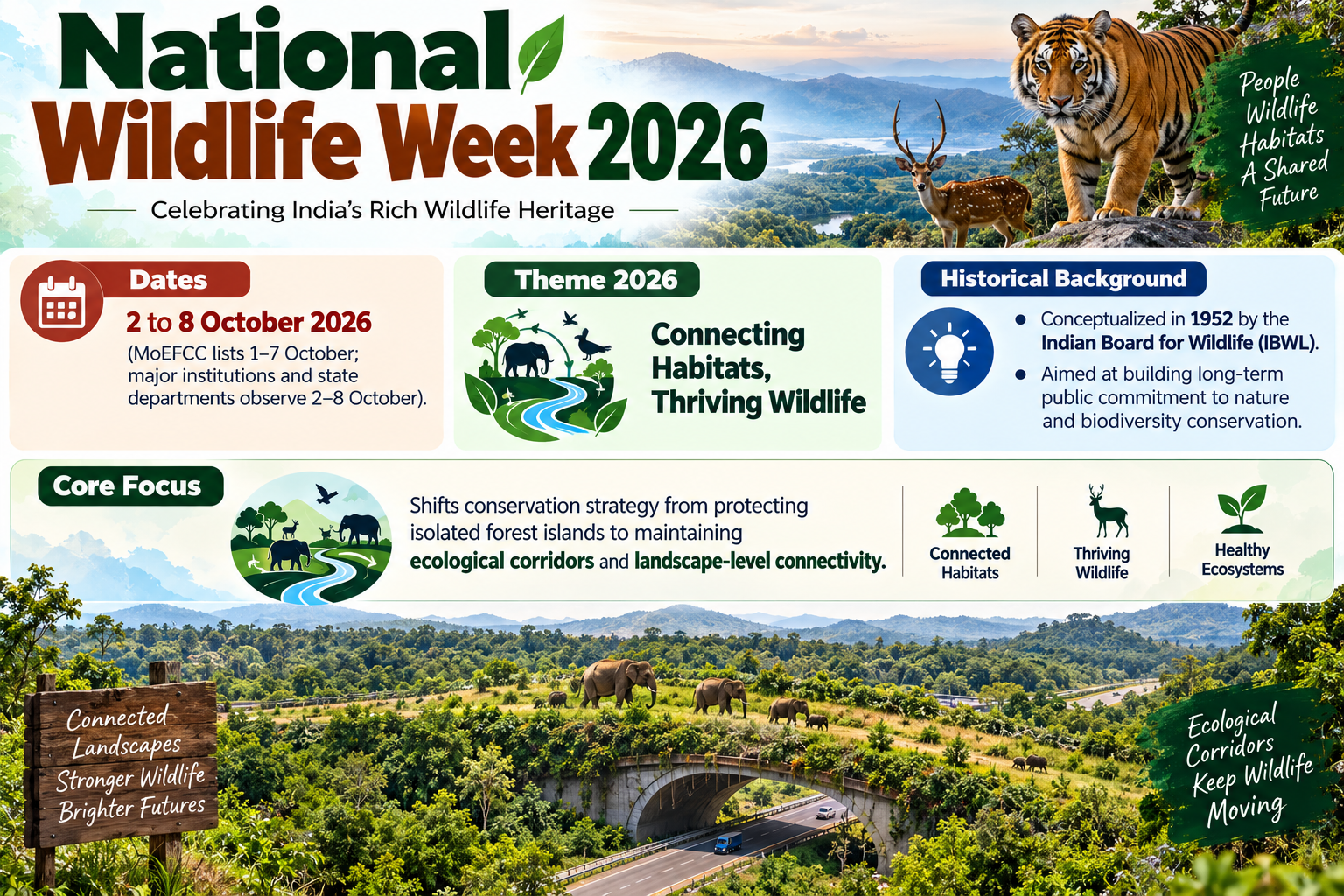
Recently, during India’s annual Wildlife Week, a major yearly event was dedicated to evaluating the country’s ecological health and conservation milestones.
What is the current ecological status and statutory framework of wildlife recovery in India?
- Ecological Diversity vs. Threat Matrix –
- India occupies 2.4% of global land area while supporting nearly 8% of flora and 7.5% of fauna.
- It is one of 17 megadiverse countries and encompasses parts of four global biodiversity hotspots.
- Endemism is high – 28% of plants and >30% of animals are endemic, out of 7,516 animal species assessed for the IUCN Red List, 1,012 are threatened (Vulnerable, Endangered, or Critically Endangered).
- However, current assessments cover only 7.2% of documented animal species in India.
- Institutional and Statutory Framework – The Union Government's Integrated Development of Wildlife Habitats (IDWH) scheme supports focused recovery actions for 24 identified species and their habitats (e.g., Great Indian Bustard, Sangai, Dugong, Hangul).
- At the IUCN World Conservation Congress in Abu Dhabi (2025), India launched its National Red List Roadmap, aiming to publish comprehensive National Red Data Books for flora and fauna by 2030.
What are the key state-level species conservation success stories and models?
- Project Nilgiri Tahr (Tamil Nadu) – Combines population surveys, radio-collaring, and habitat mapping across Tamil Nadu and Kerala in collaboration with WII, AIWC, TANUVAS, and IUCN. Population surveys recorded an increase from 1,303 in 2025 to 1,364 in 2026.
- Vulture Recovery and Habitat Safety – Driven by the ban on veterinary diclofenac alongside ex-situ conservation breeding at the Jatayu Conservation Breeding Centre (Pinjore, run by BNHS and Haryana Forest Dept.).
- Census data in Madhya Pradesh recorded 12,981 vultures in 2025 (up from 8,397 in 2019), with critical synchronised surveys across Tamil Nadu, Kerala, and Karnataka tracking breeding populations in Mudumalai Tiger Reserve.
- Asiatic Lion (Gujarat) – Long-term protection, scientific monitoring, and grassland management raised populations in Gir/Saurashtra from 674 in 2020 to 891 in 2025.
- Greater One-Horned Rhinoceros (Assam) – Targeted anti-poaching, research, translocation, and community engagement in high-density areas like Pobitora Wildlife Sanctuary have secured population expansion.
- Dugong Conservation (Palk Bay) – Tamil Nadu established India’s first Dugong Conservation Reserve in Palk Bay.
- WII's 2026 assessment mapped 270 dugongs (158 in Palk Bay, 112 in Gulf of Mannar).
- Snow Leopard (Himachal Pradesh) – India’s 2024 scientific assessment estimated 718 snow leopards.
- Integrated local stewardship models (e.g., Kibber village women collaborating with NCF, Snow Leopard Trust, and Forest Department to run camera traps and patrols).
- Clouded Leopard Action Plan (Meghalaya) – Identified 14 priority connectivity corridors across the Northeast to prevent habitat fragmentation.
What structural challenges persist in species conservation?
- Assessment Gap and Neglected Species – Over 92% of Indian animal species remain unassessed under global Red List criteria.
- Non-charismatic species (e.g., mahseer, striped hyena, Madras hedgehog) struggle to attract public attention and conservation capital.
- Funding Shortfalls and Disparity – Dependence on sporadic budget allocations creates execution lags for long-term breeding, tracking, and habitat restoration programs.
- Conflict with Development and Land Use – Integrating recovery plans into inter-departmental decision-making (infrastructure, linear projects, agriculture) remains a major administrative bottleneck.
What policy measures and future strategies are required?
- Dedicated State-Level Conservation Funds – Replicate models like Tamil Nadu’s Endangered Species Conservation Fund, which mobilizes government, industrial CSR, philanthropy, and scientific bodies to fund lesser-known species.
- Community-Centric Conservation Models – Formally integrate local and Indigenous communities into field monitoring, threat detection, and eco-tourism.
- Provide rapid, transparent compensation for economic loss (such as net damage or livestock loss) to prevent retaliatory destruction.
- Scientific Capacity Building in Forest Services – Establish decentralized field-level scientific hubs to train frontline staff in camera trapping, genetic sampling, disease screening, and habitat restoration.
- Global Funding and Landscape Partnerships – Leverage international financial vehicles such as the Phoenix Species Project (A initiative launched by Re - wild and Bezos Earth Fund in 2026) for long-term, multi-year funding guarantees.
Reference
The Hindu | Wildlife Week



