Prelims: Current events of national and international importance | Environment
Why in News?
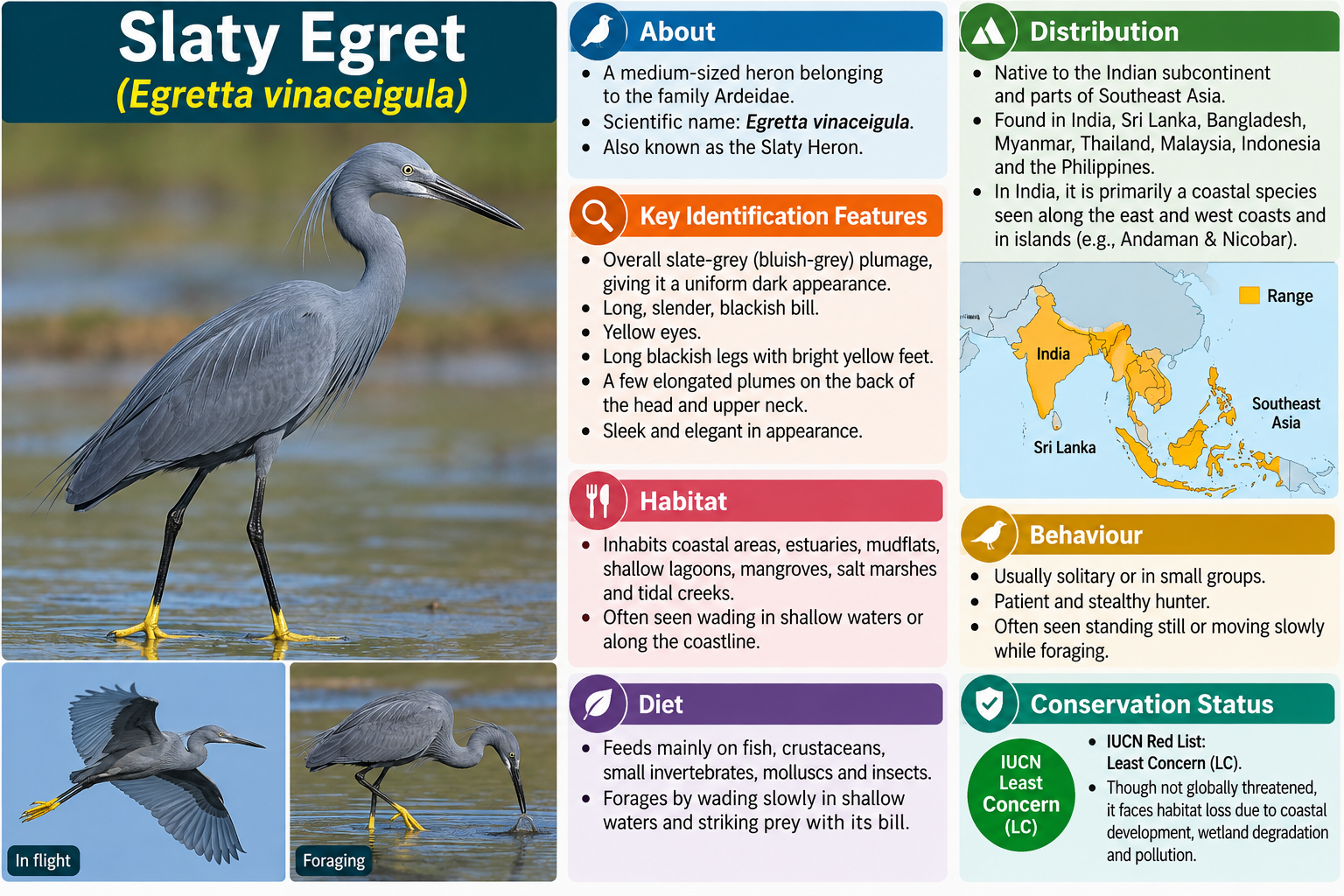
Recently, reports highlighting observations detailed the significant shifts in the breeding, nesting, and foraging habits of the Slaty Egret (Egretta vinaceigula) across Botswana’s Okavango Delta.
|
Parameter
|
Details
|
|
Geographic Range
|
Near-endemic to southern/south-central Africa (Botswana, Namibia, Zambia, Zimbabwe, Angola).
|
|
Population Stronghold
|
Around 80–85% of the total global population (~3,000 to 5,000 mature individuals) is concentrated in northern Botswana's Okavango Delta.
|
|
IUCN Red List Status
|
Vulnerable.
|
|
Protected Treaties
|
Listed under the Agreement on the Conservation of African-Eurasian Migratory Waterbirds (AEWA).
|
|
Primary Threats
|
Alteration of natural flood pulses due to upstream water abstraction/dams, invasive aquatic weeds (Salvinia molesta), reed bed fires, and agricultural encroachment.
|
Key Behavioral Discoveries
- High Sensitivity to Micro-Environmental Shifts - The Slaty Egret is an obligate shallow-water specialist, foraging predominantly in water depths under 10 cm within seasonal floodplains.
- Because its hunting relies on clear, shallow, undisturbed vegetated waters, any variation in hydrological flow, sedimentation, or vegetation density immediately impacts its distribution and presence.
- Thus, making it a key ecological indicator species (bioindicator) for the health of the Okavango Delta.
- Disruption of Traditional Nesting Sites- Surveys revealed that established long-term breeding sites vanished due to severe seasonal reed bed fires and localized habitat destruction caused by over-concentration of megaherbivores like African elephants.
- UNEP officials highlighted that the disappearance of historic breeding grounds reflects systemic ecosystem instability rather than population recovery.
- Foraging Adaptation- The species utilizes specialized foraging tactics such as foot-ruffling (stirring up riverbed mud to flush out small fish, frogs, and invertebrates).
- It requires precise water clarity and shallow conditions.
- Altered flood dynamics force birds to disperse over wider, less optimal areas.
Conservation Framework
- Global Population & Distribution
- Extremely small global population estimated at 3,000 to 5,000 mature individuals.
- Concentrated heavily in the Okavango Delta and Chobe River system of Botswana, with smaller populations extending into Zambia, Namibia's Caprivi Strip, and parts of Zimbabwe.
- Conservation Status
- IUCN Red List - Vulnerable.
- International Treaties - Covered under the Agreement on the Conservation of African-Eurasian Migratory Waterbirds (AEWA).
- AEWA coordinates international single-species action plans across southern African range states.
Threats
- Cross-border water management decisions, upstream dam construction, drainage of seasonal floodplains for agriculture, climate-driven drought cycles, and burning of papyrus/reed beds.
Reference
Down to Earth | Slaty Egret’s behaviour shift



