Prelims: Current events of national and international importance| Environment
Why in News?
A recent study published in Nature highlighted how salt marshes reduce wave energy and protect coastlines from storm surges.
Salt Marshes
- Definition – Coastal wetlands between land and sea, dominated by salt-tolerant vegetation.
- Indian Distribution – Gujarat has India's largest salt marshes, followed by Tamil Nadu, Andhra Pradesh and Maharashtra.
- Extent – A 2020 study estimated India's salt marshes cover approximately 290 sq. km.
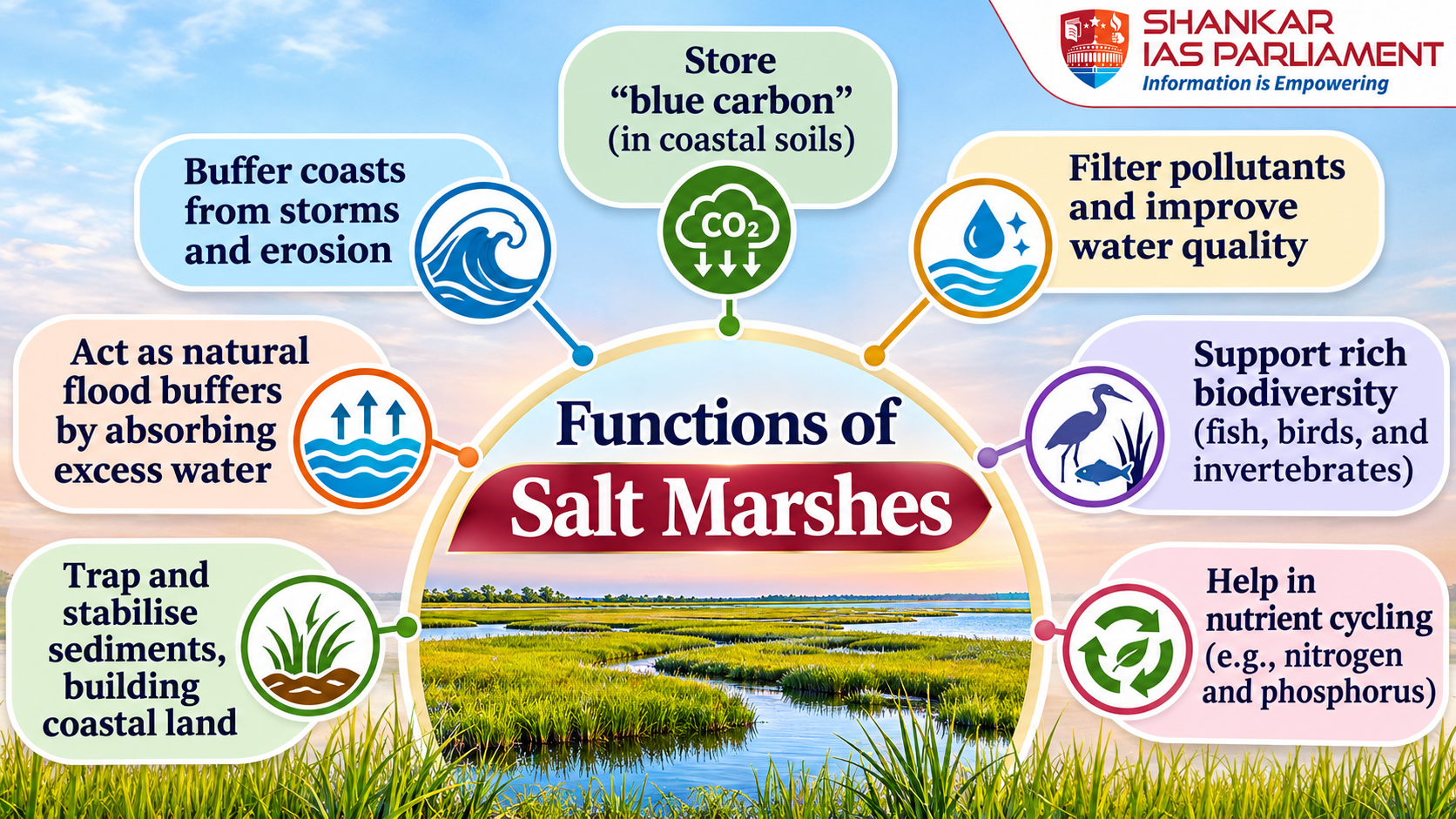
Salt Marshes Protect Coastlines?
- Wave Reduction – Dense plant stems create resistance and reduce incoming wave energy.
- Sediment Stability – Root networks bind sediments and prevent coastal erosion.
- Natural Barriers – Elevated marsh surfaces help dissipate wave energy.
Key Findings of the Recent Study
- Experimental Setup – Researchers tested 306 sq. metres of live marshland in a 300-metre-long wave flume.
- Vegetation Damage – Plant biomass declined by 75– 80%, while marsh elevation fell only 7 mm.
- Wave Attenuation – Vegetation reduced 75 cm waves by 6– 22%, but 2-metre waves by only up to 6%.
- Storm Protection – Vegetation can reduce smaller storm waves by over 10%, reaching 50% in some locations.
Threats to Salt Marshes
- Coastal Development – Aquaculture and infrastructure expansion destroy marsh habitats.
- Climate Change – Rising sea levels and stronger storms threaten vegetation.
Significance
- Disaster Management – Reduces coastal flooding, storm surges and erosion.
- Biodiversity – Supports wildlife and maintains coastal ecosystems.
- Climate Resilience – Provides nature-based coastal protection.
Reference
The Hindu| How the humble salt marsh softens the ocean’s fury



