Why in news?
According to a report in the BBC, Microsoft co-founder Bill Gates has invested in an Australian climate technology start-up (Rumin8) that aims to curtail the methane emissions of cow burps.
How do cows and other animals produce methane?
- Ruminants - The word 'ruminant' is derived from the Latin word ruminare, to chew again.
- Ruminant species include cows, sheep, goats, buffaloes, etc., which are hooved, grazing herbivores that chew cud.
- Cud-chewing is an adaptation that enables many hoofed mammals to break down the cellulose of plant cell walls into nutrients.
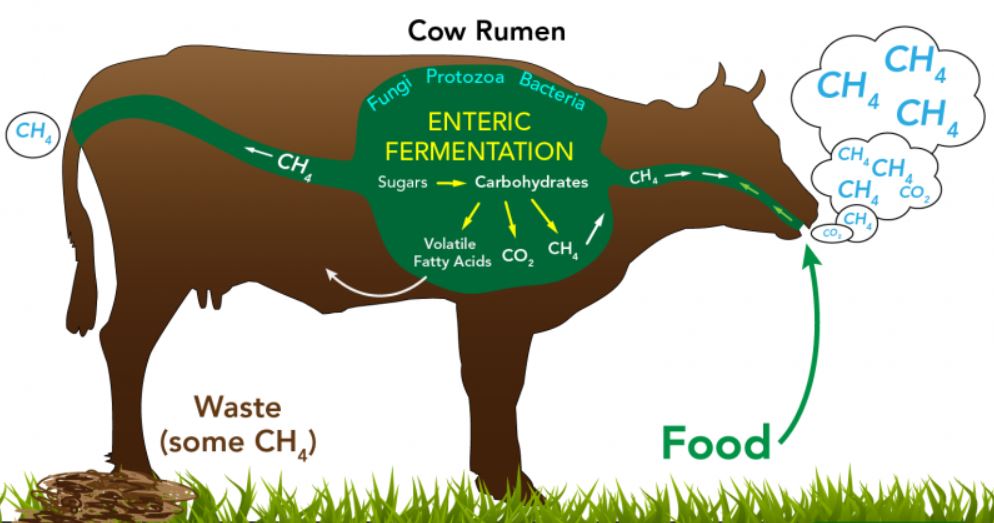
- Methane production - Stomachs of ruminant animals have four compartments, one of which, the rumen, helps them to store partially digested food and let it ferment.
- This partially digested and fermented food is regurgitated (brought into the mouth again) and chewed again to finish the digestive process.
- As the vegetation ferments in the rumen, it generates methane, a potent greenhouse gas that is released mainly through burping.
It is estimated that the ruminant digestive system is responsible for 27% of all methane emissions from human activity.
What is the issue with methane?
- Global warming - Methane is one of the main drivers of climate change, responsible for 30% of the warming since preindustrial times, second only to carbon dioxide.
- Global warming potent - The United Nations Environment Programme reports that over a 20-year period, methane is 80 times more potent at warming than carbon dioxide.
- Heat trapping - While carbon dioxide remains in the atmosphere for much longer than methane, methane is roughly 25 times more powerful at trapping heat in the atmosphere.
- Ground level ozone - It is also the primary contributor to the formation of ground-level ozone, a colourless and highly irritating gas that forms just above the Earth’s surface.
How to mitigate the methane emissions?
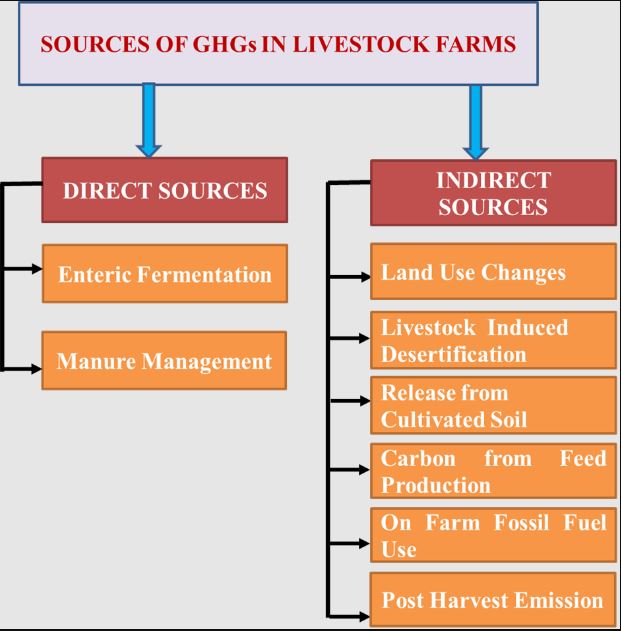
Livestock sector contributes around 54.6 % of total agricultural emissions in India adding to global warming.
- Use of sea weeds - The Australian startup, Rumin8 is developing a variety of dietary supplements that includes red seaweed, to feed to cows in a bid to reduce the amount of methane emitted into the atmosphere.
- A 2021 study found that adding seaweed to cow feed can reduce methane formation in their guts by more than 80%.
- Genetic modification - Researchers are trying to find gene-modifying techniques to produce climate-smart cow that can curtail methane emissions.
- In 2021, New Zealand announced has that they had started the world’s first genetic programme to address the challenge of climate change by breeding sheep that emit lower amounts of methane.
- Imposition of taxes - In 2022, New Zealand proposed taxing the greenhouse gases that farm animals produce from burping and urinating.
Reference
- The Indian Express | How do cows and sheep contribute to climate change?



